
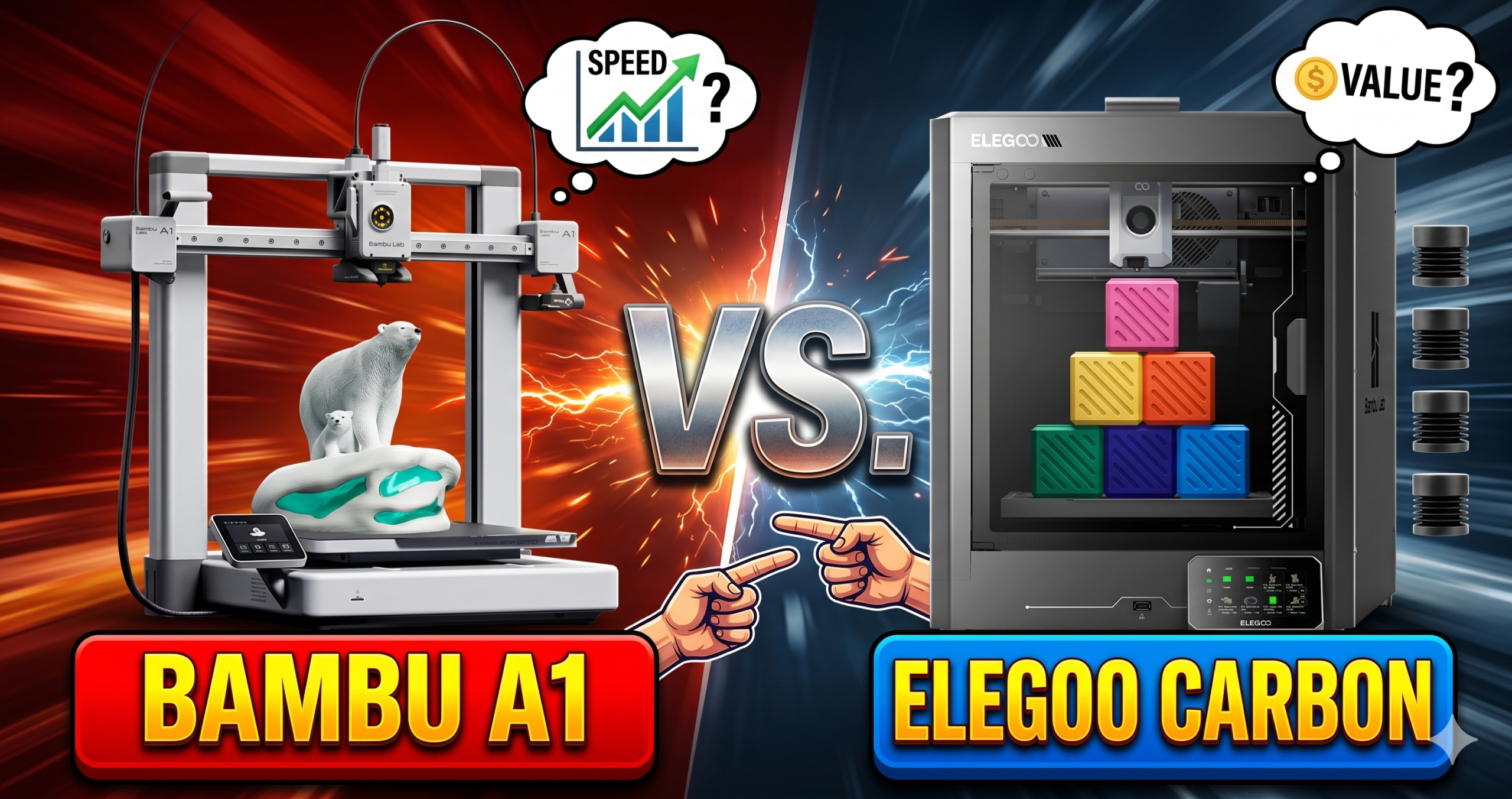
Two printers, two completely different bets: Bambu’s open-frame ecosystem play versus Elegoo’s fully enclosed CoreXY value play.
If you mostly print PLA/PETG and want the smoothest software ecosystem, get the Bambu Lab A1. If you want ABS, ASA, or carbon-fiber filaments without buying an enclosure separately, the Centauri Carbon wins on hardware for less money.
The Centauri Carbon ships fully enclosed with double the A1’s acceleration (20,000 mm/s² vs 10,000 mm/s²) for roughly $50–100 less — on paper, the better machine. The A1 counters with a far more polished slicer, AMS Lite multi-color, and the most active printer community on Reddit right now.
Bambu Lab A1: 8.5/10 · Centauri Carbon: 8/10 — both are genuinely good, the right pick depends entirely on what you plan to print.
I get asked which of these two to buy more than almost any other matchup right now. Both sit in the same price band, both claim 500 mm/s, and both show up at the top of every “best budget 3D printer 2026” list. But they’re not really competing on the same axis — one is an open-frame bedslinger built for Bambu’s ecosystem, the other is an enclosed CoreXY machine built for material flexibility. I’ve spent time with both on my own bench, and the honest answer is “it depends what you’re printing,” not “buy the cheaper one.”
Bambu Lab A1 vs Centauri Carbon: Quick Spec Comparison
Both machines share the same 256×256×256mm build volume and claim 500 mm/s top speed — that’s where the similarities mostly end. The Centauri Carbon’s CoreXY motion system and full enclosure are the structural differences that drive everything else in this comparison.
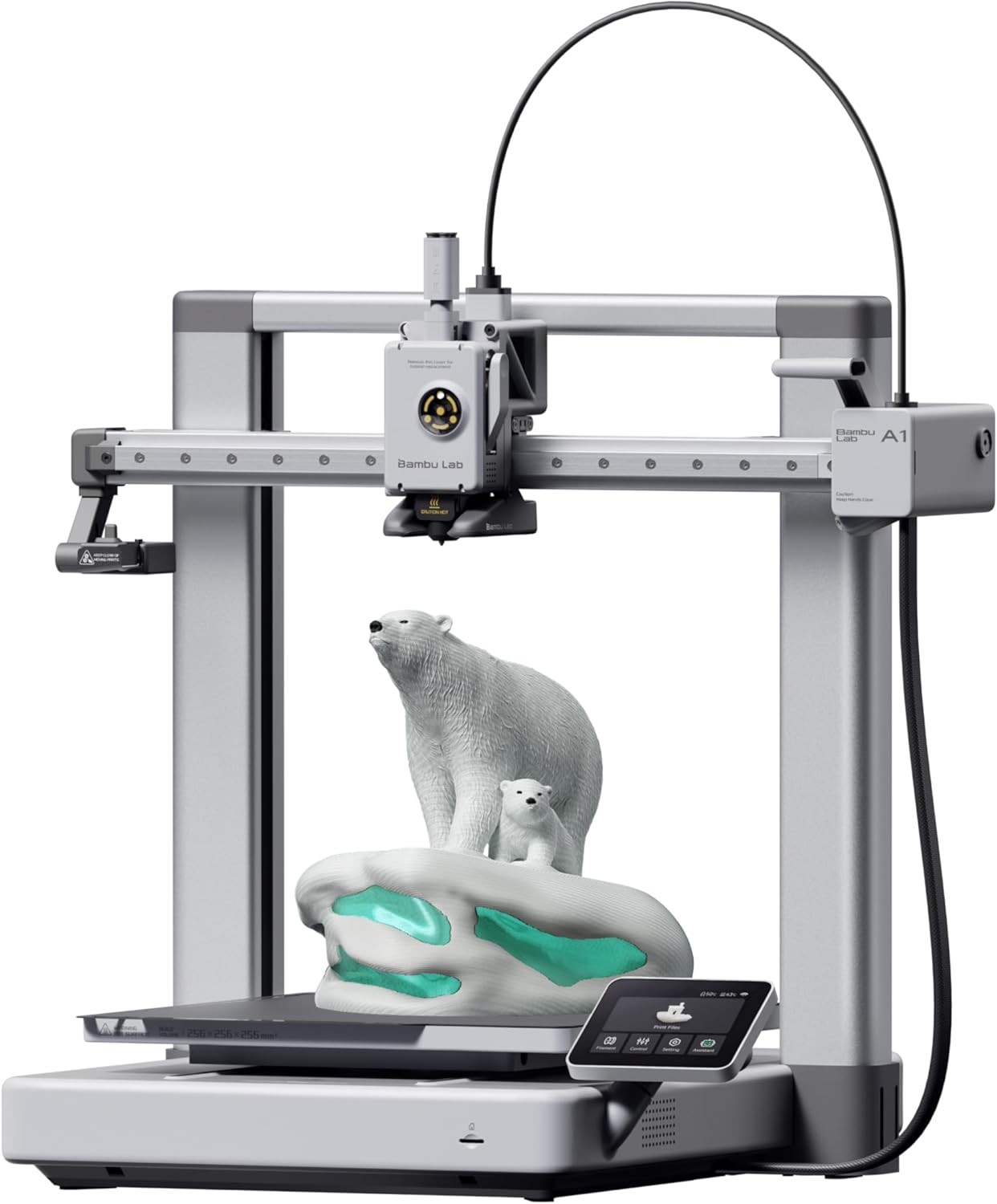
Bambu Lab A1
$349 standalone · bedslinger, AMS Lite compatible, full-color touchscreen, active motor noise cancelling (≤48dB)
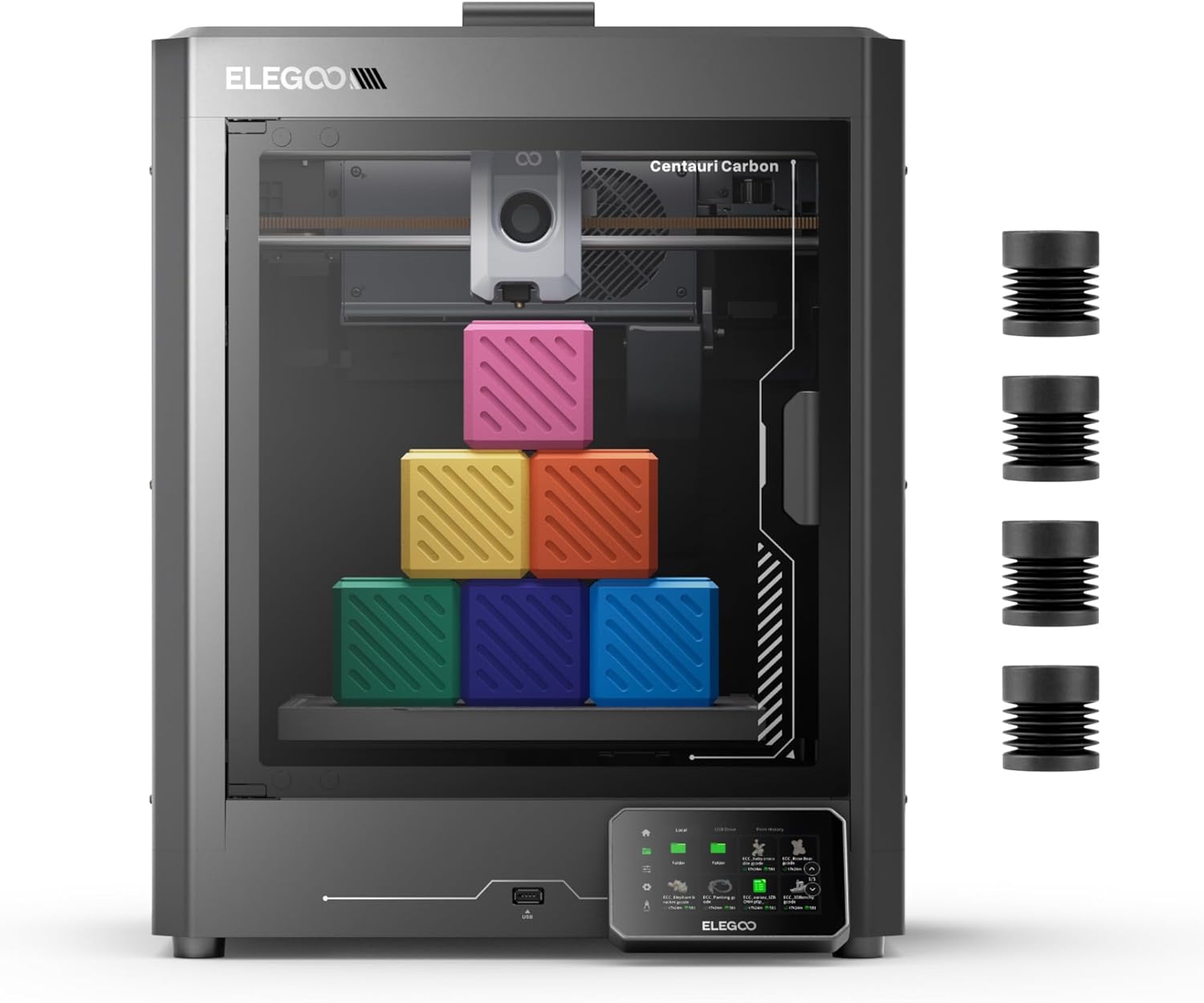
Elegoo Centauri Carbon
$299 launch price · CoreXY, fully enclosed chassis, 320°C nozzle, built-in camera, integrated filters
Which One Is Faster in Real Use?
Both are rated for 500 mm/s, but acceleration is what actually determines real-world print times on anything with corners or detail — and the Centauri Carbon doubles the A1 there. The Centauri Carbon’s CoreXY system hits 20,000 mm/s² acceleration, while the A1’s bedslinger design tops out at 10,000 mm/s². On a simple speed test print, the Centauri Carbon finished in roughly 9 minutes 45 seconds at 650 mm/s in independent benchmarking, well ahead of bedslinger-architecture printers running the same test. In practice this means the A1 will “claim” 500 mm/s on the spec sheet but rarely sustain it on real models with curves and infill changes, while the Centauri Carbon holds speed more consistently because CoreXY motion doesn’t have to fling the entire bed back and forth.
Which Printer Should You Buy: A1 or Centauri Carbon?
Buy the A1 if you’re new to 3D printing and want the gentlest learning curve, multi-color printing via AMS Lite, and the biggest community for troubleshooting. Buy the Centauri Carbon if you want to print ABS, ASA, or carbon-fiber filaments, need an enclosure for warping control, or want more accelerated, consistent print speeds for less money.
Is the Bambu Lab A1 Worth It in 2026?
Yes, specifically for the ecosystem. Bambu Studio remains the most refined slicer experience among consumer printers, with one-click MakerWorld model integration and genuinely hands-off auto-calibration. The A1 arrives needing about 20 minutes of assembly, then handles bed leveling, flow compensation, and vibration tuning automatically. The trade-off is the open frame: there’s no enclosure, so ABS and ASA are off the table unless you build or buy a separate tent, and the lower 10,000 mm/s² acceleration means it won’t match CoreXY printers on complex geometry speed.
Is the Centauri Carbon Worth It in 2026?
Yes, and it’s arguably the better value on paper. It was Elegoo’s first CoreXY printer, debuting at a $299.99 sale price, and reviewers found it delivered the best out-of-the-box experience Elegoo has produced to date. You get a fully enclosed chamber with integrated filters for fume control, a 320°C nozzle that opens the door to engineering filaments, and double the acceleration of the A1. The trade-off is software polish: Elegoo’s slicer and ecosystem simply aren’t as mature as Bambu Studio, and the interior light and visibility through the tinted glass have been called out as weak points.
Buyers consistently underestimate how much the enclosure matters until they try printing ABS or ASA on an open-frame machine in a drafty room. If engineering filaments are even a “maybe someday” on your list, that alone tips the decision toward the Centauri Carbon — retrofitting an enclosure onto the A1 later costs more than the price difference between the two printers today.
Bambu Lab A1 vs Elegoo Centauri Carbon: Full Comparison Table
| Feature | Bambu Lab A1 | Centauri Carbon | Winner | Why It Won |
|---|---|---|---|---|
| Motion System | Bedslinger (Cartesian) | CoreXY | Centauri Carbon | CoreXY moves only the print head, not the bed, enabling higher sustained speed |
| Max Acceleration | 10,000 mm/s² | 20,000 mm/s² | Centauri Carbon | Double the acceleration means faster real-world prints on detailed models, not just straight lines |
| Enclosure | Open-frame, none | Fully enclosed, aluminum + glass | Centauri Carbon | Required for stable ABS/ASA printing and contains fumes from engineering filaments |
| Max Nozzle Temp | 300°C | 320°C | Centauri Carbon | Higher ceiling supports more engineering and carbon-fiber-filled filaments |
| Multi-Color Printing | Yes, via AMS Lite (Combo) | Limited on base model | Bambu Lab A1 | AMS Lite is a mature, widely compatible multi-material system with RFID filament sync |
| Slicer / Software | Bambu Studio | Elegoo Slicer | Bambu Lab A1 | Bambu Studio has deeper calibration tools, MakerWorld integration, and a larger profile library |
| Noise Level | ≤48 dB (active noise cancelling) | Not officially rated as low | Bambu Lab A1 | Active motor noise cancelling is a specific engineering feature the Centauri Carbon doesn’t match |
| Launch Price | $349 standalone / $559 Combo | $299.99 | Centauri Carbon | Lower entry price for a fully enclosed CoreXY machine is a harder spec sheet to beat |
The Reality of Long-Term Ownership
Maintenance & Wear
The A1’s open-frame bedslinger design means more exposed moving parts collecting dust over months of use — expect to clean the linear rails and wipe down the exposed Z-axis more often than on an enclosed machine. The Centauri Carbon’s enclosure keeps dust out of the mechanics but traps heat, so reviewers have flagged the dim interior light as a real annoyance when checking on a print mid-job without opening the door and losing chamber temperature.
Hidden Costs
For the A1, the AMS Lite Combo adds $210 over the standalone price if you want multi-color printing, and third-party filament compatibility is good but not universal. For the Centauri Carbon, factor in that the launch price was a promotional rate; check current Amazon pricing before assuming you’ll hit $299.99. Neither requires a subscription, and both run common 1.75mm filament, so ongoing material costs are roughly equivalent.
The Tinkerer’s Hack
On the A1, manually re-running the vibration compensation calibration after moving the printer to a new location (even a few feet) noticeably improves surface quality — the auto-calibration on first boot doesn’t always get re-triggered. On the Centauri Carbon, propping the door very slightly during long PLA prints (not ABS/ASA, which need the seal) can help dissipate excess heat buildup from the dim, poorly ventilated interior without fully sacrificing the enclosure’s draft protection.
Bambu Lab A1 — Pros
- Best-in-class slicer and auto-calibration
- AMS Lite multi-color with RFID filament sync
- Active noise cancelling keeps it genuinely quiet
- Largest printer community for troubleshooting
Bambu Lab A1 — Cons
- No enclosure — ABS/ASA printing is unreliable
- Lower acceleration than CoreXY rivals
- AMS Lite Combo adds significant cost
- Had a notable recall earlier in its lifecycle
Centauri Carbon — Pros
- Fully enclosed out of the box
- Double the acceleration of the A1
- 320°C nozzle handles engineering filaments
- Lower launch price for more hardware
Centauri Carbon — Cons
- Less mature slicer ecosystem than Bambu Studio
- Dim interior light, hard to see through tinted glass
- Multi-color requires stepping up to the Combo/Carbon 2 line
- Smaller third-party community than Bambu’s
FAQ: Bambu Lab A1 vs Elegoo Centauri Carbon
Can the Bambu Lab A1 print ABS or ASA?
Not reliably. The A1 is open-frame with no enclosure, so warping and layer adhesion issues are common with ABS and ASA unless you add a separate enclosure tent. The Centauri Carbon’s built-in enclosure handles these materials far more consistently out of the box.
Does the Centauri Carbon support multi-color printing?
The base Centauri Carbon is primarily single-extruder. For multi-color, Elegoo’s Combo and Carbon 2 variants add that capability, similar to how the A1 needs the AMS Lite Combo bundle rather than the standalone unit.
Which printer is quieter for a bedroom or office setup?
The Bambu Lab A1 has a specific advantage here — its active motor noise cancelling keeps it at roughly 48 dB or below, a figure Bambu engineered for specifically. The Centauri Carbon’s enclosure does dampen some sound, but it isn’t marketed with the same noise-cancelling spec.
Is the Centauri Carbon actually faster than the A1 in real prints?
Generally yes, despite both listing 500 mm/s as a max speed. The Centauri Carbon’s CoreXY motion and 20,000 mm/s² acceleration let it sustain higher speeds through corners and detail, while the A1’s bedslinger design has to physically accelerate the bed back and forth, which limits real-world throughput on complex models.
Which printer is better for a complete beginner?
The Bambu Lab A1 generally has the gentler learning curve thanks to Bambu Studio’s auto-calibration and the size of its support community. The Centauri Carbon is still beginner-friendly and arrives pre-calibrated, but the software ecosystem around it is less mature for troubleshooting first-time issues.
Did the Bambu Lab A1 really have a recall?
Yes, the A1 went through a publicly documented recall earlier in its lifecycle. Bambu issued updates and guidance to address it; check current unit revisions and Bambu’s official recall page before buying a used or older-stock unit.
Specs referenced from Bambu Lab’s official tech specs page, Elegoo’s official Centauri Carbon product pages, and independent testing from Tom’s Hardware and Hackster.io. Pricing reflects launch/list pricing as of 2026 and may have changed — always confirm current price on the product page before buying.
Related 3D Printer Comparisons & Guides
- 3D Printed Decor Home — more printer reviews, comparisons, and maker guides.
- 50 Insanely Cool Things to 3D Print — project ideas once your new printer arrives.
- 3D Printing Guides — slicer comparisons, beginner buying tips, and firmware deep-dives.
Related posts:
 Bambu Lab vs Flashforge vs Creality vs Anycubic: Which to Buy in December 2025
  Bambu Lab A1 vs Creality K2 Plus vs Anycubic Kobra 3 Max: Ultimate 2026 Showdown
  Anycubic Kobra X vs ELEGOO Centauri Carbon Review: Best 3D Printer Under $400 in 2026?
  Creality K1 vs K1 SE 3D Printer: Fastest 3D Printer Under $400 in 2025?
  Bambu A1 Mini: Is the AMS Lite Worth $150? (Real Answer)
  Creality K1 SE vs Flashforge Adventurer 5M: Budget-Friendly 3D Printer Showdown
  Is the Bambu Lab A1 Worth It? Honest Review + Test Prints (2025)
  Bambu Lab P1S vs Creality K1C vs Qidi Tech Plus 4: Is an Enclosed Printer Worth It for ASA/NYLON/PC?
  Your First 3D Printer: Elegoo Neptune 4 Pro vs Creality Ender 3 V3 KE (2025 Review)
  Bambu Lab A1 vs A1 Mini: Complete 2025 Comparison
  ELEGOO Centauri Carbon vs FLASHFORGE AD5X: Which Multi-Color 3D Printer Should You Buy in 2025?
  ELEGOO Centauri Carbon vs FLASHFORGE Adventurer 5M: Which $300 3D Printer Should You Buy in 2025?