
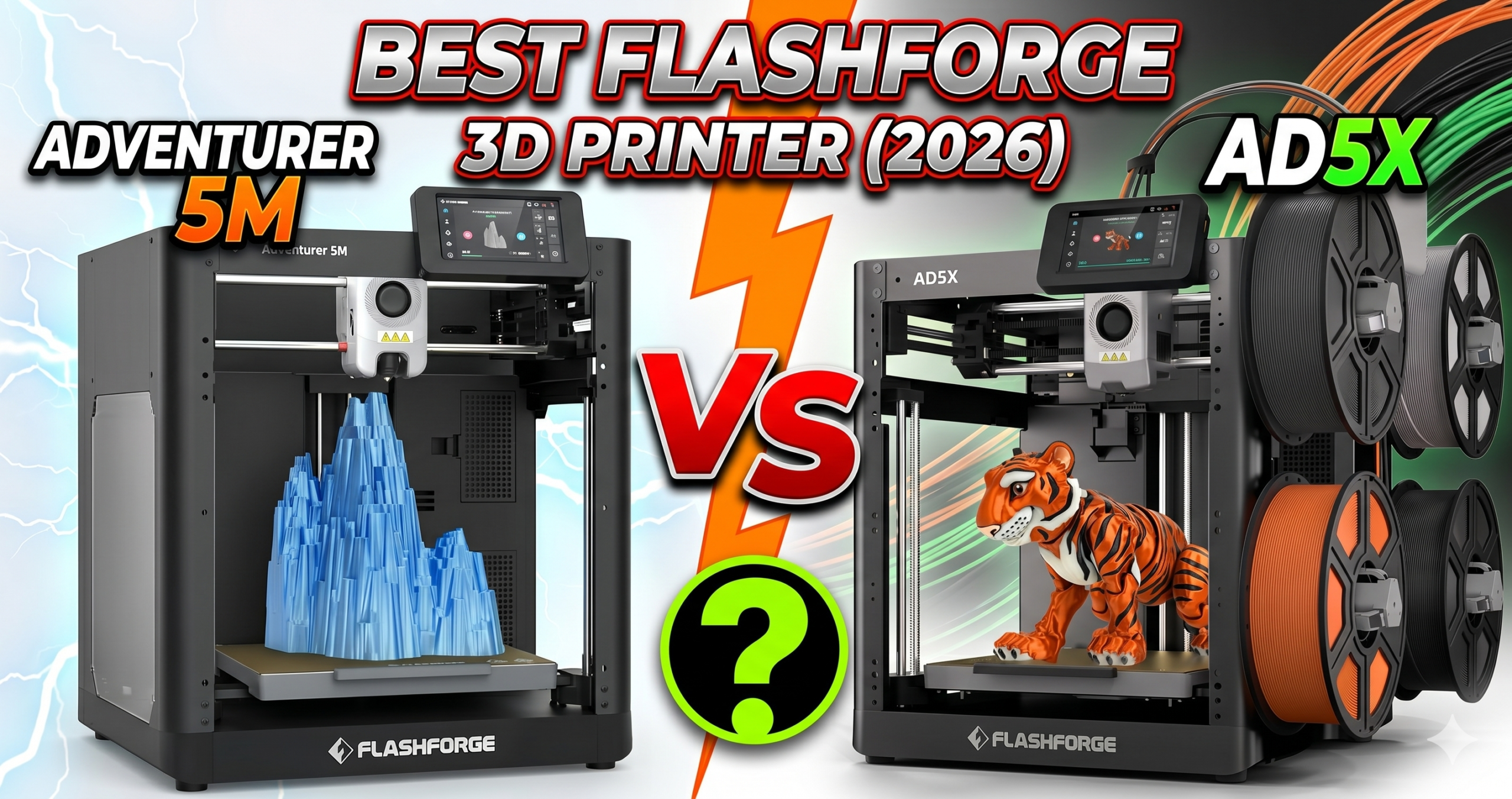
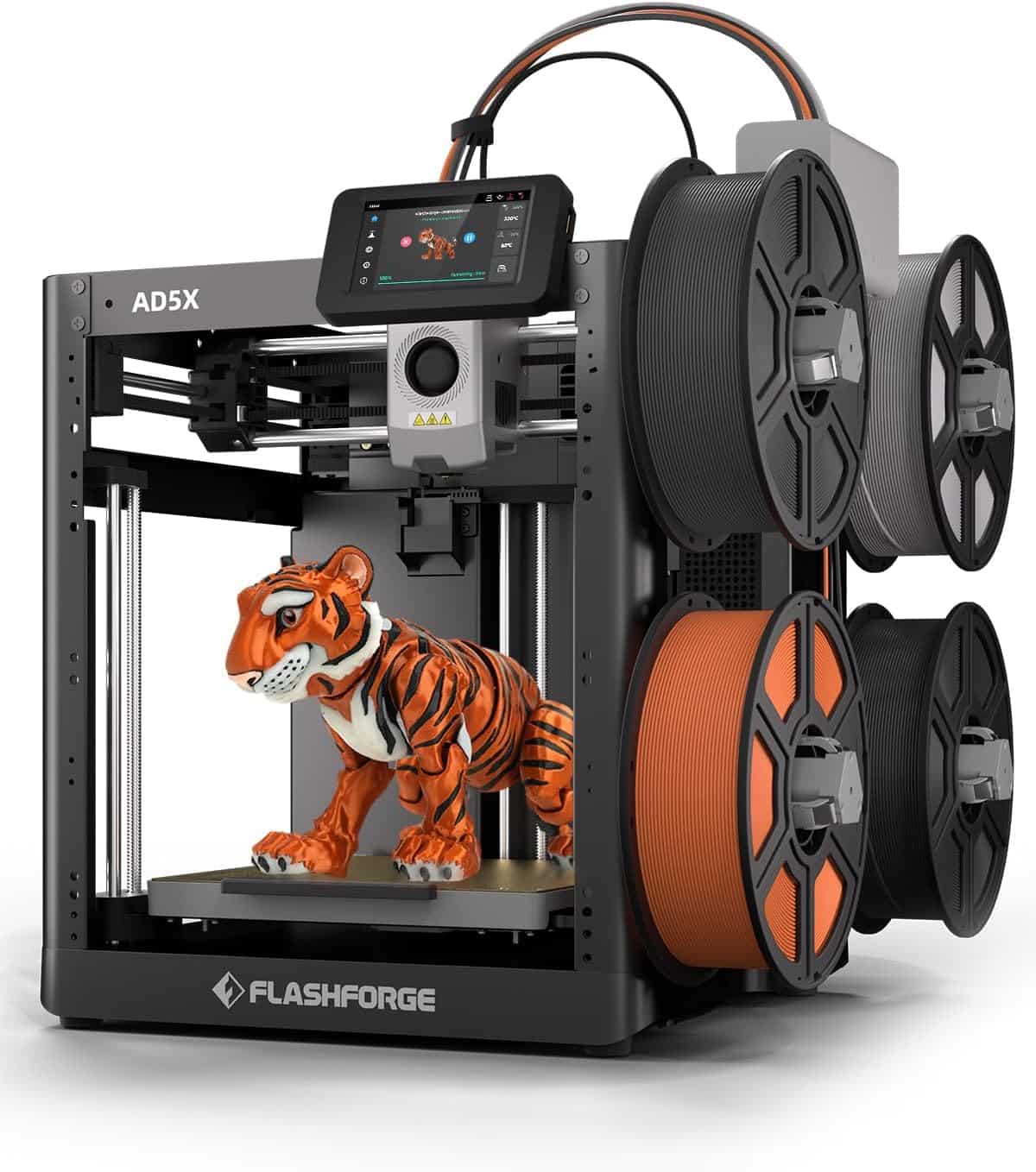
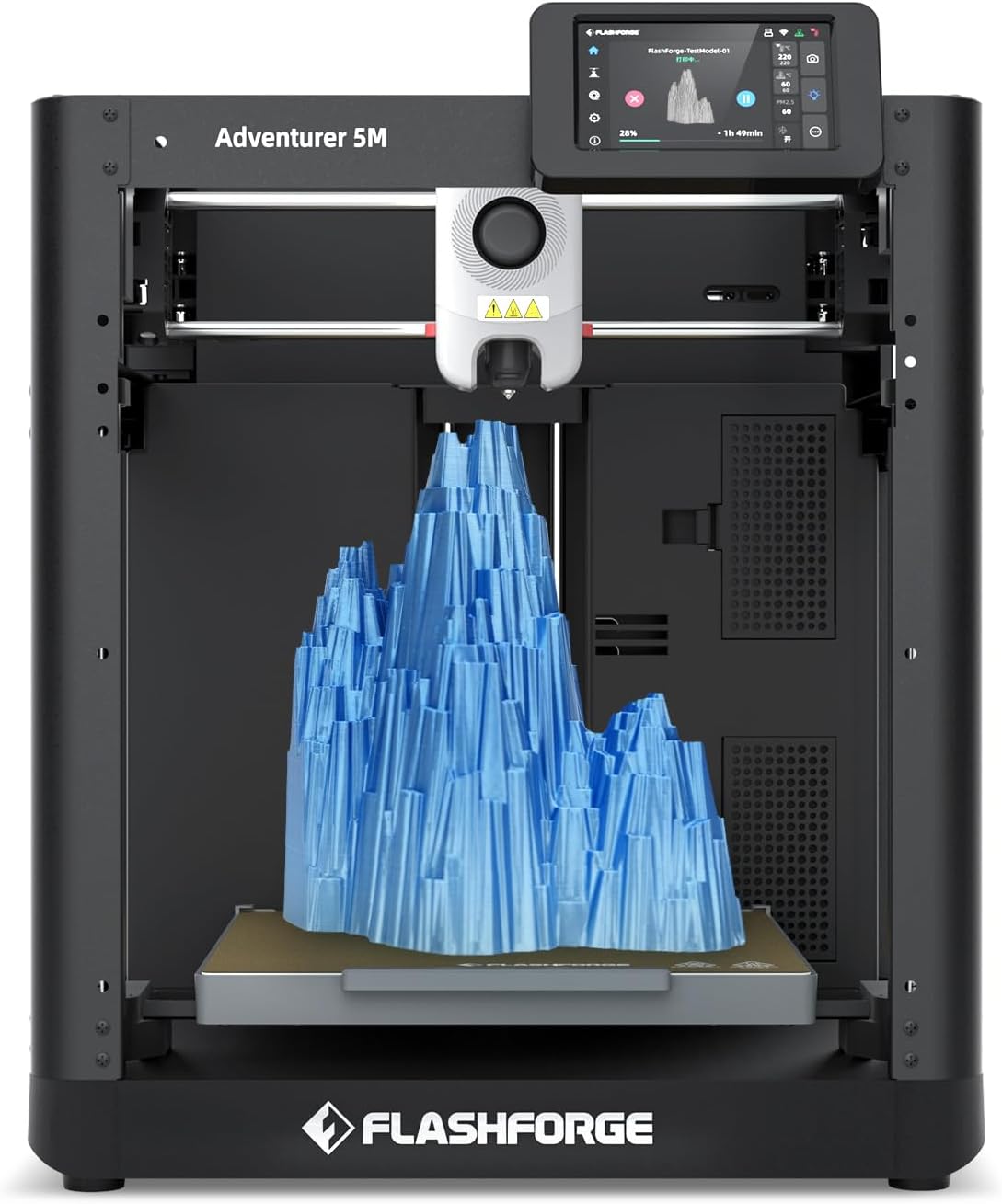
Side-by-side: the $339 AD5X (multicolor, 4 filaments) vs. the $239 Adventurer 5M (single-color, open-source). Same CoreXY bones. Very different use cases.
Value Score
Value Score
✓ Prime eligible · 30-day returns · Free shipping
↗ Check Adventurer 5M Single-Color — $239 on Amazon✓ Prime eligible · 30-day returns · Free shipping
FlashForge released two CoreXY printers within months of each other and set a price trap. The AD5X costs $100 more than the Adventurer 5M. The question is whether that $100 delta gets you $100 worth of printer — or just $100 worth of purge waste and noise. I own a Creality K1 Max, I’ve put time on an Ender 3, and I’ve watched both of these machines rack up real-world hours in the community. Here’s the honest breakdown.
The short version: the AD5X is one of the cheapest CoreXY multicolor printers alive. The AD5M is one of the best single-color speed printers under $250. They share the same CoreXY frame, the same 600mm/s theoretical ceiling, and the same FlashForge slicer headache. Everything else diverges.
✓ Prime eligible · 30-day returns · Free shipping
Do Either Printer Actually Hit 600mm/s?
Both printers list 600mm/s as the maximum speed. In practice, neither machine runs daily jobs at that ceiling. Verified buyers running 1,000+ hours on the AD5X report their sweet spot at 200–350mm/s — fast enough to demolish most bed slingers but nowhere near the marketing number. The CoreXY structure earns its keep: vibration compensation keeps layer adhesion clean at speeds that would cause ghosting on a Cartesian machine.
The 20,000mm²/s acceleration figure is more meaningful than the top speed. Short, rapid movements — like infill patterns and support structures — benefit most from high acceleration. At $339, you’re getting a speed-optimized architecture that punches significantly above its price class.
AD5X Multicolor: How Good Is It Really?
The AD5X supports up to 4 simultaneous filament colors. This is a genuine differentiator — no other CoreXY printer at this price point does it. The mechanism works, and the output quality is legitimately competitive with machines 2× the price. But there’s a tax on every multicolor print you run.
The purge waste is brutal. On prints with frequent color changes, the purge tower can consume more filament than the model itself. A small business owner running the machine commercially reported starting multicolor prints only on full spools — half-empty spools don’t make it to the end. If you’re selling prints, factor an extra 20–40% filament cost into your multicolor jobs.
Print times also balloon. It’s not unusual for the AD5X to run 24-hour+ multicolor jobs. The same owner ran week-long back-to-back 24-hour sessions — the machine didn’t complain. Reliability at load is excellent. Just budget the time.
Adventurer 5M: Is the $239 Price Tag Justified?
Yes — without reservation. The Adventurer 5M is one of the best single-color printers at this price in 2026. The 3-second quick-swap nozzle is genuinely useful for shops running different materials back to back. The vibration calibration system runs automatically and keeps quality consistent across the full speed range.
The first-layer auto-leveling via pressure sensor works reliably. Buyers report calibration being a “breeze” with little ongoing maintenance. The open-source firmware means you can flash third-party builds and run Klipper-compatible tooling if you want more control. At $239, this is rare.
AD5X vs Adventurer 5M: Full Head-to-Head Comparison
Seven rows covering the specs that matter to actual buyers — not the marketing sheet highlights.
| Feature | AD5X | Adventurer 5M | Winner | Why It Won |
|---|---|---|---|---|
| Price (May 2026) | $339 | $239 | AD5M | $100 cheaper for same core architecture |
| Multicolor Printing | ✓ Up to 4 colors | ✗ Single color only | AD5X | Only CoreXY multicolor at this price |
| Max Extruder Temp | 300°C | 280°C | AD5X | 20°C headroom matters for PC and nylon |
| Firmware | Closed source | Open source | AD5M | Klipper compatibility, community mods |
| Nozzle Swap | Standard swap | 3-second quick-swap | AD5M | 3 sec vs. minutes — matters in production |
| Noise Level | Loud (open frame, purge clicks) | Loud (open frame) | Tie | Both need a Creality tent for noise reduction |
| Filament Cost Per Print | Higher (purge waste) | Standard | AD5M | Multicolor purge waste can exceed model weight |
| Beginner-Friendliness | Moderate | High | AD5M | Simpler setup; fewer failure modes for newcomers |
✓ Prime eligible · 30-day returns · Free shipping
↗ Buy Adventurer 5M — $239 Best Single-Color Value✓ Prime eligible · 30-day returns · Free shipping
AD5X and AD5M: Honest Pros and Cons
FlashForge AD5X — Pros & Cons
Pros
- Cheapest CoreXY multicolor printer available in 2026
- 300°C extruder handles engineering-grade filaments
- 1,000+ hour reliability verified by commercial users
- Print quality genuinely competes with Bambu A1
- Auto leveling via 1-click — reliable first layers
Cons
- Purge waste can exceed actual model filament use
- Loud — open frame amplifies every operation
- Slicer (FlashPrint) is buggy; must use Orca-FlashPrint
- Closed firmware — no Klipper, no community modding
- Enclosure kit requires printing 2kg of parts in ABS (catch-22)
FlashForge Adventurer 5M — Pros & Cons
Pros
- Cheapest open-source CoreXY at 600mm/s in this class
- 3-second quick-swap nozzle — best in class at this price
- Vibration calibration auto-runs; minimal manual tuning
- Open firmware supports Klipper and community upgrades
- Simple setup — under 10 minutes out of box
Cons
- Single color only — no upgrade path to multicolor
- Misleading product images suggest enclosure that isn’t there
- Same slicer problem as AD5X — use Orca-FlashPrint
- Loud for an open-frame machine
- ABS requires enclosure; enclosure requires printing parts first
✓ Prime eligible · 30-day returns · Free shipping
The Reality of Long-Term Ownership
The AD5X has verified buyers who’ve crossed 1,000 hours on the odometer. Original PEI build plate still running on one side, single nozzle change across the entire run. That’s genuinely impressive for a $339 machine. The machine ran PLA, PETG, a little TPU, and ABS across that lifespan with minimal failures — and the reported failures were almost all user error, not hardware.
Maintenance & Wear
Nozzle changes are the primary consumable on both machines. The AD5M’s 3-second quick-swap system makes this painless in production environments. On the AD5X, expect to replace the nozzle every few hundred hours of abrasive filaments. The PEI build plate is double-sided — flip it before replacing. Both machines use standard 0.4mm nozzles as default, with options down to 0.25mm and up to 0.8mm for specialized jobs.
Hidden Costs
The biggest hidden cost on the AD5X is filament consumption during multicolor prints. Budget 20–40% more filament per multicolor job than the model weight suggests. On the AD5M, the main hidden cost is the enclosure if you need one — panels kit plus filament for the printed frame adds $50–$80 to your actual all-in cost. Neither machine has subscription fees or proprietary consumables beyond the nozzles.
AD5X or AD5M: Who Should Buy Which?
Buy the FlashForge AD5X if:
You want to print multi-color models — decorative items, miniatures, product prototypes, or anything that benefits from color variety. At $339, no competitor delivers CoreXY multicolor this cheaply. You’re comfortable with a steeper setup curve. You’re either running a small business or are an experienced hobbyist who won’t be phased by purge waste and slicer quirks.
Buy the Adventurer 5M if:
Single-color printing covers 100% of your use cases. Engineers, educators, rapid prototypers, and print farm operators who want speed and open-source flexibility without paying the multicolor premium. At $239, it’s one of the most capable single-color machines at this price. First-time buyers who tried a printer and failed — this is a genuinely friendly machine with good calibration and reliable first layers.
Neither is right if:
You want a polished multicolor ecosystem with minimal waste and a refined app experience — look at the Bambu A1 with AMS. The Bambu AMS system wastes far less filament in purge and the software is significantly more mature. You’ll pay more, but the gap in usability is real.
Frequently Asked Questions
✓ Best CoreXY multicolor under $350 · Prime eligible · Free shipping
↗ Buy FlashForge Adventurer 5M — $239 on Amazon✓ Best single-color value under $250 · Prime eligible · Free shipping
Related posts:
 Creality K2 Pro Combo: Your Gateway to Pro-Level Multicolor 3D Printing
  QIDI Max4 Combo Review 2026: The Largest Sub-$1,500 CoreXY That Can Actually Print Nylon
  Anycubic Kobra X vs ELEGOO Centauri Carbon Review: Best 3D Printer Under $400 in 2026?
  Anycubic Kobra 3 Combo 3D Printer Review: Your Ultimate Guide to Stunning Multicolor 3D Printing
  Bambu Lab P1S vs A1 Mini: The $1000 Regret (Why I Sold My P1S)
  Anycubic Kobra S1 vs Creality K1C: I Tested Both for 6 Months – Here’s the Winner (Dec 2025)
  Bambu Lab A1 Mini Combo vs FLASHFORGE AD5X: I Tested Both for 30 Days—Here’s the SHOCKING Winner
  Creality K2 Pro Combo Review: The Good, The Bad & The Ugly Truth
  ELEGOO Centauri Carbon 2 Combo Review: Best Sub-$500 Multicolor 3D Printer in 2026?
  Best 3D Printer 2026: 14 Models Tested and Compared
  Bambu Lab P2S vs. Creality K2 Pro: Which 2026 Flagship Wins?
  Best 3D Printers for Beginners 2026: What Nobody Tells You Before You Buy