
As an Amazon Associate, 3DPrintedDecor earns from qualifying purchases. Prices and availability were checked through Amazon on November 1, 2026 and change often, so confirm the current price on Amazon before you buy.
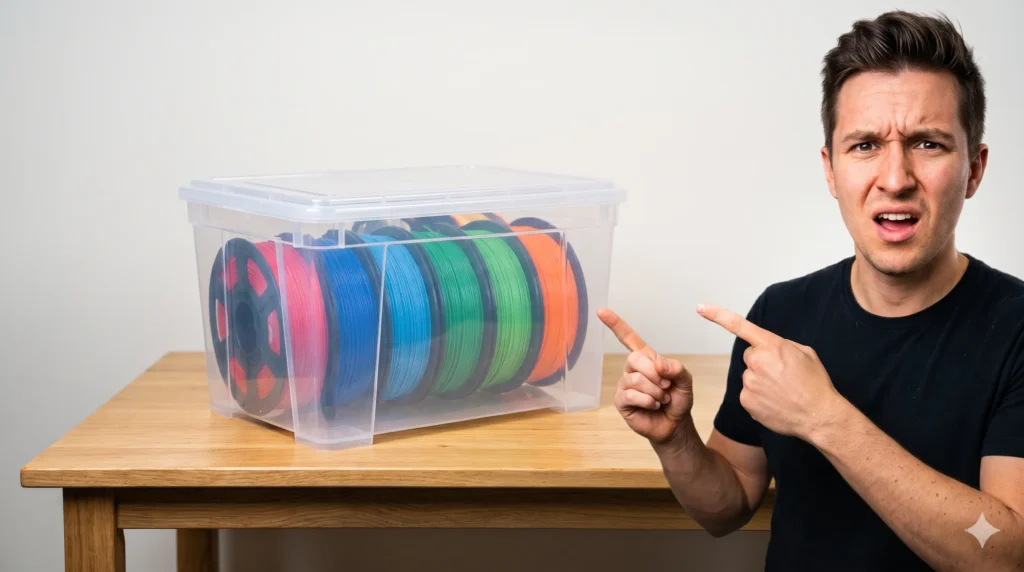
If your prints have started popping, stringing or coming out rough, your filament has probably soaked up moisture from the air. Most people’s first instinct is to buy a dryer. Often you don’t need one. You need to stop the moisture getting in.
Filament storage is one of the most-discussed topics in our r/3DPrinterComparison community, and the questions are always the same: what actually works, what’s a waste of money, and how dry is “dry enough”? This guide answers all three. You’ll learn how to tell if your filament is wet, how sensitive each material is, three storage setups for different budgets, and a simple routine that keeps spools printing like new.
The short version
- Seal every opened spool in an airtight bag or box with desiccant. Sealing matters more than which product you use.
- Use desiccant that shows when it’s spent (color-changing beads) or a hygrometer, so you’re not guessing.
- Aim for low humidity inside your storage. Below about 30% suits most filaments; nylon, TPU and PVA need it drier.
- Buy a dryer only when you need one: for humid climates, moisture-hungry materials, or spools that are already wet. Storage keeps filament dry; a dryer fixes filament that’s already wet.
Is Your Filament Wet? 6 Signs to Look For
Most filaments are hygroscopic: they pull water vapor out of the air. When that water hits a hot nozzle it turns to steam, and that’s what ruins prints. Look for these signs:
- Popping, crackling or hissing from the nozzle as it prints. This is the most reliable sign.
- Wisps of steam coming off the nozzle, visible under a bright light.
- Much more stringing than usual, even with settings that used to work.
- Rough, fuzzy or bubbly surfaces where you used to get smooth walls.
- Weak parts that split along layer lines more easily than they should.
- PLA that snaps in the feed path. Moisture and age often make PLA brittle.
Quick test: print a small object with a fresh, sealed spool and then with the suspect spool, using the same settings. If only the old spool pops or strings, moisture is the likely cause, not your settings.
How Moisture-Sensitive Is Your Filament?
Not every material needs the same care. Use this as a starting point. Drying temperatures vary by brand, so always check the label or manufacturer page for your exact filament.
| Filament | Sensitivity | Storage tip | Typical drying start point |
|---|---|---|---|
| PLA | Low–moderate | Sealed bag or box once opened; can sit out for days or weeks in a dry room | 45–55°C, 4–6 hours |
| PETG | Moderate | Keep sealed between prints; stringing is often the first warning | 60–65°C, 4–6 hours |
| ABS / ASA | Moderate | Keep sealed; less fussy than PETG but still benefits | 60–80°C, about 4 hours |
| TPU (flexible) | High | Store sealed at all times; ideally print from a dry box | 45–55°C, 4–8 hours |
| Nylon | Very high | Can absorb moisture within hours; print straight from a dryer or dry box | 70–80°C, 8–12 hours |
| PVA (soluble support) | Very high | Never leave it out; reseal immediately after every print | 45–55°C, 4–6 hours |
If you mostly print PLA in a dry, air-conditioned room, simple sealed storage is usually all you need. If you print TPU or nylon, or live somewhere humid (coastal areas, the Gulf Coast, Florida, or anywhere above about 50% humidity most of the year), plan on a dryer as well. New to materials? Our PLA vs ABS vs PETG guide explains the differences, and our TPU guide covers flexible filament in depth.
Which Storage Setup Is Right for You?
| Your situation | Best setup | Cost |
|---|---|---|
| 1–10 spools, mostly PLA, dry room | Setup 1: Vacuum bags | $13–$22 |
| A growing collection, PLA plus PETG, you want to see humidity | Setup 2: Airtight boxes + monitoring | $65 |
| Many spools, several materials, or a humid home | Setup 3: Monitored boxes + rack | $102 |
| Spools that are already wet, or nylon and TPU | Any setup above + a filament dryer | +$45 and up |
Vacuum Bags: The Cheapest Setup That Actually Works
Best for: beginners, small collections, PLA in a reasonably dry room.
Bags take up almost no space and seal well. The trade-off is that you have to open and reseal a bag every time you swap spools, and you can’t see the humidity inside.

Option A: Equippo Filament Vacuum Storage Kit
Everything in one box: 30 vacuum bags sized for filament spools, an electric pump plus a manual backup pump, 30 silica gel packs, 5 clips and 2 markers for labeling. It works out to about 43 cents per spool, and the vacuum pulls most of the air (and its moisture) out of the bag. It’s the cheapest complete setup we found.
Check price on Amazon
Option B (DIY): Ziploc 2-Gallon Freezer Bags
If the Equippo kit is out of stock, heavy-duty freezer bags are the classic workaround. A 2-gallon bag fits a standard 1 kg spool, and the double zipper seals better than single-track bags. Squeeze out as much air as you can before sealing. Unlike the kit, these don’t come with desiccant, so pair them with the packets below.
Check price on Amazon
Dry & Dry Rechargeable Silica Gel Packets, 30 × 10 g
Fabric silica packets you drop into each bag. They’re rechargeable, so when they’ve absorbed all they can, you dry them out and reuse them instead of throwing them away. Thirty packets cover a whole shelf of spools.
Check price on AmazonSetup 1 total: $12.98 with the Equippo kit, or $22.38 for Ziploc bags plus Dry & Dry packets.
Airtight Boxes + Monitoring: The Sweet Spot
Best for: anyone with 5+ spools, PLA and PETG users, and anyone tired of guessing.
Rigid boxes stack neatly, are quick to open and close, and you don’t fight with zippers. Add color-changing desiccant and a hygrometer and you always know whether your filament is actually dry.

YOOPAI Pro Airtight Filament Boxes, 4-Pack
Single-spool airtight containers shaped to fit a 1 kg spool, so there’s little wasted air space for moisture to sit in. The flat lids stack steadily, and desiccant is included. At about $5.22 per box, they’re a cheap step up from bags.
Check price on Amazon
Dry & Dry Orange Indicating Silica Beads, 2 lb
The most useful thing in this guide for its price. These beads are orange when dry and turn green as they fill with moisture, so one glance tells you when to recharge them. Two pounds is enough to refill boxes many times over. It’s also one of Amazon’s best sellers in its category (rank #415 when we checked).
Check price on Amazon
SwitchBot Bluetooth Thermometer-Hygrometer, 2-Pack
Shows temperature and humidity on a large display and sends readings to an app, which can alert you when humidity goes above a level you set and lets you export history. Put one in the room where your printer lives and one in your largest storage container or tote. It shows whether your storage is working, and whether your room is humid enough to need a dryer.
Check price on AmazonSetup 2 total: $64.87 for four airtight boxes, 2 lb of indicating desiccant and two smart hygrometers.
Monitored Boxes + Rack: For Bigger Collections
Best for: 10+ spools, multiple materials, multicolor printers and humid homes.
At this point you want to see each spool’s humidity without opening anything, and your filament needs a proper home instead of a pile on the floor.
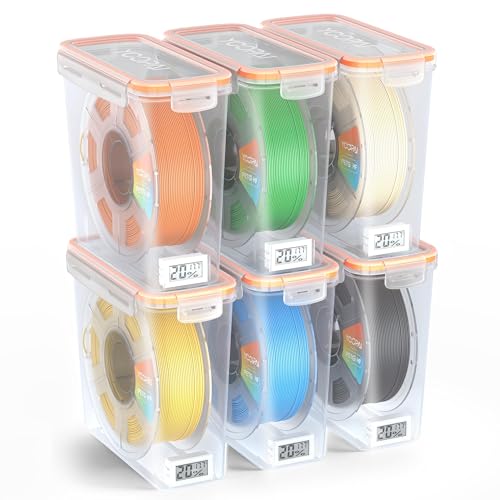
YOOPAI Pro Filament Boxes with Humidity Monitor, 6-Pack
The same airtight single-spool design as the 4-pack, but every box has its own built-in temperature and humidity display. You can scan a stack of six spools and spot the one that needs fresh desiccant without opening a lid. At about $6.67 per box with a monitor, it’s cheaper than buying boxes and hygrometers separately, and it’s a strong seller in its category (rank #899).
Check price on AmazonDry & Dry Orange Indicating Silica Beads, 2 lb
The boxes include desiccant, but a 2 lb jar of indicating beads lets you top them all up and swap spent beads instantly while the old batch recharges.
Check price on Amazon
VEVOR 4-Tier Rolling Filament Rack
A heavy-duty rolling rack built for filament spools, so your collection stays organized, visible and off the floor. One important point: an open rack does not protect filament from moisture. Use it for the PLA you’re printing this week in a dry room, and keep everything else sealed in boxes. Want more options? See our filament rack roundup.
Check price on AmazonSetup 3 total: $101.88 for six monitored airtight boxes, 2 lb of indicating desiccant and a rolling rack.
The 5-Minute Routine That Keeps Filament Dry
The products only work if you use them consistently. This is the routine we’d follow:
- Reseal right after printing. Don’t leave a spool on the printer overnight unless it’s PLA in a dry room. For PETG, TPU and nylon, put it back the moment the print finishes.
- Add desiccant to every bag or box. One packet or a small scoop of beads per spool is enough for short-term storage. Use more if a spool will sit for months.
- Remove as much air as you can. Vacuum the bag, press air out of a freezer bag, or pick boxes that fit the spool snugly. Less air means less moisture inside.
- Label it. Write the material, color and date opened on the bag or box. It tells you which spools have been open longest and might need drying.
- Check humidity once a week. Look at your hygrometer or the bead color. When the beads have changed color, or humidity starts climbing, recharge or replace the desiccant.
Can You Trust Your Hygrometer? How to Check It
Cheap hygrometers can read several percentage points high or low, which matters when you’re aiming for under 30%. Checking yours takes a day and costs almost nothing.

Boveda 75% One-Step Calibration Kit
Seal your hygrometer in the bag with the Boveda pack. After 24–32 hours, an accurate hygrometer reads 75%. If yours reads 70% or 80%, you know it’s off by 5 points and can adjust its readings in your head (or in the app, if it supports an offset). It’s single use, but you rarely need to check more than once.
Check price on AmazonThe free alternative: the “salt test” works on the same principle. Mix table salt with a few drops of water into a damp paste (wet, but not dissolved), put it in a bottle cap inside a sealed bag with your hygrometer, and wait about 12–24 hours. Saturated salt holds the air at roughly 75% humidity, so that’s what an accurate hygrometer should read.
7 Filament Storage Mistakes to Avoid
- Bags or boxes with no desiccant. Sealing traps whatever moisture is already inside. Desiccant is what actually removes it.
- Trusting “used up” desiccant. Saturated silica does nothing. If you can’t tell whether it’s spent, use indicating beads or a hygrometer.
- Treating a rack as storage. Open racks look great but don’t stop moisture. Only keep spools out in the open that you’ll use soon.
- Storing filament next to the printer, a window or a heater. Heat and sunlight can warp spools and soften some filaments. A cool, dark, dry spot is best.
- Assuming new spools are perfectly dry. Factory-sealed spools are usually fine, but a damaged seal or long time in a warehouse can let moisture in. If a brand-new spool pops, dry it.
- Throwing out the original bag and desiccant. Many spools arrive in a resealable bag with a desiccant pack. It’s a free short-term storage option.
- Expecting storage to fix wet filament. Storage keeps filament dry. If a spool is already wet, dry it first, then store it.
When Storage Isn’t Enough: Do You Need a Filament Dryer?
Buy a dryer if any of these apply:
- Your room’s humidity is regularly above about 50% (your hygrometer will tell you).
- You print nylon, TPU or PVA, which absorb moisture fast enough that you should print them straight from a dryer.
- You have spools that already show the wet-filament signs above.
- Long prints with PETG or other sensitive materials start out fine but get worse over several hours.
If you do need one, our best filament dryers roundup compares the main options, and our complete filament dryer guide explains how they work. For specific models, see our Sovol SH02 review (a strong value pick) and SUNLU FilaDryer S4 (four spools at once). Just getting started with your first printer? Our 30-day new printer checklist shows when storage and drying are worth adding.
Frequently Asked Questions
What is the best way to store 3D printer filament?
Seal each opened spool in an airtight bag or box with rechargeable desiccant, and store it somewhere cool, dark and dry. Vacuum bags are the cheapest effective option, at about $13 for a 30-bag kit. Airtight boxes with color-changing desiccant and a hygrometer are easier to use day to day and show you when the desiccant needs recharging.
What humidity should filament be stored at?
A common target is below about 30% relative humidity inside your storage container. PLA tolerates more, while nylon, TPU and PVA do best much drier. A hygrometer inside your container or storage tote shows whether you’re hitting your target.
How long can PLA sit out before it goes bad?
It depends on your room’s humidity. In a dry, air-conditioned room, PLA can often sit out for days or weeks without noticeable problems. In a humid room, print quality can drop much faster. If you’re not printing a spool for more than a few days, it’s safest to seal it.
Can you store filament in Ziploc bags?
Yes. Heavy-duty 2-gallon freezer bags fit a standard 1 kg spool. Squeeze out as much air as you can and add a desiccant packet to each bag. Without desiccant, a bag only traps the moisture already inside.
Does storing filament in a sealed box dry it out?
Only slowly, and only if there’s desiccant inside. Storage mostly prevents new moisture from getting in. To dry filament that’s already wet, use a filament dryer at the temperature recommended for that material, then store it sealed.
Do I need a filament dryer if I store filament properly?
Many PLA users in dry climates never need one. A dryer becomes worthwhile if you live somewhere humid, print nylon, TPU or PVA, or have spools that already show signs of moisture like popping, stringing or rough surfaces.
Prices, deals and availability were pulled from Amazon on November 1, 2026 and may have changed. Product details come from manufacturer listings; drying temperatures are typical starting points, not manufacturer specifications for any particular brand. 3DPrintedDecor has not lab-tested these products.
Related posts:
 Comgrow Filament Dryer Box Review: Is This the Best Budget Dryer for 3D Enthusiasts?
 Comgrow SH02 Filament Dryer Box Review: Does it Really Work?
 Creality CFS Multicolor Filament System Review: Worth $319 in 2025?
 3D Printing Tips: The Ultimate Janky Yet Effective Beginner’s Guide
 Best 3D Printing Sites for Every 3D Printer User in 2025: Free STL Files, Premium Designs, and More
 Creality Space Pi Plus Filament Dryer vs Comgrow Filament Dryer Box: Which One Boosts Your 3D Prints Best?
 SUNLU FilaDryer SP2: 2-in-1 Dryer Drops May 19!
 Best Silk PLA Filaments for Cosplay and Decorative 3D Printing
 Sovol SH01 Filament Dryer 2025 Review: Best Budget Pick for 3D Printing?
 3D Printer Filament Dryer | The Ultimate Guide | No More Failed Prints
 Unlock Hidden Speed: Transform Your Bambu Lab A1 Mini Settings (50% Faster Prints Guaranteed
 16 Best 3D Printing Tools That Actually Fix Real Problems (2026)
