
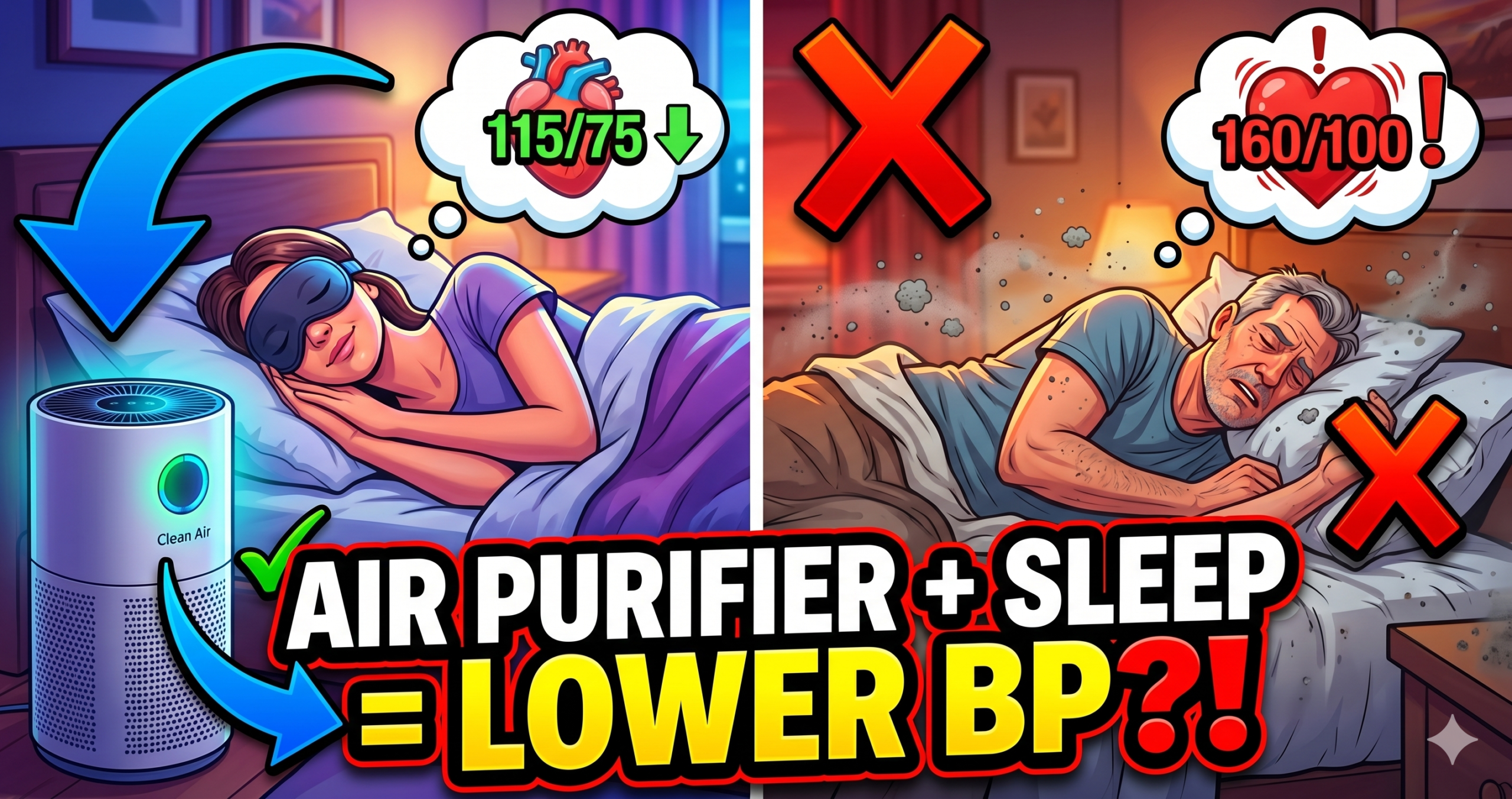
Bedroom PM2.5 builds up overnight from dust, skin cells, and outdoor infiltration — this is the air a purifier is actually working on while you sleep.
A HEPA purifier running overnight won’t sedate you, but it can measurably cut the fine particles that fragment deep sleep and nudge nighttime blood pressure down — the effect is real, modest, and strongest if you already breathe polluted or allergen-heavy air.
The benefit isn’t about “cleaner air feels nicer.” It’s mechanical: less particulate matter means less airway irritation and less sympathetic nervous system activation, which is the same pathway connecting bad air to high blood pressure.
6.5/10 — helpful and evidence-backed, not a substitute for treating sleep apnea, hypertension, or allergies medically.
I started running a purifier in my bedroom after waking up congested for the third night in a row during Mumbai’s pollution season. I didn’t expect it to do much beyond filtering dust. What changed my mind wasn’t a deeper sleep “feeling” — it was checking my blood pressure cuff readings over a few weeks and noticing my morning numbers were quietly, consistently lower. That sent me down a research rabbit hole, and the data backs up what I noticed, with real limits worth knowing before you expect too much.
Does an Air Purifier Actually Improve Sleep Quality?
Yes, but mainly by removing things that interrupt sleep rather than by helping you fall asleep faster. Indoor PM2.5 has been linked to a measurable drop in deep sleep (N3 stage) and more nighttime arousals, so a purifier’s main job is protecting the sleep stages you don’t notice losing.
Polysomnography research has found that PM2.5 exposure was significantly associated with a reduction in the proportion of deep sleep, and researchers believe PM2.5 may provoke inflammatory and oxidative responses that alter autonomic balance, shifting the body toward sympathetic dominance and disrupting slow-wave sleep. That’s the stage where your body does most of its physical repair. You don’t feel yourself losing it — you just wake up not feeling rested, even after eight hours.
Separately, elevated indoor CO2 (which builds up in a closed bedroom overnight, purifier or not) has been tied to subjective reports of decreased sleep quietness, reduced sleep satisfaction, and a measurable decrease in deep sleep. That’s worth flagging because a purifier filters particulate matter, not CO2 — cracking a window or running an exhaust fan still matters even with a good HEPA unit running.
A purifier won’t fix a stuffy, sealed bedroom on its own. If you sleep with windows and doors shut all night, pair the purifier with at least minimal ventilation — otherwise CO2 buildup can undercut the sleep-quality gains you’re getting from cleaner particulate air.
What About Sleep Apnea Specifically?
The evidence here is more mixed than purifier marketing suggests. Long-term outdoor PM2.5 and NO2 exposure has been associated with higher odds of obstructive sleep apnea in large cohort studies — a 5 μg/m³ greater annual PM2.5 exposure was associated with roughly 60% greater odds of sleep apnea in one major analysis. But a more recent meta-analysis specifically looking at PM2.5 and sleep-disordered breathing found no substantial overall impact on OSA risk, while NO2 showed a small, non-significant increase. The honest summary: air quality plausibly worsens sleep apnea severity in already-diagnosed cases, but a purifier isn’t a treatment for OSA itself. If you snore loudly, gasp for air, or wake up exhausted regardless of air quality, that needs a sleep study, not a HEPA filter.
Can an Air Purifier Lower Blood Pressure?
Modestly, yes — multiple 2026 clinical studies found small but statistically significant reductions in systolic blood pressure from portable air cleaner (PAC) use, concentrated in people whose blood pressure was already elevated.
A 2026 meta-analysis pooling 10 randomized controlled trials found portable air cleaners produced a PM2.5 reduction of roughly 21 μg/m³ on average, a 56% relative drop, and a significant mean systolic blood pressure reduction of about 3.9 mmHg, though the diastolic change wasn’t statistically significant. A separate, larger pooled analysis of 17 studies and 880 participants found a 60% relative reduction in indoor PM2.5 exposure alongside a systolic/diastolic blood pressure reduction of roughly 2.4/0.8 mmHg.
A real-world study reinforced this in people living near a highway: researchers installed HEPA purifiers in the homes of 154 participants and found a modest but significant 3 mmHg reduction in systolic blood pressure for those whose blood pressure was already elevated at baseline, with no significant change for people who already had normal systolic blood pressure. The proposed mechanism: air pollution can trigger the sympathetic nervous system and cause structural changes to arteries that lead to hypertension, and filtering it out reduces that trigger.
For context on why this matters specifically at night: nighttime is when blood pressure is supposed to dip below daytime levels (a pattern called “BP dipping”). When that dip doesn’t happen — called non-dipping or nocturnal hypertension — it’s linked to meaningfully higher cardiovascular risk, independent of daytime readings. Anything that disrupts sleep, including poor air quality, works against that protective overnight dip.
Is the Effect Just About Sleep, or Does Air Quality Affect Blood Pressure Directly?
Both, and they reinforce each other. Poor sleep itself raises blood pressure independent of air quality — in one noise-disruption study, a single night of impaired sleep increased systolic blood pressure from an average of 129.5 to 133.6 mmHg, alongside a measurable drop in vascular function. So a purifier helps through two overlapping paths: less airborne irritation triggering your sympathetic nervous system directly, and better sleep architecture, which on its own keeps blood pressure lower.
The Reality of Long-Term Overnight Use
Maintenance & Wear
Running a purifier 8+ hours a night, every night, ages the HEPA filter faster than daytime-only use. Expect to check filter life indicators monthly rather than quarterly, and budget for a replacement every 6–8 months in moderately polluted areas, sooner if you have pets or live near traffic. The fan motor is the other wear point — cheaper units get noticeably louder after 12–18 months of nightly use as bearings wear, which defeats the purpose if noise becomes a new sleep disruptor.
Hidden Costs
Filter replacements are the real ongoing cost, typically $20–$60 every few months depending on the unit. Factor in electricity too: most bedroom-sized purifiers draw 20–50 watts on low/sleep mode, which is cheap (a few dollars a year) but adds up if you’re running multiple units across a home.
Run the purifier on its highest setting for 20–30 minutes before bed to knock down particulate levels fast, then switch to sleep/low mode for the actual night. You get the air-quality benefit without sleeping next to a unit running at full fan noise all night — most of the PM2.5 reduction happens in that first aggressive pass, not gradually over 8 hours.
What Real Users Run Into
A recurring theme in buyer feedback: people place the purifier too close to the bed, pointed directly at their face, which can dry out nasal passages and throat overnight — ironically working against the breathing-comfort benefit they wanted. The general guidance from sleep-and-air-quality resources is to position the unit a few feet away with airflow circulating the room rather than aimed directly at you, and to prioritize true HEPA with activated carbon if allergens or odor (not just dust) are the main issue.
Who Benefits Most From Running One at Night?
The clinical effect sizes above are population averages, and they’re not evenly distributed. You’re most likely to notice a real difference if you fall into one of these groups:
- Elevated baseline blood pressure — the highway-adjacent study found essentially no change in people with normal systolic BP, and a real one in those already elevated.
- Allergy or asthma sufferers — reduced airway irritation overnight means fewer micro-arousals from coughing, congestion, or post-nasal drip.
- People near traffic, construction, or wildfire smoke — outdoor PM2.5 infiltrates indoor air more than most people assume, especially with windows cracked.
- Pet owners — dander is a major contributor to nighttime airway irritation that a HEPA filter directly addresses.
If none of those apply — you have normal blood pressure, no allergies, and live somewhere with genuinely clean outdoor air — the realistic expectation is a smaller, harder-to-notice benefit. That doesn’t make it useless, just less dramatic than the headlines suggest.
FAQ: Air Purifiers, Sleep, and Blood Pressure
How long before I notice a difference in sleep quality?
Most of the clinical trials measuring blood pressure changes ran 2–9 weeks of continuous use before seeing significant results. Subjective sleep quality can shift faster — often within a week or two — but the cardiovascular benefit builds gradually with consistent nightly use, not overnight.
Should I run the purifier all night or just before bed?
Running it continuously on a low/quiet setting gives the most consistent particulate reduction, since dust and allergens continue circulating from bedding, skin cells, and air leaks throughout the night. A pre-bed high-setting burst helps if your unit is too loud to sleep through on higher fans.
Does air purifier noise cancel out the sleep benefit?
It can, if the unit is loud enough to cause its own arousals. This is why CADR-per-decibel matters more for bedroom use than CADR alone — a purifier rated for a larger room but run on a low, quiet setting in a smaller bedroom usually beats a smaller unit maxed out to keep up.
Will an air purifier help with sleep apnea?
Not directly. The research connecting air pollution and sleep apnea risk is mixed, and a purifier doesn’t address the airway obstruction mechanics behind OSA. If you suspect sleep apnea, a purifier may modestly help overall air quality but isn’t a substitute for diagnosis and treatment such as CPAP.
Do I need true HEPA, or is a cheaper ionizer enough?
True HEPA is what the cited research is actually built on — it’s the filtration standard used in the clinical trials showing PM2.5 and blood pressure reductions. Ionizers and “ionic” purifiers work on a different mechanism with thinner evidence behind them for these specific outcomes, and some generate trace ozone, which is its own respiratory irritant.
Can I expect a guaranteed blood pressure drop?
No. The studies show population-level average reductions of roughly 2–4 mmHg systolic, concentrated in people with elevated baseline blood pressure. It’s a meaningful, low-risk addition to a broader approach — not a replacement for medication, diet, or other interventions your doctor has recommended.
This article reflects findings from peer-reviewed studies and clinical research published through 2026, including meta-analyses in The Journal of Clinical Hypertension and the Journal of the American College of Cardiology. It is for informational purposes and isn’t a substitute for personalized medical advice — talk to a doctor about persistent high blood pressure or suspected sleep apnea.
Related Reading on Bedroom & Air Quality
- Best Quiet Air Purifiers of 2026 — for picking a unit that won’t undo the sleep benefit with fan noise.
- Top-Rated HEPA Air Purifiers for Molds and Allergens — if congestion and allergens are your main nighttime disruptor.
- HEPA vs Activated Carbon Filters — understanding what each filter type actually removes.
- Best Levoit Air Purifiers for Pet Owners in Small Apartments — for dander-driven nighttime airway irritation.
- Levoit Core 200S-P Smart Air Purifier Review — a quiet, app-controlled option suited to scheduled overnight runs.
- Best Air Purifiers Under $300 — for CADR and filter cost comparisons if budget is the deciding factor.
Related posts:
 12 Top-Rated HEPA Air Purifiers for Molds and Allergens (Sept 2025 Update): Expert Picks
  Ultimate Guide: 5 Best Levoit Air Purifiers for Pet Owners in Small Apartments (USA 2025-2026)
  Pureborne PB6866 Air Purifier Review: Is This 2800 Sq Ft HEPA Monster Worth Your Money?
  Breathe Easy: Top 9 Air Purifiers Under ₹15,000 for a Healthier Home in India
  Cyber Monday Smart Home Deals for 3D Printing
  MOOKA B-D02L Air Purifier Review 2026: The Best Budget HEPA for Large Rooms?
  Air Oasis iAdaptAir 2.0 Air Purifiers: S vs M vs L vs P – Which Size Do You Really Need?
  PuroAir Air Purifiers: 99.9% Cleaner Air in 60 Minutes (2026 Test Results)
  Are PuroAir Good Air Purifiers? Complete 2026 Analysis
  Blueair 211i Max vs 311i Max Air Purifiers: Which One Should You Actually Buy in 2026?
  HEPA vs Activated Carbon Filters: The Real Difference Most Buyers Miss
  Blueair Blue Pure 511i Max vs 311i Max Review 2026: Which One Is Actually Worth It?