
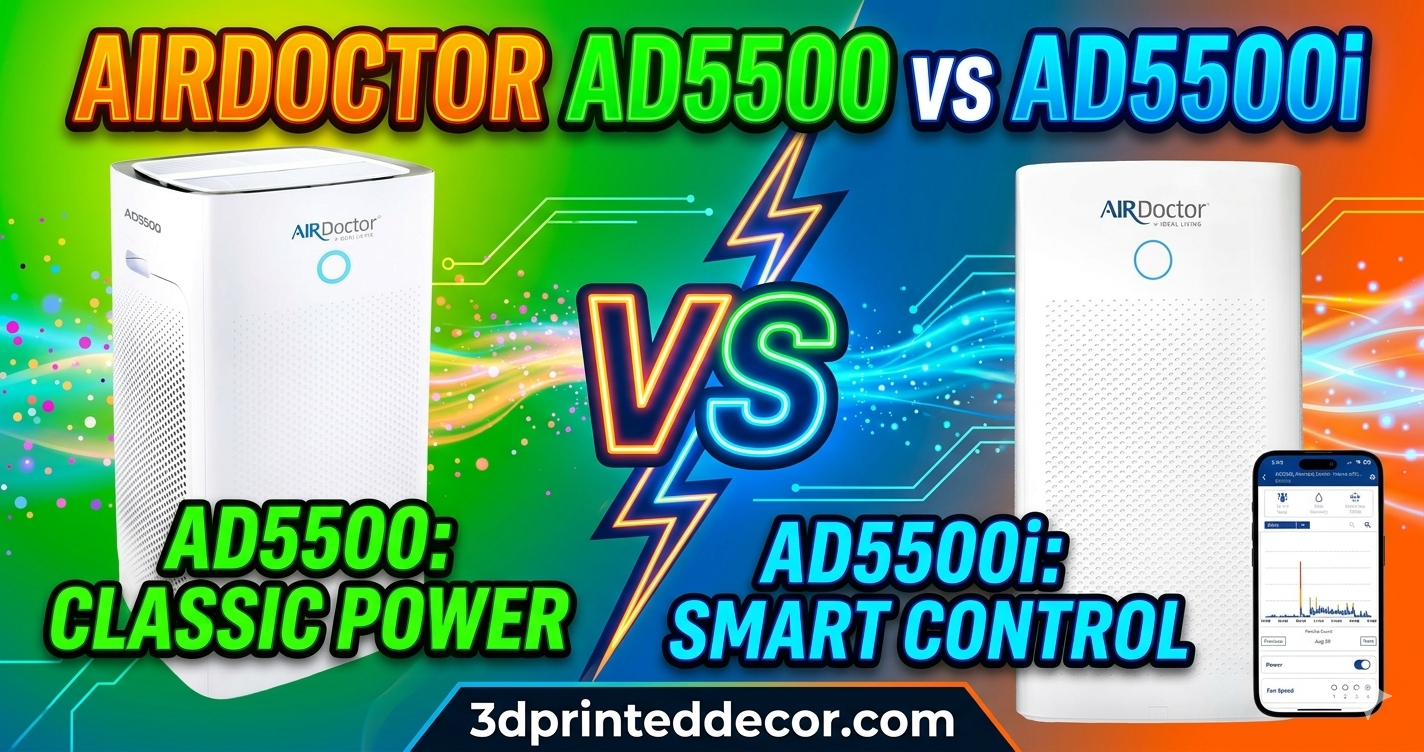
AirDoctor AD5500 vs AD5500i (2026): Which One Actually Cleans Your Air Better?
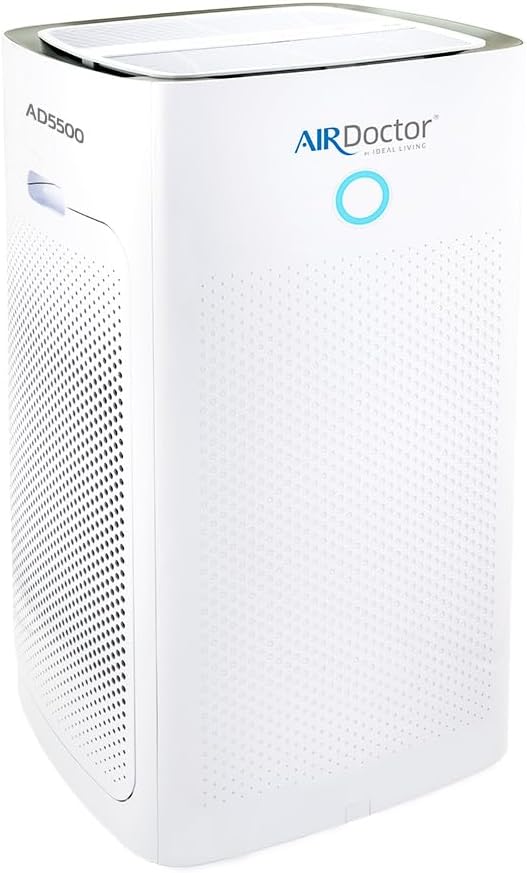
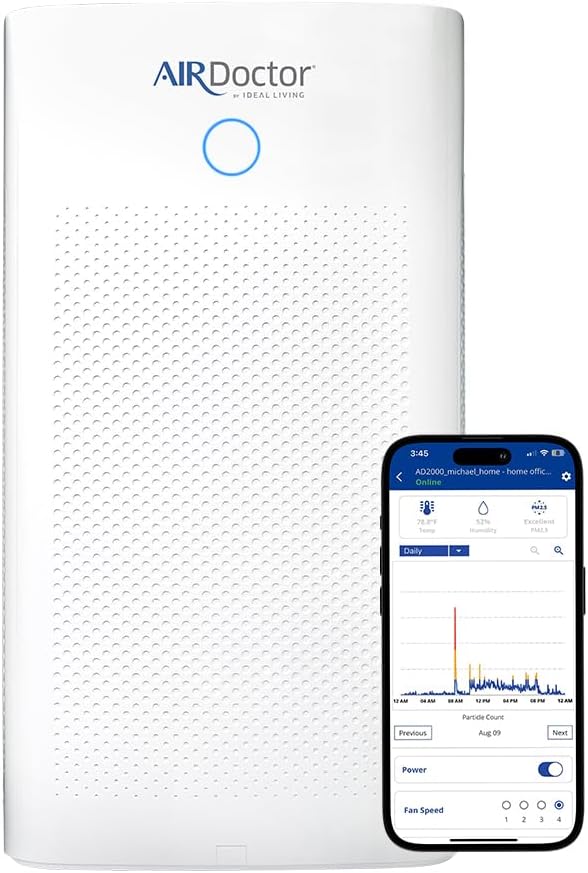
AD5500 vs AD5500i: What’s Actually Different?
The honest answer is: one thing. The AD5500i adds Wi-Fi app control. That’s the entire $50 premium. Same UltraHEPA filter. Same 2,086 sq ft coverage at 2x/hour. Same 6-speed Whisper Jet fans. Same dual-sided 3-stage filtration platform.
If the app works, $50 is a fair trade for scheduling, remote monitoring, and air quality history. The problem? Multiple verified buyers report the app failing to connect entirely — for months — with no resolution from AirDoctor support.
Filtration Performance: Is the UltraHEPA Claim Real?
The H13 UltraHEPA claim holds up. AirDoctor’s own independent testing shows 99.99% capture at 0.003 microns — true HEPA standard is 0.3 microns. That’s not marketing math; it’s a meaningful difference for virus-sized particles and ultrafine combustion byproducts.
The dual-sided intake draws air through two UltraHEPA panels and two Carbon VOC panels simultaneously. This is why the AD5500 series jumped from 3 filters (in the AD5000) to 6. More surface area, faster throughput, cleaner air per pass.
The auto mode particle sensor responds fast. One buyer noted it spinning up within seconds of cooking — not minutes. That kind of real-time response is the difference between a purifier that prevents pollution and one that reacts to it after the fact.
Does the AD5500i’s Smart App Actually Work?
This is where the AD5500i earns its controversy. The core functionality — filtration, auto mode, fan speed — is identical to the base AD5500. The app is purely additive. But when it fails, it fails completely.
A second AD5500i buyer reported all control panel electronics malfunctioning within 15 days of purchase. Support responsiveness was slow. These are outliers in a mostly positive review base — but they’re worth knowing before you drop $1,049.
AD5500 vs AD5500i vs Blueair 211i Max: 2026 Feature Table
| Feature | AD5500 ($999) | AD5500i ($1,049) | Winner |
|---|---|---|---|
| Filter Standard | H13 UltraHEPA (0.003μm) | H13 UltraHEPA (0.003μm) | Tie Identical filtration |
| Coverage Area | 2,086 sq ft (2x/hr) | 2,086 sq ft (2x/hr) | Tie Same hardware |
| App / Smart Control | None | Wi-Fi app (when it works) | AD5500i* *Only if app connects |
| Annual Filter Cost | ~$500/yr | ~$500/yr | Tie Same 6-filter system |
| Noise Level | Whisper Jet (30% quieter) | Whisper Jet (30% quieter) | Tie Same fans |
| Scent Sensitivity Risk | Low-moderate | Low-moderate | Tie Same filters, same risk |
| Customer Support | Mixed reports | Poor (per multiple reviews) | AD5500 Fewer complaints |
| Overall Value 2026 | Strong | Conditional | AD5500 Better reliability-to-cost ratio |
AD5500 — Pros & Cons
✓ Pros
- Genuinely effective for severe allergy sufferers
- Whisper-quiet on auto once air is clean
- Fast particle sensor response (seconds, not minutes)
- No app dependency — one less thing to break
- Excellent for open-concept spaces and high ceilings
- Handles cat litter dust, cooking odors, ragweed
✗ Cons
- ~$500/year in filter costs — expensive long-term
- Some units emit faint fabric-softener scent
- Sensor calibration issues reported in some units
- No smart control at this price point
- Proprietary filters lock you into AirDoctor pricing
AD5500i — Pros & Cons
✓ Pros
- App control for scheduling and remote monitoring
- Same world-class UltraHEPA performance
- Slightly higher review rating (4.4 vs 4.2) — smaller sample
- Effective on wound odors, cooking smells, pet dander
✗ Cons
- App fails to connect for some users — no fix provided
- Electronics failure reported within 15 days by one buyer
- Support response time: 4–5 days with no resolution
- $50 premium for a feature that isn’t guaranteed to work
- Same $500/yr filter cost as base model
The Reality of Long-Term Ownership
Maintenance & Hidden Costs
The AD5500 series doubled its filter count going from the AD5000 (3 filters, single intake) to the AD5500 (6 filters, dual intake). More airflow capacity is genuinely better. But the math is brutal: at ~$250 per filter set every 6 months, you’re spending $500 annually on consumables — more than some competing full units.
After two years, you’ve spent $1,000 on filters alone. That’s more than the cost of the machine itself. Run these numbers before you buy, especially if your household budget is tight.
The Scent Issue — Who’s Actually at Risk
One verified buyer’s wife experienced severe respiratory distress after a single night with the AD5500 running — even with the ionizer off. The unit emits a faint fabric-softener type scent from the new filter materials. For most people: undetectable. For someone with extreme chemical sensitivity or severe reactive airways: potentially serious.
The fix is simple — run the unit on high in an unoccupied room for 24–48 hours before introducing it to a sleeping environment. This off-gassing period isn’t documented in the manual, but it’s standard for activated carbon filter products.
The Tinkerer’s Hack: Sensor Accuracy Test
Before trusting auto mode, validate your unit’s particle sensor. Close yourself in a room with the purifier, light a match, blow it out, and wave the smoke gently near the sensor port. The display should shift to orange or red within 10–15 seconds. If it doesn’t respond, your sensor may be miscalibrated — document this on video before your 30-day return window closes.
Who Should Buy the AD5500 vs AD5500i?
Buy the AD5500 ($999) if: you have severe allergies, pets, or live in a smoky or high-pollen environment. You want the most powerful air purification in AirDoctor’s lineup without betting $50 on app software that may never connect. Allergy relief is confirmed by multiple verified buyers. The hardware is proven.
Buy the AD5500i ($1,049) if: app scheduling and remote monitoring are genuinely important to your routine — and you commit to testing app connectivity within your Amazon return window. If it connects on day one, the smart features are useful. If it doesn’t, send it back and get the standard AD5500.
Frequently Asked Questions
The AD5500i adds Wi-Fi app control for $50 more ($1,049 vs $999). Filtration performance, coverage, and fan hardware are identical. The only practical difference is smart scheduling and remote monitoring — when the app works.
Approximately $250 per replacement set, replaced every 6 months on average — roughly $500/year. The 5500 series uses 6 filters (dual-sided system), which doubled costs versus the older AD5000’s 3-filter setup.
Yes. Multiple verified buyers with ragweed, cedar, pet dander, and dust allergies report significant or complete symptom relief. The H13 UltraHEPA filter’s 0.003 micron capture rate is a genuine step above standard HEPA certification.
Not universally. At least two verified buyers report app connectivity failures lasting months. AirDoctor’s support response in these cases was slow or unresolved. Test connectivity within your 30-day Amazon return window.
Some units emit a faint scent from new filter off-gassing, even with the ionizer disabled. For most users this is imperceptible. For those with extreme sensitivity, run the unit unoccupied for 24–48 hours before placing it in a sleeping area.
Related posts:
 Blueair 211i Max vs 311i Max Air Purifiers: Which One Should You Actually Buy in 2026?
  The Levoit Core 200S-P Smart Air Purifier: A Comprehensive In-Depth Analysis for Bedrooms and Small Spaces
  MOOKA B-D02L Air Purifier Review 2026: The Best Budget HEPA for Large Rooms?
  Air Oasis iAdaptAir 2.0 Air Purifiers: S vs M vs L vs P – Which Size Do You Really Need?
  7 Best CARB-Certified True HEPA Air Purifiers for California (2026) — Wildfire Smoke Tested & Ranked
  HEPA vs Activated Carbon Filters: The Real Difference Most Buyers Miss
  Best Quiet Air Purifiers of 2026: Top 6 Ranked by Decibels
  Pureborne PB6866 Air Purifier Review: Is This 2800 Sq Ft HEPA Monster Worth Your Money?
  Breathe Easy: Top 9 Air Purifiers Under ₹15,000 for a Healthier Home in India
  Cyber Monday Smart Home Deals for 3D Printing
  PuroAir Air Purifiers: 99.9% Cleaner Air in 60 Minutes (2026 Test Results)
  Does Sleeping With an Air Purifier Lower Blood Pressure?