
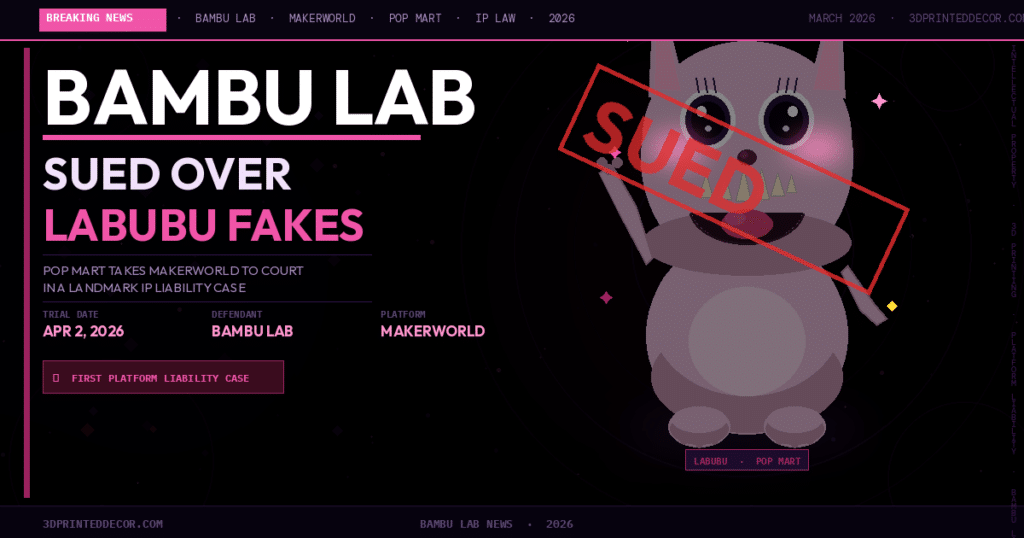
Bambu Lab Is Being Sued Over 3D-Printed Labubu Fakes — Here’s the Full Story
Chinese toymaker Pop Mart has taken Bambu Lab’s MakerWorld platform to court over user-uploaded Labubu knockoff files. The trial is set for April 2, 2026 — and the outcome could reshape how 3D printing platforms handle IP enforcement forever.
When you think of Bambu Lab, you probably think of fast, reliable 3D printers — the A1, the P1S, the X1C. What you likely don’t picture is the company sitting across a courtroom table from the makers of one of China’s most viral toys.
Yet that’s exactly where things stand heading into April 2026. Pop Mart — the company behind the wildly popular Labubu character — has filed suit against Bambu Lab and its MakerWorld file-sharing platform, alleging that the platform enabled copyright infringement by hosting user-created knockoff 3D print files of the grinning, fuzzy dolls. The trial date is April 2nd.
This isn’t just a story about one toy brand chasing down counterfeit files. It’s a landmark case that asks a question the 3D printing world has never had to answer in court before: when users on your platform infringe IP, are you — the platform — liable?
What Is Labubu — and Why Does Pop Mart Care So Much About Fakes?
Labubu is a wide-eyed, pointy-toothed monster character created by Hong Kong–based artist Kasing Lung and commercially distributed by Pop Mart through their popular blind-box collectible format. The toys went genuinely viral around 2023, fueled by celebrity sightings and social media unboxing content. For a period, limited-edition Labubu figures were commanding two to three times their retail price on secondary markets.
The character is notable for being an entirely Chinese-owned intellectual property — and Chinese authorities have shown consistent enthusiasm for protecting it. Counterfeit physical Labubu toys have faced aggressive enforcement actions domestically, so it’s not surprising that Pop Mart would eventually turn its attention to 3D printable versions as well.
Pop Mart’s stock has been declining as Labubu’s hype cycle winds down. Industry analysts have noted that the company’s aggressive stance on counterfeits — even against comical 3D-printed versions — may be a strategic move to shore up the brand’s perceived exclusivity as it prepares to push its next character, Hirono, into the spotlight.
What Is MakerWorld and How Does It Fit Into the Bambu Lab Ecosystem?
MakerWorld is Bambu Lab’s official 3D model file-sharing community — roughly equivalent to Printables (Prusa’s platform) or Thingiverse, but tightly integrated with Bambu Studio software and Bambu Lab printers. Users upload print-ready files, and the platform handles discovery, ratings, remixes, and downloads.
For Bambu Lab, MakerWorld isn’t just a community perk — it’s a meaningful part of their product ecosystem. If you own a Bambu Lab A1 or a Bambu Lab A1 Mini, MakerWorld is where you go to find pre-sliced, one-click-print files optimized for your specific machine. That tight integration makes MakerWorld considerably stickier than generic file repositories — and also means Bambu Lab has more direct control over what’s on the platform than arms-length sites might claim.
A Timeline of Events: From Viral Toy to Courtroom
- 12023Labubu goes viral globallyPop Mart’s Labubu blind-box toys explode in popularity across social media, driven by celebrity endorsements and limited-edition scarcity. A secondary resale market emerges almost immediately, with prices inflating significantly above retail.
- 22023–20253D printable knockoff files spread across platformsFan-made and counterfeit Labubu models begin appearing across major 3D printing repositories worldwide — including MakerWorld, Printables, Thingiverse, Thangs, and Cults3D. Most treat them as harmless fan art in a long-standing gray area of maker culture.
- 3Early 2026Pop Mart files suit against Bambu Lab in ChinaPop Mart names Bambu Lab and MakerWorld as defendants in a Chinese court, alleging the platform enabled IP infringement by hosting Labubu knockoff files. A trial date of April 2, 2026 is set. This marks the first time a 3D printing file platform — rather than an individual uploader — has been named as a defendant in this type of action.
- 4February–March 2026Bambu Lab removes all Labubu content from MakerWorldBambu Lab executes a broad takedown of Labubu and Labubu-adjacent files. An automation error during the process causes dozens of completely unrelated user models — printer mods, cable clips, paint brush holders, locksmith tools — to be delisted alongside the targeted content.
- 5March 2026Bambu Lab apologizes; most models restoredFollowing user complaints on Reddit and the MakerWorld Community Forum, Bambu Lab issues a public apology acknowledging the operational error and confirms most mistakenly removed models have been restored. Users with still-missing files are directed to submit support tickets.
- 6April 2, 2026Trial begins in Chinese courtThe case proceeds. The outcome will set a precedent for how 3D printing platforms across China — and potentially globally — are expected to proactively police infringing content on their platforms.
How Did Bambu Lab Respond — and What Did They Get Wrong?
Bambu Lab moved quickly once the suit was filed, removing Labubu content from MakerWorld entirely. But the execution exposed a gap between the platform’s stated commitment to creator protection and its actual technical capabilities for targeted content removal.
The mass takedown swept up files that had nothing to do with Pop Mart’s IP. A locksmithing tool set, a collection of printer cable clips, paint brush holders, and other completely original user creations were pulled offline alongside the infringing models. The community reaction on Reddit and Bambu’s own forums was swift and vocal.
The irony here is pointed: Bambu Lab had, just weeks before, launched a Creator Copyright Protection Service — a tool specifically designed to help MakerWorld Exclusive Designers report their own files being stolen and redistributed elsewhere. The platform was actively building IP protection for its creators while simultaneously being sued for failing to protect someone else’s IP from its creators.
Why This Case Matters Far Beyond Labubu
The 3D printing community has operated for years under an informal understanding: fan art is fan art, nobody’s getting hurt, and takedown requests handle the edge cases. That framework has worked reasonably well in a world where platforms respond reactively to notices filed against specific files.
Pop Mart’s suit challenges that framework at the platform level. If the court rules that MakerWorld bears responsibility for what its users upload — rather than merely being obligated to remove infringing content once notified — it would introduce a proactive monitoring obligation that every 3D printing file platform in China would need to reckon with.
Key Legal Questions the Trial Will Address
- Does a 3D printing file platform have an affirmative duty to prevent IP-infringing uploads — or only a duty to remove them once notified?
- Does platform integration (Bambu Studio, one-click printing) make Bambu Lab more responsible for user content than a neutral file host?
- How should damages be calculated when the infringing content was free and the platform itself charged nothing for it?
- Does a platform’s commercial benefit from user-generated content affect its liability for what users upload?
Western platforms — Printables, Thingiverse, Thangs, Cults3D — are watching closely. As of March 2026, Labubu knockoff models remain freely available on all of them. None have issued proactive takedowns. If the Chinese court establishes a platform-liability precedent, the pressure to act may eventually reach Western repositories as well, particularly as IP holders become more aware of their enforcement options.
What Does This Mean If You Own a Bambu Lab Printer?
Practically speaking — very little, right now. This lawsuit has no effect on Bambu Lab hardware, Bambu Studio software, firmware updates, or the company’s ability to sell and support printers. Your Bambu Lab A1, P1S, or any other machine will continue working exactly as before.
MakerWorld itself also continues operating normally — minus the Labubu content. For the vast majority of users who were downloading legitimate files, nothing has changed. The models that were accidentally caught in the mass takedown have largely been restored.
The longer-term implications depend entirely on the trial outcome:
- If Bambu Lab wins: The current reactive takedown model is validated. Platforms remove infringing content when notified; they’re not expected to proactively police uploads. MakerWorld continues as-is.
- If Pop Mart wins: Bambu Lab — and likely every other Chinese 3D printing platform — faces pressure to implement proactive content scanning and filtering. This could mean stricter upload reviews, automated model scanning, or restrictions on certain character-adjacent content categories.
Bambu Lab in 2026: Where the Printer Lineup Stands
Whatever happens in court, Bambu Lab’s position as the dominant force in consumer desktop 3D printing remains intact heading into 2026. Their printer lineup spans beginner-friendly open-frame machines to fully enclosed multi-material systems — and the MakerWorld ecosystem, despite this controversy, remains one of the best-integrated file libraries in the space.
If you’re evaluating Bambu Lab hardware right now, here’s where to start:
Frequently Asked Questions About the Bambu Lab Lawsuit
Our Take: What Happens Next
The April 2 trial date will be one of the most closely watched legal events in the 3D printing world this year. A ruling in Pop Mart’s favor would put every community-driven file platform on notice that passive content moderation isn’t enough — that platform operators may have an affirmative duty to proactively police uploads for IP violations.
A ruling for Bambu Lab would reinforce the notice-and-takedown model that has governed online platforms for decades, extending those protections into the maker space.
Either way, Bambu Lab’s hardware business is unaffected, their printer lineup remains compelling, and the MakerWorld community continues to function. If you’ve been on the fence about a Bambu Lab machine, this lawsuit isn’t a reason to wait. The company’s fundamentals are strong, and the printers themselves are best-in-class for their price points.
More Bambu Lab coverage: Black Friday Deals · P2S vs P1S vs X1C · A1 vs K2 Plus vs Kobra 3 Max · Bambu Lab vs Competitors 2025
Related posts:
 Nike Unveils the Groundbreaking 3D-Printed Air Max 1000
  The Best 3D Printers for Kids and Teens 2025 Amazon
  Bambu Lab P1S vs A1 Mini: Making the Right 3D Printer Choice
  Live Black Friday 3D Printer Offers 2025 – Updated Hourly – Save Up to $400!
  Black Friday 3D Printer Deals Reddit – What 500+ Users Are Actually Buying (2025)
  Bambu Lab 3D Printer Review 2026: Real User Experience After 1000+ Hours