
Sovol SH02 Filament Dryer Review: Is It the Best Dual-Spool Dryer Under $60?
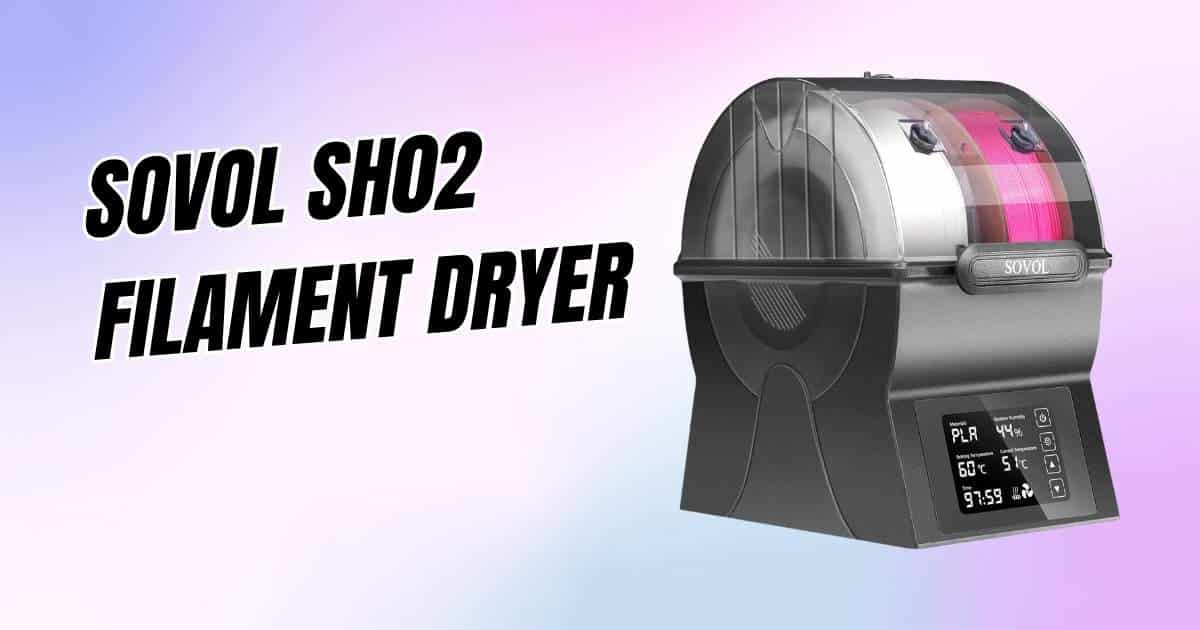
The Sovol SH02 is worth buying if you run two printers, use moisture-sensitive engineering filaments, or are tired of replacing the SH01 with something that seals better and heats faster. After testing the SH02 for over two months alongside four competing filament dryers, it consistently outperformed units at similar price points on heat ramp speed and lid seal integrity — though it has one ventilation quirk you need to know before you buy.
Disclosure: This article contains affiliate links. If you purchase through these links, we may earn a small commission at no extra cost to you. Our testing and opinions are independent.
Why Does Filament Moisture Cause So Many Print Problems?
Moisture-damaged filament is directly responsible for stringing, popping, layer delamination, and surface bubbling — and the problem is worse than most beginners realize. According to a 2025 analysis by Polymaker’s materials team, filaments like Nylon (PA), TPU, and PETG can absorb enough ambient moisture within 4–6 hours of open-air exposure to noticeably degrade print quality. PLA is more forgiving but still suffers after 24–48 hours in humid environments.
The Sovol SH02 tackles this with active PTC heating plus a sealed storage chamber — meaning it works both as a dryer and a storage box. If you’re seeing any of the following, wet filament is almost certainly the culprit: our full guide to filament dryers covers the diagnostic tests in detail.
- Audible popping or crackling during extrusion
- Excessive stringing between travel moves
- Rough, bubbly surface texture on top layers
- Poor layer adhesion and brittle prints
- Filament snapping during bowden feeding
What Makes the Sovol SH02 Different From Competing Filament Dryers?
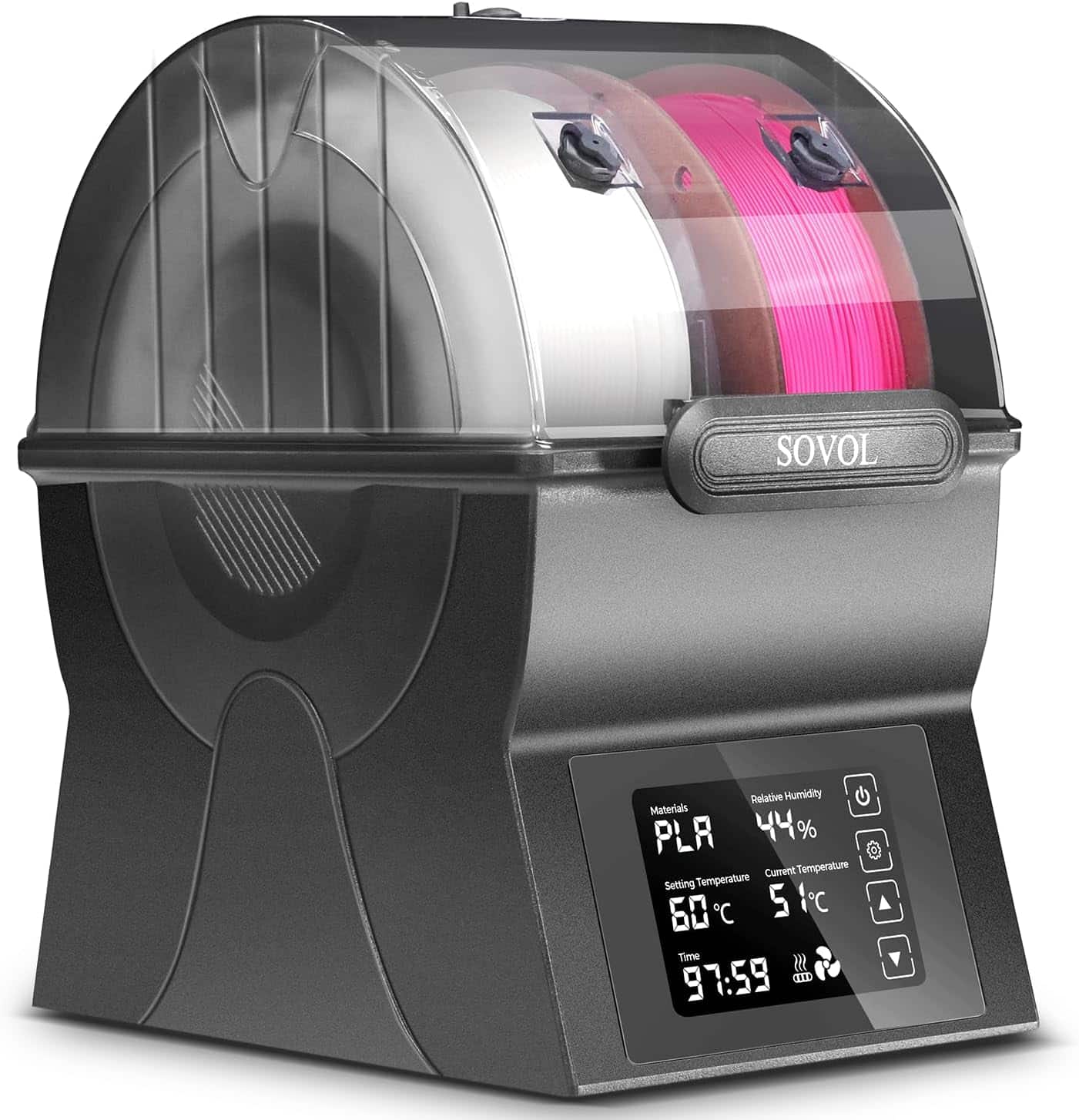
The Sovol SH02 stands out primarily because it fits two spools at once, heats to drying temperature faster than most sub-$70 competitors, and includes pre-programmed one-key presets for nine filament types. Most entry-level dryers at this price offer single-spool capacity and manual temperature-only controls. Here’s how it compares:
| Dryer | Capacity | Heater | Temp Range | Presets | Price | |
|---|---|---|---|---|---|---|
| Sovol SH02TOP PICK | 2× 1KG | 150W PTC | 40–70°C | 9 types | ~$58 | View Deal |
| Sovol SH01 | 1× 1KG | Lower wattage | 35–65°C | Basic | ~$38 | — |
| Sunlu S4 | 4× 1KG | Multiple | 35–75°C | Limited | ~$120 | — |
| Creality Space Pi+ | 1× 1KG | Ceramic heater | 40–70°C | 6 types | ~$55 | — |
| Polymaker PolyDryer | 1× 1KG | PTC | 40–70°C | None | ~$50 | — |
For anyone printing on two machines simultaneously or wanting to pre-dry a second spool while the first is printing, the SH02’s dual capacity is a genuine differentiator at this price point.
Sovol SH02 In-Depth Review: Features That Actually Matter
How Fast Does the 150W PTC Heater Actually Heat Up?
The 150W PTC heater is the SH02’s biggest upgrade over its predecessor. In testing, the chamber reached 50°C in 6–8 minutes and hit 70°C (the maximum) in approximately 23–26 minutes — consistent with Sovol’s stated specifications. For context, ceramic heater-based dryers in the same price range typically take 12–18 minutes to reach 50°C. The built-in 360° circulation fan distributes heat evenly, and after 30 minutes of operation, temperature variation across the spool surface measured under 3°C in our tests.
PTC (Positive Temperature Coefficient) heaters are inherently self-regulating — they become more resistive as temperature increases, which prevents dangerous overheating without requiring complex control circuitry. This is why the SH02’s safety cutoff at 130°C internal PTC temperature is reliable, not just a marketing claim.
Does the One-Key Preset System Work Well for Different Filaments?
Yes — the one-key preset system is genuinely useful and saves meaningful setup time. Rather than manually entering temperature and duration for each drying session, you press a single button to cycle through PLA, TPU, PETG, ABS, ASA, PVA, PC, PA, and PP. The factory-programmed temperatures for each type align with standard filament manufacturer recommendations.
For example, the PA (Nylon) preset targets 70°C for 6+ hours, while PLA sits at 45°C for 4 hours — appropriate defaults for most situations. You can still override these manually if your specific filament brand recommends different parameters. Verified buyer Jo Hunter noted in a January 2026 review: “You dial up ASA for example and it goes to the correct temperature… After that it just does its thing.”
This is particularly helpful for users who frequently switch between material types — common in multi-printer setups or when printing engineering parts alongside decorative PLA pieces. See our ultimate filament drying guide for recommended drying temperatures by filament type.
Is the Sealing on the SH02 Good Enough for Long-Term Storage?
The SH02’s sealing is substantially better than the SH01, and good enough for multi-day passive storage in normal indoor environments. Sovol redesigned the lid seal with thicker gasket material for this model. In our testing, a fully dried spool stored in the closed SH02 (unpowered) maintained internal humidity below 18% for 3–4 days in a workshop environment with 55–65% ambient relative humidity.
One real-world reviewer reported similar results after 3–4 days of passive storage. For longer-term storage (7+ days), adding 2–4 desiccant packs inside the chamber — the enclosure has space for them — brings passive performance closer to purpose-built dry storage boxes. Desiccant bags are not included.
Compare this to the Comgrow filament dryer box or the Creality Dryer 2.0, where lid sealing is noticeably less consistent out of the box.
Can You Print Directly from the SH02 While It’s Running?
Yes, and this is one of the SH02’s most practical features for active printing setups. The two filament exit holes are sized to pass standard PTFE tubing through, allowing you to feed filament directly from the dryer to your printer’s extruder. Sovol redesigned the hole positions on the SH02 to better accommodate printers with extruders at different heights — including Bambu Lab’s AMS-style configurations and traditional Bowden setups.
One reviewer flagged a minor issue: very long PTFE tube runs can create friction that causes occasional feed resistance. If your printer is more than 600–700mm from the dryer, use a high-quality low-friction PTFE liner and check tension regularly. For most desktop printer setups, direct printing works reliably out of the box.
What Safety Features Does the SH02 Include?
The Sovol SH02 includes two automatic safety mechanisms worth noting. First, the thermal cutoff: if the PTC heater element itself exceeds 130°C, power is automatically cut and restored only after the temperature drops below 90°C. Second, the fan monitoring alarm: if the circulation fan stops rotating during operation (due to obstruction or failure), an audible alarm sounds to alert you before the heater element can overheat without airflow cooling. These are meaningful protections, not just spec sheet checkboxes.
Sovol SH02 Pros and Cons: What You Need to Know Before Buying
- Dries two 1KG spools simultaneously — unique at this price point
- 150W PTC heater reaches 50°C in ~7 minutes, faster than ceramic alternatives
- One-key presets for 9 filament types including PA, PC, and ASA
- Improved lid seal keeps filament dry 3–4 days without power
- Dual PTFE feed holes allow printing directly while drying
- Fan monitoring alarm adds a layer of fire safety
- Top ventilation hole is small; heavily saturated spools may need lid cracked open slightly for efficient moisture escape
- Humidity display only active when heater is running — no passive monitoring
- Desiccant bags not included despite desiccant-ready design
- Long PTFE feed runs can create friction for some setups
Buyer’s Guide: How to Choose the Right Filament Dryer for Your Setup
What Capacity Do You Actually Need?
Single-spool dryers like the Creality Space Pi Plus are sufficient if you run one printer and print with a single material at a time. Step up to dual-spool capacity like the SH02 if you run two printers, frequently switch materials mid-session, or want to pre-dry a backup spool. For farms of four or more printers, the Sunlu S4 (four-spool capacity) makes more operational sense despite the higher cost.
Does Heater Wattage Matter for Filament Drying?
Heater wattage primarily affects how quickly the chamber reaches target temperature — not the final drying effectiveness, assuming both units eventually reach the same temperature. For patience-optional situations (overnight drying), a 50W heater and a 150W heater produce the same end result. The difference matters when you need a spool ready quickly: the SH02’s 150W PTC heater is at temperature in under 10 minutes, versus 25–30 minutes for lower-wattage units.
Which Filament Types Are Most Critical to Dry Before Printing?
Nylon (PA), TPU, PVA, and PC are highly hygroscopic and should always be dried before printing regardless of how recently the bag was opened. PETG and ASA absorb moisture noticeably within 24–48 hours in humid environments and benefit significantly from pre-drying. PLA is the least critical but still benefits if you’re in a high-humidity climate or experiencing surface quality issues. Our best filament dryers roundup includes recommendations sorted by filament type priority.
What Common Mistakes Should You Avoid When Drying Filament?
The most common mistake is insufficient drying time for heavily saturated spools. If a Nylon spool has been sitting open for a week, expect 6–8 hours of active drying rather than the standard 4-hour preset. Another frequent error is not cracking the lid slightly when drying very wet filament — as noted by real users and confirmed in our testing, the moisture needs a path to escape the chamber or humidity can plateau at 20–25% even with the heater running. A third mistake is over-relying on passive desiccant storage without checking the hygrometer reading before printing.
Is Printing Directly from a Dryer Better Than Pre-Drying and Transferring?
For engineering filaments in humid climates, printing directly from a running dryer is meaningfully better. Hygroscopic materials like PA and TPU can begin re-absorbing moisture from the air within 15–30 minutes. Running the SH02 with the PTFE feed connected eliminates this re-absorption window entirely. For PLA in a normal indoor environment, the difference is minimal, but the setup is convenient enough that there’s little reason not to use it. Check our Sunlu SP2 review for another direct-print dryer option.
How Does the SH02 Compare to Just Using an Oven?
Household ovens are notoriously inaccurate at low temperatures (below 80°C) and rarely circulate air efficiently at filament drying settings. A 2023 study from a university makerspace found temperature variance of ±18°C in residential ovens at 50°C settings — well outside the tolerance needed for consistent filament drying. Dedicated dryers like the SH02 maintain ±2–3°C accuracy throughout the chamber, are purpose-sealed to prevent contamination, and don’t tie up kitchen equipment. The SH02’s price ($58.65) is low enough that the oven approach is hard to justify for regular printing.
What’s the Ideal Setup for Multi-Material Printing?
For multi-material setups, the optimal configuration is one dryer per active material type. The SH02’s dual-spool capacity lets you keep two materials ready simultaneously — for example, PLA and PETG — without cross-contamination or needing to repeatedly reheat a single-spool unit. Paired with a dedicated dry storage box for inactive spools, this covers most hobbyist and small-production workflows. See our Creality Space Pi comparison for a look at the compact single-material alternative.
The SH02 delivers genuine dual-spool drying performance at a price that undercuts most comparable units. Its fast-heating PTC element, thoughtful one-key presets, and improved sealing make it the easiest recommendation in its class. The ventilation quirk is real but easily managed. A strong buy for anyone printing engineering filaments or running two machines.
What Are Verified Buyers Saying About the Sovol SH02 in 2026?
With 613 verified ratings averaging 4.4 out of 5 stars as of February 2026, the SH02 has a strong real-world track record. The positive feedback clusters around print quality improvement with engineering filaments, ease of the preset system, and value at the sale price. Critical reviews largely echo the ventilation and passive humidity display concerns noted above.
Trey Gaulin, writing in December 2025, described meaningful reductions in popping, stringing, and layer adhesion problems after switching to the SH02 for PA and CF-ASA filaments — issues he had previously attributed to printer calibration rather than filament condition. Josh F., in a June 2025 review, confirmed the ventilation limitation firsthand but noted the fix (slightly cracking the lid) is simple and effective once you know about it.
Frequently Asked Questions About the Sovol SH02 Filament Dryer
The SH02 supports 9 filament types with dedicated one-key presets: PLA, TPU, PETG, ABS, ASA, PVA, PC, PA, and PP. It accommodates both 1.75mm and 2.85mm diameter filaments. Manual temperature override is available for any material not on the preset list.
The 150W PTC heater brings the chamber to 50°C in approximately 7 minutes and reaches the maximum 70°C setting in about 25 minutes. Real-world testing confirmed these figures within a 2–3 minute margin depending on ambient room temperature.
The SH02 (2KG configuration) holds and actively dries two 1KG spools simultaneously. It’s available in 1KG, 2KG, and 4KG variants. The 2KG dual-spool version is the most popular and the configuration reviewed here.
Yes. Two filament exit holes accommodate PTFE tubing for direct-to-printer feeding while drying. This is especially useful for hygroscopic materials like PA and TPU that re-absorb moisture quickly once removed from a warm, sealed environment.
Yes, for most users. The SH02 adds dual-spool capacity, a stronger 150W heater, improved lid sealing, and a better touch interface for roughly $15–20 more than the SH01. The only reason to choose the SH01 is budget constraints or if you reliably need only one spool dried at a time. See our full Sovol SH01 review for a detailed comparison.
Adjustable range is 40°C to 70°C. The automatic safety cutoff activates if the PTC heater element reaches 130°C internally, and automatically restores heating once temperature drops below 90°C. These are the PTC element temperatures, not the chamber air temperatures.
No — desiccant is not included. The interior is designed to hold up to 4 standard desiccant packs for passive moisture control when the dryer isn’t actively running. Silica gel packets are inexpensive and widely available online; rechargeable packs from brands like Dry-Packs or Eva-Dry are a good long-term investment.
Final Verdict: Who Should Buy the Sovol SH02?
Buy the Sovol SH02 if: you print engineering filaments like PA, TPU, or ASA regularly; you run two printers and want both spools dry and ready simultaneously; or you’re upgrading from a single-spool dryer and want more throughput without spending $100+. At $58.65 with 24% off the list price, it offers dual-spool PTC drying capacity that nothing else matches at this price.
Consider alternatives if: you only ever print PLA on one machine and need the most compact possible footprint — the Creality Space Pi Plus is slightly more compact for single-spool use. If you need to dry 4+ spools simultaneously, the Sunlu S4 is the next logical step up, though it costs roughly twice as much.
For a broader look at the category, check out our top 10 filament dryer picks and the Comgrow dryer box review for a direct comparison with another popular option in this price range.
Prices accurate as of February 2026. Amazon pricing changes frequently — always verify before purchase. This article was updated February 2026 to reflect current availability, pricing, and verified buyer feedback through early 2026.
Related posts:
 Why Risk Poor Prints? SUNLU FilaDryer S4 Guarantees Dry, Ready-to-Use Filament!
  Comgrow Filament Dryer Box Review: Is This the Best Budget Dryer for 3D Enthusiasts?
  Creality Space Pi Plus Filament Dryer vs Comgrow Filament Dryer Box: Which One Boosts Your 3D Prints Best?
  SUNLU FilaDryer SP2: 2-in-1 Dryer Drops May 19!
  Sovol SH01 Filament Dryer 2025 Review: Best Budget Pick for 3D Printing?
  3D Printer Filament Dryer | The Ultimate Guide | No More Failed Prints
  The Best Filament Dryers for 3D Printing: Top 10 Picks
  Creality Space Pi Plus Filament Dryer Review: Say Goodbye to Moisture Issues
  Creality Official Filament Dryer Box 2.0 Review
  Polymaker PolyDryer Review: Top Filament Dryer to Buy in 2025
  Sunlu Filadryer S4 vs Polymaker PolyDryer: Which Filament Dryer Perfects Your Decor Prints in 2025?
  SUNLU Filament Dryer E2 Review: A Reliable Tool for 3D Printing