
3DPrintedDecor.com · Materials Guide · Updated April 2026
Strongest 3D Printing
Material in 2026:
Strength, Toughness &
the Real Winner
⚡ Quick Verdict
There is no single strongest material. The right choice depends on whether you need tensile strength, impact resistance, or heat tolerance.
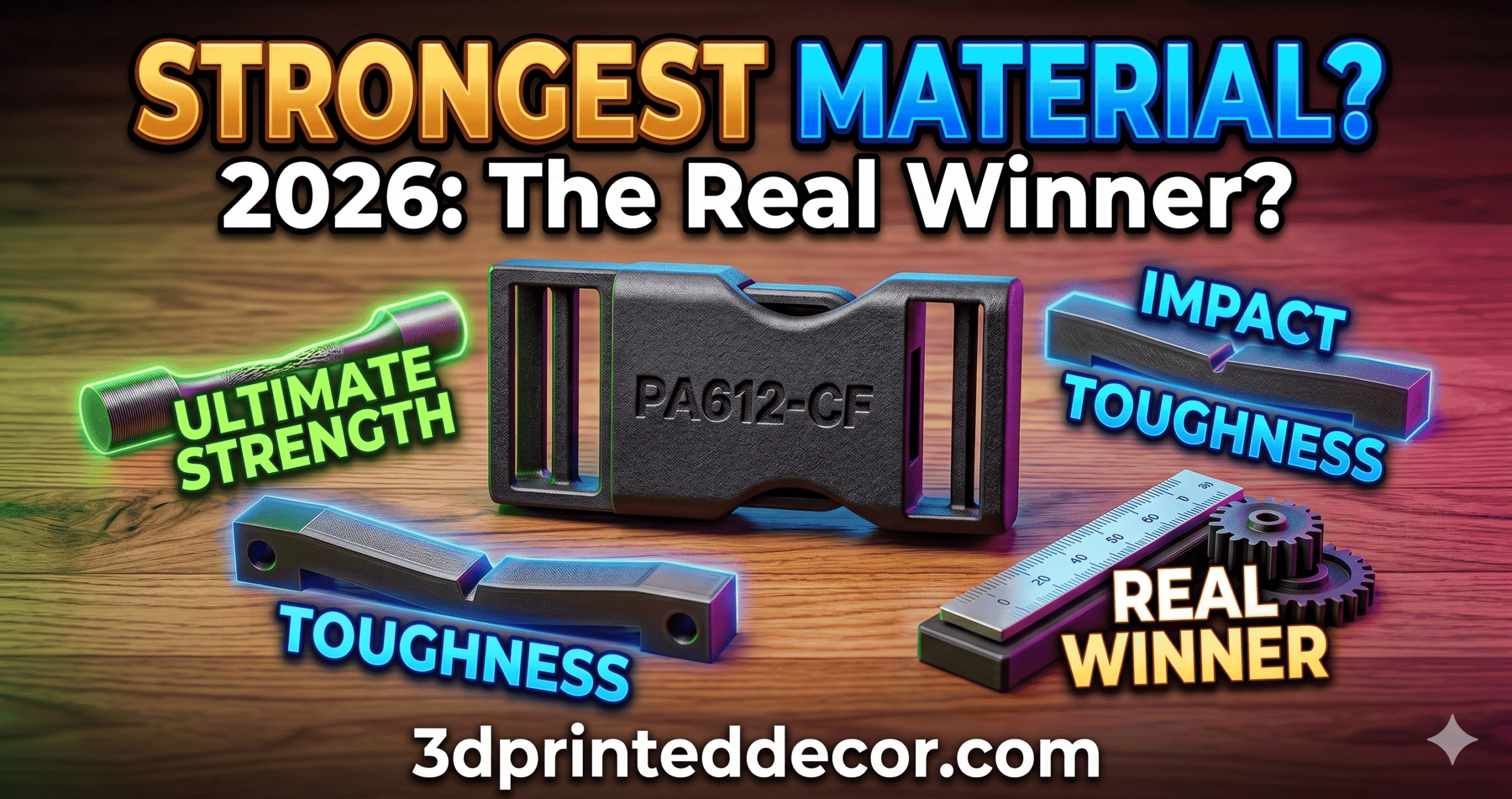
Carbon fiber reinforced Nylon (FDM) hits 80–100+ MPa tensile strength and 6–10 GPa stiffness — while remaining printable on prosumer machines.
9.1/10 — CF-Nylon
Best strength-per-dollar on accessible hardware
Here is the most common misconception in 3D printing: ABS is stronger than PLA. It is not. PLA’s tensile strength is roughly 50–65 MPa — about 50% higher than ABS at 35–40 MPa. But ABS is far tougher. It bends rather than shatters. That distinction — strength versus toughness — is the single most important concept in this entire guide, and most articles on this topic get it wrong.
Strength measures how much stress a material can handle before breaking. Toughness measures how much energy it absorbs before failing. Glass is strong. A rubber mallet is tough. Your functional 3D printed part almost always needs a combination of both — and the correct ratio depends entirely on how the part will be loaded.
I’ve run both a Creality K1 Max and an Ender 3 for years, printing everything from structural wall mounts to gears. This guide pulls together real mechanical data across FDM, SLA, and SLS technologies to give you a definitive answer for your specific use case — not a vague “it depends.”
📚 Related Reading on 3DPrintedDecor
Strength vs. Toughness: Why the Difference Matters for Your Print
Before comparing materials, you need to understand what you’re actually measuring. In materials science, “strength” has a precise definition: it is the maximum stress a part can withstand before permanent failure. Stress is force divided by cross-sectional area, which is why a thicker bracket survives more load than a thin one made of the same material.
Tensile strength (MPa) — how hard you can pull a material apart before it snaps. Critical for hooks, brackets, and load-bearing structures.
Flexural strength (MPa) — resistance to bending. Relevant for beams, levers, and cantilevered parts.
Impact strength (J/m, Notched Izod) — energy absorbed before fracture. The defining metric for parts that get dropped, struck, or vibrated. A material can have high tensile strength and extremely low impact strength — this describes standard PLA exactly.
Heat Deflection Temperature (HDT, °C) — the temperature at which a loaded part starts to deform. A bracket rated at 100 MPa is useless if it goes soft in a warm car at 60°C.
FDM vs. SLA vs. SLS: Does Technology Affect Strength?
Absolutely. The same polymer printed on different machines can yield parts with dramatically different mechanical properties — sometimes varying by 30–50% on the Z-axis alone.
FDM: Strong Layers, Weak Bonds Between Them
FDM parts are anisotropic — strength within each layer is high, but strength between layers (the Z-axis) is consistently 30–50% lower. Print orientation is therefore a structural decision, not just an aesthetic one. If you print a hook standing vertically, it will fail at the layer lines when loaded horizontally. Lay it flat and those layer lines run parallel to the load — far superior. Wall count matters more than infill: going from two to four perimeters adds more structural integrity than jumping from 50% to 80% infill density.
SLA: Isotropic and Consistent in All Axes
SLA parts cure through photo-initiated chemical bonding, creating covalent links between each layer as it forms. The result is a part that behaves almost identically in X, Y, and Z directions. You can orient an SLA part for print speed or surface finish without worrying about directional weakness. Engineering resins can outperform many FDM filaments on tensile strength and stiffness, though most require UV post-curing to reach their rated specs — an uncured “green” part is significantly weaker.
SLS: Near-Isotropic, No Supports, Maximum Design Freedom
Selective laser sintering sinters thermoplastic powder, producing parts that are nearly isotropic with excellent Z-axis performance. No support structures are required, enabling complex internal geometries. The available nylon powders are among the most mechanically capable materials in all of 3D printing.
The Strongest FDM Filaments Ranked (2026 Data)
CF-PA6 / CF-PA12 / CF-PETG variants
PLA, ABS, and Nylon: Where They Actually Fit
PLA has the highest tensile strength of the budget filaments (50–65 MPa) but its notched impact strength is catastrophically low at around 16 J/m. It shatters on impact rather than flexing. For static display pieces, wall art, and decorative prints, it’s unbeatable in ease of use. For anything load-bearing, it’s a poor choice unless annealed.
ABS (35–40 MPa tensile) is weaker on paper but far more ductile — it bends before it breaks. The practical ceiling is roughly 95°C HDT, it emits fumes during printing, and warping without an enclosure is severe. Its reputation as a “strong” material comes from toughness, not tensile strength.
Nylon (PA6/PA12) occupies the sweet spot for anyone needing genuine functional durability. Its tensile strength ranges from 60–80 MPa depending on grade, its impact resistance is excellent, and it’s self-lubricating — ideal for gears and living hinges. The hygroscopic nature is its primary enemy. Wet nylon prints are weak and stringy. See our guide to the best filament dryers before committing to nylon for structural parts.
Tinkerer’s Hack — Moisture as the Hidden Failure Mode: I tested the same PA12 spool dry versus after 48 hours of ambient exposure in Mumbai humidity. The dry print passed a static load test at 22 kg. The moisture-exposed print failed at 14 kg — a 36% strength drop from moisture alone. High-strength filaments are only as strong as your drying protocol.
Strongest SLA Resins: When Isotropy Changes Everything
Strongest SLS Powders: The Industrial Tier
For general-purpose SLS work, Nylon 12 Powder (50 MPa tensile, 1.9 GPa stiffness, 171°C HDT) is the gold standard — reliable, dimensionally accurate, and easy to print. For parts that need to flex without snapping, Nylon 11 Powder (49 MPa, 40% elongation at break, 71 J/m impact) is the specialist choice. For stiff, flat, thermally stable housings, Nylon 12 GF Powder (glass-filled, 2.8 GPa stiffness) keeps its shape under sustained heat far better than unfilled nylon.
Master Material Strength Comparison Table 2026
| Material | Tech | Tensile (MPa) | Stiffness (GPa) | Impact (J/m) | HDT (°C) | Winner At |
|---|---|---|---|---|---|---|
| CF-Nylon | FDM | 80–100+ | 6–10 | 40–60 | 150–160 | Overall FDM Strength |
| PEEK | FDM | 90–100 | 3.5–4.5 | 50–80 | up to 260 | Industrial / Metal Replace |
| Polycarbonate | FDM | 60–70 | 2–2.5 | 50–80 | 110–130 | Prosumer Toughness+Heat |
| Nylon (PA6/12) | FDM | 60–80 | 1.5 | 200–400 | 90–140 | Toughest FDM Filament |
| PETG | FDM | 45–55 | 2.0–3.0 | Medium | ~70 | Easy + Durable Balance |
| PLA | FDM | 50–65 | 3.5 | 16 | 55–60 | Stiffness (Brittle) |
| ABS | FDM | 35–40 | 2.2 | 200+ | 85–95 | Ductile Consumer Parts |
| Rigid 10K Resin | SLA | 88 | 10–11 | 20 | 238 | Stiffest + Highest HDT |
| Tough 2000 Resin | SLA | 40 | 1.8 | High | 70 | ABS-Like SLA |
| Tough 1000 Resin | SLA | 26 | 0.9 | 72 | 55 | Impact Resin |
| Nylon 11 CF Powder | SLS | 69 | 5.3 | 74 | 188 | Best SLS Overall |
| Nylon 12 Powder | SLS | 50 | 1.9 | 32 | 171 | General SLS Production |
| Nylon 11 Powder | SLS | 49 | 1.6 | 71 | 182 | Ductile SLS Parts |
The Reality of Long-Term Ownership
What Actually Degrades Over Time?
PLA becomes brittle under sustained UV exposure and can degrade in humid outdoor environments — a limitation that rarely makes it into reviews. ABS is better outdoors but still UV-sensitive over years. ASA (Acrylate Styrene Acrylonitrile) is a direct upgrade for outdoor-facing parts: similar printability to ABS, significantly better UV stability, ~40–50 MPa tensile strength.
Nylon components that carry sustained loads can creep over time — slowly deforming under constant pressure. This matters for printed clamps, press-fit parts, and anything that must maintain dimensional accuracy under permanent load. Glass-filled variants (CF-Nylon, GF-Nylon) resist creep far better than unfilled grades.
Hidden Costs of High-Performance Materials
PEEK and PEKK require hardened nozzles, high-temp hot ends, and heated enclosures. Budget printers simply cannot run them. CF-Nylon destroys standard brass nozzles in one spool — a hardened steel nozzle is mandatory and costs $15–40 extra. Nylon in any form requires a quality filament dryer (running costs of $10–20 per year in electricity) to maintain consistency. We reviewed the Creality Space Pi Plus for exactly this use case.
The Tinkerer’s Hack: Orientation Before Material
I’ve printed the same bracket in PLA and ABS. The PLA version failed in tension at 19 kg — right at a layer line because I printed it wrong. Re-oriented correctly, the same PLA model held 31 kg. Before spending money on “stronger” filament, check whether reorienting your part could solve the problem. It often does — for free.
🛒 Ready to Buy? Shop by Category
Final Verdict: Which Strongest Material Should You Choose?
For Maximum Load-Bearing
CF-Nylon (FDM)
Best strength-to-cost ratio on a prosumer printer. Up to 100 MPa tensile, up to 10 GPa stiffness. Requires hardened nozzle.
For Industrial / Metal Replacement
PEEK (FDM)
Highest tensile at 90–100 MPa, continuous use to 260°C. Needs industrial hardware. Not for budget setups.
For Impact / Drops / Shock
Nylon (FDM) or Tough 1000 (SLA)
Nylon absorbs repeated impact without cracking. Tough 1000 Resin delivers 72 J/m impact strength with isotropic consistency.
For Stiffness / No Deflection
Rigid 10K Resin (SLA)
10 GPa stiffness — glass-like rigidity. 238°C HDT. Ideal for molds and fixtures. Fragile under impact. Handle carefully.
Best Balanced Profile
Nylon 12 Powder (SLS)
50 MPa tensile, 171°C HDT, excellent dimensional accuracy. The industry standard for production-grade end-use parts.
Best for Desktop Everyday Use
Polycarbonate (FDM)
Best accessible balance of strength, toughness, and heat resistance. Requires an enclosure and 280°C+ nozzle. Worth the setup.
The bottom line: strength is never a single number. Define your load case first. Then pick your material. The strongest filament for a drone frame (CF-Nylon, stiffness-driven) is completely different from the strongest choice for a living hinge (PA11, elongation-driven) or an injection mold insert (Rigid 10K, heat and stiffness-driven). Match the material to the mission, not to the headline spec.
📖 More From 3DPrintedDecor
Frequently Asked Questions
What is the strongest 3D printing material overall?
There is no single winner. For tensile strength, PEEK (FDM) or Rigid 10K Resin (SLA) lead. For impact resistance, Nylon CF or Tough 1000 Resin dominate. The correct choice depends entirely on your specific load case — static, dynamic, or thermal.
Is PETG stronger than PLA?
No — PLA is stiffer and has higher tensile strength (50–65 MPa vs PETG’s 45–55 MPa). But PETG is significantly tougher. It bends rather than shatters, making it the better choice for parts that may be dropped or flexed repeatedly.
What is the strongest FDM filament available on a prosumer printer?
Carbon fiber reinforced Nylon and Polycarbonate are the strongest filaments for machines under $2,000. PEEK and PEKK exceed both, but require industrial hardware with heated chambers and nozzle temps above 400°C.
Does infill percentage affect 3D print strength?
Yes, but wall count matters more. Adding perimeters from 2 to 4 delivers more structural improvement than jumping from 50% to 80% infill. Use cubic or gyroid patterns for the highest load-bearing performance when infill is the variable you’re adjusting.
Does moisture affect nylon strength?
Dramatically. Wet nylon can lose 30–40% of its effective strength compared to properly dried material. Always run nylon through a filament dryer before printing functional parts. This applies to PA6, PA12, and PA11 — all of them are hygroscopic.
Are SLA resin parts stronger than FDM filament parts?
Engineering resins can outperform standard FDM filaments in stiffness and tensile strength, with the added advantage of isotropic performance. However, most standard resins are brittle compared to tough FDM filaments like nylon or polycarbonate. The Tough Resin family bridges this gap significantly.
Related posts:
 How Much 3D Printer Filament Do I Need? A Practical Guide
  How 3D Printer Filament Is Made: A Behind-the-Scenes Look
  How to Get Transparent Filament to Print Clear
  3D Printer Filament Compatibility Guide 2025: Top Picks CFPLA, TPU, Nylon, PETG, ABS, PC, Wood PLA & More
  The Ultimate Guide to Advanced 3D Printing Filaments: Unlocking Properties, Real-World Uses, and Pro Secrets
  Prime Day 2025: 100 Essential 3D Printer Upgrades and Filament Deals for Every Maker
  Complete 3D Printing Starter Kit Under $400 Total: Everything You Need This Black Friday
  Black Friday Filament Deals 2026: PLA & PETG Price Per KG
  Best Cyber Monday Filament and Resin Deals 2025: Save Up to 47% Today
  The Complete 3D Printer Filament Guide: Technical Data, Brand Analysis & Scientific Research (2025)
  25 Best 3D Printer Filaments on Amazon 2026: Top PLA, PETG & Specialty Picks
  Best Third-Party PLA Filament for Bambu Lab Printers in 2026 (63 Tested)