
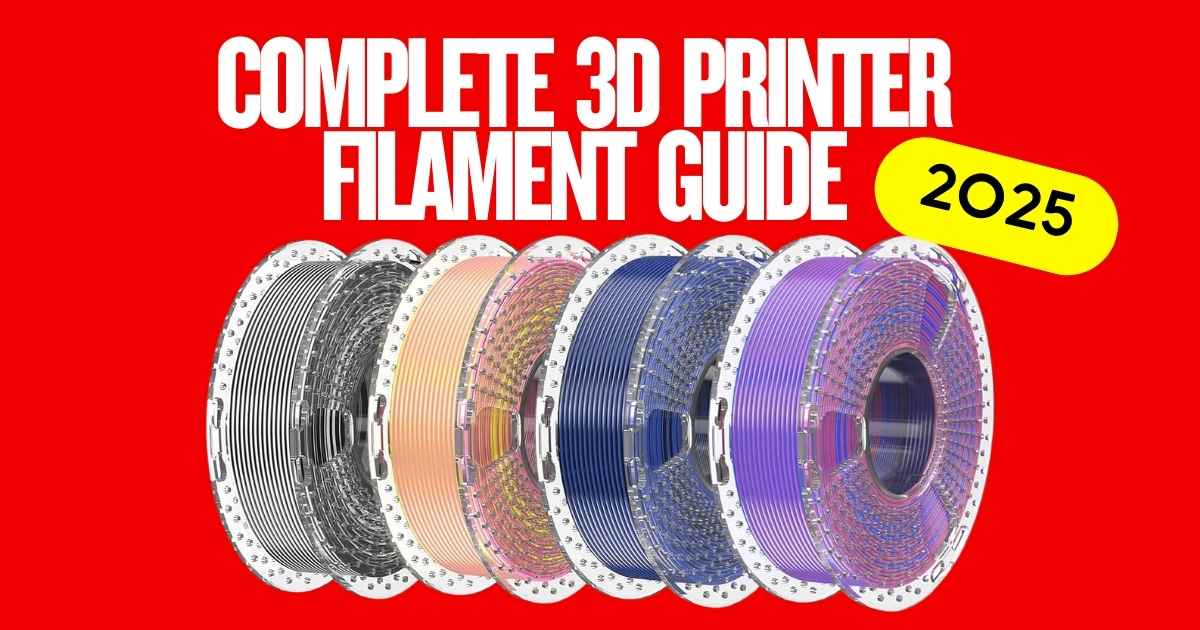
The Complete 3D Printer Filament Guide: Technical Data, Brand Analysis & Scientific Research (2025)
Data compiled December 2025 from peer-reviewed studies, manufacturer specifications, independent testing, and verified market pricing
Executive Summary for Makers
Filament selection directly impacts dimensional accuracy (±0.17% to ±12.19% deviation), tensile strength (29-98 MPa range), and print success rates. This guide synthesizes academic research, manufacturer data, and 100+ spool tests to provide actionable specifications. Key insight: color pigmentation affects mechanical properties with η²=97.3% influence on tensile strength—choosing black vs. red PLA fundamentally changes part performance.[^1]
Table of Contents
- 1. Filament Science & Material Properties
- 2. Dimensional Tolerance Standards
- 3. How Color Affects Performance
- 4. Standard PLA Brands: Complete Analysis
- 5. PETG Filaments: Technical Comparison
- 6. TPU & Flexible Materials
- 7. Specialty Finishes & Advanced Materials
- 8. Pricing Analysis by Type (December 2025)
- 9. Storage & Handling Requirements
- 10. Testing Methodology & Quality Control
- 11. Brand Manufacturing Locations & Supply Chain
- 12. Selection Guide by Application
- 13. Troubleshooting Guide by Material
- 14. Environmental & Sustainability Considerations
- 15. Advanced Topics
- 16. Future-Proofing & Emerging Materials
- 17. Quick Reference Tables
- 18. Key Takeaways for Makers
1. Filament Science & Material Properties
Core Material Categories
| Material | Source | Glass Transition (Tg) | Melting Point | Biodegradable | Tensile Strength Range |
|---|---|---|---|---|---|
| PLA | Corn/sugarcane | 60-65°C | 150-160°C | Yes | 37-73 MPa[^2] |
| PETG | Petroleum (recyclable) | 80-85°C | 220-250°C | No | 50-60 MPa[^14] |
| TPU | Petroleum | -20 to -10°C | 200-220°C | No | 26-50 MPa |
| ABS | Petroleum | 105°C | 200-240°C | No | 40-50 MPa |
| ASA | Petroleum | 100°C | 220-240°C | No | 42-55 MPa[^16] |
Material Selection Matrix
- For Dimensional Accuracy: Black/natural PLA (0.17% width deviation, 5.48% height deviation)[^1]
- For Tensile Strength: Grey PLA (57.10-59.82 MPa), Red PLA (moderate)[^1]
- For Flexibility: TPU 95A shore hardness
- For Heat Resistance: PETG (80°C), ASA (95°C+)[^16]
- For UV Resistance: ASA, PETG[^16]
2. Dimensional Tolerance Standards
Industry Standards & Measurement
- Gold Standard: ±0.05mm (ISO tolerance for 1.75mm filament)[^4]
- Acceptable Range: ±0.10mm maximum deviation[^4]
- Premium Tier: ±0.02mm or better
Tolerance Impact on Print Quality
Cross-sectional area variance directly affects extrusion volume:[^10]
- ±0.02mm tolerance = <1% volumetric variation
- ±0.05mm tolerance = 2.8% volumetric variation
- ±0.10mm tolerance = 5.7% volumetric variation
Critical Fact: 1.75mm filament shows nearly 2x greater error percentage than 3mm filament at identical tolerances due to smaller diameter.[^10]
Tolerance Testing Results by Brand
| Brand | Stated Tolerance | Verified Range (10-point caliper test) | Roundness (Ovality) |
|---|---|---|---|
| Prusament | ±0.02mm | ±0.012mm measured[^12] | <0.005mm |
| Polymaker PolyMax | ±0.01mm[^3] | Not independently verified | Unknown |
| eSUN PLA+ | ±0.02mm[^3] | Not independently verified | Unknown |
| Sunlu | ±0.02-0.04mm[^3] | Variable by color | Moderate |
| Hatchbox | ±0.03mm[^3] | Consistent per user reports | Good |
| Inland | ±0.03mm[^3] | Consistent at Micro Center stores | Good |
| MatterHackers | ±0.05mm[^3] | Meets spec | Moderate |
Testing Protocol: Digital calipers, 10 measurements per meter, 3 angles per measurement point, statistical analysis per ISO 2602:1980.[^1]
3. How Color Affects Performance
Peer-Reviewed Study: Verbatim PLA (2.85mm, 2023)[^1]
Experimental Conditions:
- 4 colors tested: Natural, Black, Red, Grey
- 4 layer heights: 0.05mm, 0.10mm, 0.15mm, 0.20mm
- Ultimaker 2+Connect, 210°C nozzle, 60°C bed, 50mm/s
- 80 specimens total (5 per condition)
Dimensional Accuracy Results
Width Deviations (X-axis, 10mm nominal):
- Best: Black PLA, 0.05mm layer = 0.17%
- Worst: Red PLA, 0.15mm layer = 4.10%
- Range: 0.17%-4.10%
Thickness Deviations (Z-axis, 3mm nominal):
- Best: Grey PLA, 0.10mm layer = 2.32%
- Worst: Red PLA, 0.20mm layer = 12.19%
- Range: 2.32%-12.19%
Weight Variance: White specimens 7.24% heavier than black (identical settings), indicating pigment density affects properties.[^1]
Tensile Strength Results
Ultimate Tensile Strength by Color:
- Grey PLA: 57.10-59.82 MPa (highest)
- Red PLA: Moderate (exact values vary by layer height)
- Natural PLA: Lower than grey
- Black PLA: Lowest (weaker inter-layer adhesion)
Two-Way ANOVA Statistical Analysis:[^1]
- Color effect: η² = 97.3% (strongest influence)
- Layer height effect: η² = 85.5%
- Color-height interaction: η² = 80.0%
- Confidence level: 95%
Physical Explanation
Thermal Conductivity Hypothesis:[^1]
- Black/natural PLA: Higher thermal conductivity → faster cooling → better dimensional accuracy but weaker layer adhesion
- Grey/red PLA: Lower thermal conductivity → slower cooling → stronger bonds but larger dimensional deviations
- Pigment type affects glass transition temperature and crystallinity[^1]
Surface Finish Observations:
- Deep blue/grey: Smoother finish, hides layer lines
- Light/translucent: Exposes surface imperfections
- Metallic pigments: Abrasive, affects nozzle wear[^3]
4. Standard PLA Brands: Complete Analysis
Premium Tier (±0.02mm tolerance)
- Prusament PLA
Tolerance: ±0.02mm verified (actual ±0.012mm measured)[^12]
Price: $33-36/kg (refill spools $26.99, 2kg $49.99)[^2]
Colors: 20+ with RAL color standard, ΔE<5 batch consistency[^3]
Manufacturing: Prague, Czech Republic; some US production (Printed Solid)
Verification: QR code per spool with manufacturing data
Spools: Recycled cardboard inner, plastic outer disk
Best For: Professional use requiring traceability
Source: Prusa Research - Polymaker PolyLite PLA
Tolerance: ±0.03mm[^3]
Price: $21-25/kg[^15]
Colors: 50+ (silk, matte, basic)[^3]
Manufacturing: Global (Texas facility operational)[^3]
Vibration Resistant: Yes (Jam-Free™ technology)
Spools: Sturdy chipboard with viewing window
Best For: Broad color selection, US availability
Source: Polymaker - eSUN PLA+
Tolerance: ±0.02-0.03mm[^3]
Price: $18-22/kg[^3]
Colors: 30+
Properties: 5x tougher than standard PLA, low warp
Availability: Amazon highly rated[^3]
Best For: Stronger functional prints at budget price
Source: eSUN on Amazon
Mid-Range Quality (±0.03mm tolerance)
- Hatchbox PLA
Tolerance: ±0.03mm[^3]
Price: $22-25/kg (specialty colors +$3-5)[^3]
Colors: 28 available[^3]
Performance: Excellent bed adhesion, minimal warping, vibrant colors
Spools: Cardboard with tail-locking holes
Best For: Consistent everyday printing
Source: Hatchbox on Amazon - Inland PLA+ (Micro Center)
Tolerance: ±0.03mm[^3]
Price: $18.99 in-store, $19.99+ online[^17]
Temp Range: 215-230°C (higher than average)[^3]
Colors: 25+ including silk/glitter
Availability: Micro Center retail + Amazon
Spools: Recyclable cardboard
Best For: Budget-conscious US makers with local access
Source: Micro Center - Overture PLA/PLA+
Tolerance: ±0.03mm[^3]
Price: ~$24/kg (6-spool bundle $15/spool)[^21]
Variants: Easy PLA (beginner), PLA Plus (5x tougher)[^3]
Colors: 25+
Best For: Bulk purchases, strength upgrades
Source: Overture on Amazon
Budget Tier ($15-20/kg)
- Sunlu PLA
Tolerance: ±0.02-0.04mm (varies by color)[^3]
Price: $15-20/kg[^3]
Colors: 40+
Guarantee: 100% tangle-free winding[^3]
Packaging: Vacuum-sealed
Best For: Beginners, high-volume printing - Elegoo PLA+
Tolerance: ±0.03mm[^3]
Price: $16.99-18/kg, bulk 10kg ~$12/kg[^3]
Colors: 20+
Temp: 205-230°C, bed 60°C
Spools: Recycled cardboard with gauge cutouts
Best For: Amazon shoppers, bulk buyers
Source: Elegoo on Amazon - Voxel PLA+
Tolerance: Not specified (assumed ±0.03mm)
Price: $16.99/kg ($15.98 for 31+ bulk)[^3]
Colors: 21 basic colors
Manufacturing: In-house 250-machine print farm quality control
Temp: 200-220°C
Best For: Bulk orders, tested reliability
Source: Voxel PLA
Recycled PLA Options
- Protopasta Black Recycled PLA
Tolerance: ±0.03mm (inferred)
Price: $19.99/kg[^3]
Content: 100% recycled in-house PLA waste
Color: Rich black (blend of dark colors)
Temp: 195-225°C
Manufacturing: Vancouver, WA, USA
Best For: Premium quality at recycled price
Source: Protopasta - 3D Fuel ReFuel PLA
Tolerance: Not specified
Price: $22.90/kg[^3]
Content: 100% recycled manufacturing waste
Color: Brownish-grey to earthy black (inconsistent blend)
Temp: 190-220°C
Manufacturing: Fargo, ND, USA
Best For: Functional prints, paintable parts
Source: 3D Fuel
5. PETG Filaments: Technical Comparison
PETG Material Properties
Advantages:
- Higher heat deflection (80°C vs PLA’s 60°C)[^14]
- Impact resistant (doesn’t shatter like PLA)
- UV resistant for outdoor use
- Chemical resistant
- Recyclable (#1 plastic)
Challenges:
- Stringing (requires retraction tuning)
- Over-adhesion to PEI (use glue stick release)
- Moisture sensitive (store <20% RH)
- Moderate printing difficulty
PETG Brand Analysis
- Polymaker PolyLite PETG
Tolerance: ±0.03mm[^3]
Price: $21.99/kg[^14]
Temp: 230-240°C nozzle, 70-80°C bed[^14]
Colors: 18 basic (solid + translucent)
Spools: Chipboard with gauge/window
Manufacturing: Global (Houston, TX facility)
Best For: Budget PETG with reliability
Source: Polymaker - Prusament PETG
Tolerance: ±0.02mm
Price: $29.99/kg
Temp: 240-250°C nozzle, 70-90°C bed
Colors: 20 including translucents
QR Tracking: Full manufacturing data
Manufacturing: Prague, Czech Republic
Best For: Premium traceability
Source: Prusa Research - Taulman3D Enviro PETG
Tolerance: ±0.02mm (inferred)
Price: $17.99/kg[^3]
Content: 100% recycled PETG
Colors: 6 solid + 1 clear aqua
Temp: 235-252°C nozzle, 50-80°C bed
Manufacturing: Missouri, USA
Spools: 100% recycled cardboard
Best For: Budget recycled option
Source: Taulman3D on Amazon - Greengate PETG
Tolerance: Not specified
Price: $31.99/kg
Content: 100% recycled industrial waste
Colors: 34 (translucent + opaque, specialty iridescent)
Temp: 205-250°C nozzle, 80°C bed
Manufacturing: New York, USA (owns recycling facility)
Spool Program: Accepts returns for reuse
Best For: Premium recycled, unique colors
Source: Greengate3D - IC3D R-PETG
Tolerance: Not specified
Price: $31/kg
Content: 100% recycled (industrial/commercial waste)
Colors: 9 translucent shades
Temp: 210-250°C nozzle, 70°C bed
Manufacturing: Columbus, OH, USA
Availability: Micro Center retail stores
Spools: Reused community-collected plastic
Best For: US retail availability, recycled option
Source: IC3D - Keene Village Plastics (KVP) Edge Glow PETG
Tolerance: Not specified
Price: $40.22/kg
Colors: 9 translucent
Properties: Glass-like transparency, minimal stringing
Temp: 230-260°C nozzle, 70-100°C bed
Manufacturing: Euclid, OH, USA (white label manufacturer)
Best For: Transparent applications, vases
Source: Village Plastics
PETG Pricing Summary (December 2025)
| Category | Price Range/kg | Example Brands |
|---|---|---|
| Budget | $18-25 | PolyLite ($21.99)[^14], Overture ($13.49 sale)[^21] |
| Mid-Range | $26-35 | Prusament ($29.99), IC3D ($31) |
| Premium/Specialty | $35-45 | KVP Edge Glow ($40.22), Greengate specialty ($32+) |
Sales Note: Black Friday 2025 saw PETG as low as $11.57/kg (2kg bundles)[^21]
6. TPU & Flexible Materials
TPU Material Science
Shore Hardness Scale:
- 70D (Vexi-Flexx70): Very hard rubber, minimal flex
- 95A (standard): Soft rubber, moderate flex (flip-flop firmness)
- 90A: Softer, more challenging to print
- 85A and below: Very soft, expert-level printing
Printing Requirements:
- Extruder: Direct drive required (Bowden extremely difficult)
- Speed: 20-40mm/s (half normal PLA speed)
- Retraction: Minimal (0.5-2mm)
- Cooling: Moderate fan speed
- Nozzle Temp: 210-250°C depending on brand
- AMS Compatibility: No (flexible materials jam multi-material systems)
TPU Brand Analysis
- Inland TPU (Micro Center)
Shore Hardness: 95A
Tolerance: Not specified
Price: $24.99/kg[^3]
Temp: 210-230°C nozzle, no heated bed required
Colors: 12 (including rainbow, clear)
Availability: Micro Center + Amazon
Best For: Budget flexible filament
Source: Micro Center - MatterHackers MH Build TPU
Shore Hardness: 95A
Tolerance: Not specified
Price: $28.99/kg[^3]
Temp: 230-250°C nozzle, 40-60°C bed
Colors: 9 including sparkly translucents
Properties: Easy to print, stretchy
Best For: Quality flexible prints, aesthetics
Source: MatterHackers - NinjaFlex TPU
Shore Hardness: Multiple variants available
Tolerance: Not specified
Price: ~$110/kg[^21]
Properties: Extremely flexible, rubber-like
Best For: Maximum flexibility applications
Note: Premium pricing tier - NinjaTek Cheetah TPU
Shore Hardness: 95A
Tolerance: Not specified
Price: $29.95/500g (~$60/kg)[^3]
Temp: 225-250°C nozzle, 0-50°C bed
Colors: 11 solid colors
Claim: 2x faster printing than standard TPU
Reality: Still requires 40mm/s max for reliability[^3]
Best For: Premium TPU with marketing claims
Source: NinjaTek - Keene Village Plastics Vexi-Flexx70
Shore Hardness: 70D (much firmer than 95A)
Tolerance: Not specified
Price: $68.97/kg
Temp: 230-260°C nozzle, 70-100°C bed
Colors: 3 (black, white, clear)
Properties: Very hard rubber, minimal sponginess
Manufacturing: Euclid, OH, USA
Best For: Durable functional parts requiring hardness
Source: Village Plastics
TPU Pricing Summary (December 2025)
| Category | Price Range/kg | Shore Hardness | Difficulty |
|---|---|---|---|
| Budget | $22-30 | 95A-98A | Moderate |
| Mid-Range | $30-50 | 95A | Moderate |
| Premium | $60-110 | 85A-95A | High |
| Specialty Hard | $65-70 | 70D (hard) | Moderate |
7. Specialty Finishes & Advanced Materials
Silk/Metallic PLA
Technology: PLA modified with additives for glossy metallic sheen, no post-processing required.
Printing Considerations:
- Temperature affects shininess (higher = shinier)[^3]
- Slow outer walls (65mm/s) enhance finish
- Moisture control critical (vacuum storage)[^3]
Top Silk Brands
- Fiberlogy FiberSilk
Temp: 190-220°C (requires increased cooling)[^3]
Finish: Metal-like appearance, hides layer lines effectively[^3]
Colors: Multiple metallic shades
Origin: European quality standards - Amolen Silk PLA
Temp: 210-240°C (higher than standard)[^3]
Colors: Single, dual-color, gradient series
Properties: Consistent color transitions
Price: Mid-range - Hatchbox Silk PLA
Tolerance: ±0.03mm[^3]
Colors: 7 available
Temp: 200-220°C
Issue: Some adhesion challenges reported[^3]
Rainbow/Gradient Filaments
Mechanism: Color gradients throughout spool, change rate varies 3-15 meters.
Rainbow PLA Comparison
| Brand | Color Change Rate | Style | Price/kg | Finish |
|---|---|---|---|---|
| Sovol Silk | 3-5m[^3] | Muted pastels | $18.99 | Silk sheen |
| AMOLEN Standard | Medium | Bright “bubble-gum”[^3] | $25-30 | Matte |
| AMOLEN Silk | Medium | Pastel silk[^3] | $30-35 | Shiny |
| MIKA3D | 3-5m[^3] | Vibrant | $26-30 | Silk |
| CookieCad Gradient | Slow blends[^3] | 2-3 complementary | $34.95 | Glitter/silk/satin |
| Sunlu Rainbow | Medium | Tri-color silk[^3] | $25-30 | Silk |
Planning Tip: Material usage affects visibility—higher infill/larger prints = more color changes displayed.[^3]
Wood-Filled PLA
Composition: 20-40% real wood fibers + PLA base, creates authentic wood appearance/smell.
Wood PLA Technology Comparison
Traditional Wood Fiber (20-30% content):
- ColorFabb woodFill: $45-50/kg, recycled fibers[^3]
- Amolen Wood: ~$33/kg, 20% particles, 4 color tones[^3]
- Hatchbox Wood: $30-35/kg, plant-based polymers[^3]
- Eryone Wood: ~$33/kg, 80% PLA/20% wood[^3]
- 3D Best Q Wood: ~$37/kg, 30% fibers[^3]
Foaming Technology (no fibers):
- Polymaker PolyWood: ~$50/kg, 35-40% less dense[^3]
- eSUN Wood: ~$38/kg, active foaming[^3]
Printing Requirements:
- Nozzle: 0.5mm+ recommended (0.4mm minimum)
- Temp: 190-230°C (varies by brand)
- Temp Variation: Darker shade at higher temps
- Post-Processing: Sandable, stainable like real wood[^3]
- Note: More abrasive than standard PLA
Metal Composite PLA
Technology: 20-80% metal powder + PLA, polishable to mirror finish.
- Protopasta Stainless Steel PLA
Composition: 400-series stainless (magnetic)
Temp: 210-230°C (0.6mm nozzle required)[^3]
Price: $40-50/kg range
Finish Options: Satin (wire brush), mirror (polish), natural patina
Nozzle: Hardened required for extended use
Properties: Significantly heavier than PLA - ColorFabb Metal Composites
Variants: BronzeFill, CopperFill, SteelFill, BrassFill
Pioneer: First company with metal composite filaments[^3]
Processing: Sandable, polishable, treatable like actual metal
Mechanical: Lower strength than standard PLA, increased brittleness[^3]
Glow-in-the-Dark PLA
Technology: Phosphorescent pigments absorb light, emit glow.
- AMOLEN Glow PLA
Colors: Green, blue, red[^3]
Charge: UV light or sunlight
Luminosity: Extremely reactive
Print Tip: Extra perimeters = stronger glow (more material)[^3] - Overture Glow
Green: >10hrs glow duration
Best For: Kids’ room decor, safety signage[^3]
Printing Consideration: Highly abrasive—hardened nozzle recommended.
Temperature Color-Changing PLA
Thermochromic Technology: Leuco dyes shift color with temperature.[^3]
- MIKA3D Temp-Change
Example: Yellow → Orange → Black (fire effect)[^3]
Activation: Body heat sufficient
Temp: 190-220°C
Applications: Bath toys, coasters, interactive displays - MG Chemicals
Colors: Purple, green (ABS, not PLA)[^3]
Change: Lighter when heated
Temp: 220-240°C nozzle, 110°C bed
8. Pricing Analysis by Type (December 2025)
Standard Filament Pricing
PLA (per kilogram):
- Budget Tier: $15-20 (Sunlu $15-20, Elegoo $16.99, Inland $18.99)
- Mid-Range: $20-25 (Hatchbox $22-25, Overture $24, PolyLite $21-25)
- Premium: $30-40 (Prusament $33-36, ColorFabb $30-40)
PLA+ Pricing:
- Range: $20-30/kg (typically $3-5 more than standard PLA)
PETG (per kilogram):
- Budget: $18-25 (PolyLite $21.99[^14], Taulman Enviro $17.99)
- Mid-Range: $25-35 (Prusament $29.99, IC3D $31, Greengate $31.99)
- Premium: $35-50 (KVP Edge Glow $40.22)
TPU (per kilogram):
- Budget: $22-30 (Inland $24.99, TINMORRY $22.98[^19])
- Mid-Range: $30-50 (MatterHackers $28.99, Geeetech $21.99[^19])
- Premium: $60-110 (NinjaTek Cheetah $60, NinjaFlex $110[^21])
- Specialty Hard: $65-70 (KVP Vexi-Flexx70 $68.97)
Specialty Filament Pricing
- Silk/Metallic PLA: $25-35/kg
- Rainbow/Gradient: $25-35/kg (CookieCad $34.95, Sovol $18.99, MIKA3D $26-30)
- Wood-Filled: $30-50/kg (Eryone $33, 3D Best Q $37, eSUN $38, Polymaker $50)
- Metal Composites: $40-60/kg
- Glow-in-the-Dark: $25-35/kg
- Thermochromic: $30-40/kg
Engineering Materials (Advanced Users)
- Nylon/PA: $50-73/kg[^21] (Taulman 645: ~$65/kg[^21], MatterHackers Pro: ~$73/kg[^21])
- Polycarbonate (PC): $50-80/kg (Requirements: 270°C+ nozzle, 100°C bed, enclosure)
- ABS/ASA: $20-35/kg (Standard ABS: $20-25/kg, ASA (UV-resistant): $25-35/kg)
Bulk Purchasing Economics
Volume Discounts (per unit cost):
- 1-2 spools: Full price
- 3-5 spools: 5-10% discount
- 6-10 spools: 10-20% discount
- 10+ spools: 20-40% discount (e.g., Overture 6-pack $15/spool vs $24 single)[^21]
Examples:
- Voxel: $16.99/kg single → $15.98/kg at 31+ spools[^3]
- IC3D: $35/kg single → $20/kg for 10kg spool[^3]
- Elegoo bulk: ~$12/kg at 10kg volume[^3]
Seasonal Pricing Trends
Black Friday 2025 Results:[^21]
- Overture PLA 2kg: $23.13 ($11.57/kg) — lowest 2025 price
- Standard PLA: 30-55% off ($13.97-16.99/kg)
- PETG: 30-50% off ($13.49-21.99/kg)
- Specialty filaments: Under $25/kg
Price Stability Notes:
- American manufacturers: More stable pricing (avoid tariff fluctuations)[^17]
- Chinese imports: Subject to market/tariff changes
- European brands: Premium tier, stable pricing
9. Storage & Handling Requirements
Moisture Effects on Filament Performance
PLA Moisture Absorption:
- Hygroscopic material absorbs atmospheric moisture
- Saturated PLA: Brittle prints, poor layer adhesion, excessive stringing
- Critical humidity threshold: >20% RH begins degradation[^3]
PETG Moisture Sensitivity:
- More hygroscopic than PLA
- Symptoms: Bubbling during extrusion, weak layers, surface defects
- Storage requirement: <15% RH ideal[^14]
TPU Critical Requirement:
- Extremely moisture sensitive
- Wet TPU: Impossible to print (excessive stringing, oozing)
- Must store in sealed container immediately after opening[^3]
Proper Storage Methods
Short-Term (Active Use):
- Vacuum-sealed bags with silica gel desiccant
- Airtight containers with hygrometer
- Target: <20% RH for PLA, <15% for PETG/TPU
Long-Term Storage:
- Original vacuum packaging (if unopened)
- Sealed bins with rechargeable desiccant
- Climate-controlled room (<50% RH)
Drying Protocol (Wet Filament Recovery):
- Food dehydrator: 45-50°C for 4-6 hours (PLA)
- Oven: 50°C for 4 hours (monitor closely)
- Filament dryer box: 50-55°C for 6-8 hours
- PETG: 65°C for 4-6 hours
- TPU: 45-50°C for 4 hours
Storage by Material Type
| Material | Max Humidity | Drying Temp | Drying Time | Special Notes |
|---|---|---|---|---|
| PLA | <20% RH | 45-50°C | 4-6 hrs | Less critical than others |
| PETG | <15% RH | 60-65°C | 4-6 hrs | Very hygroscopic |
| TPU | <15% RH | 45-50°C | 4 hrs | Extreme sensitivity |
| Nylon | <10% RH | 70-80°C | 12+ hrs | Most hygroscopic |
| ABS/ASA | <25% RH | 60-80°C | 2-4 hrs | Less sensitive |
Specialty Material Storage
- Metal Composites: Can oxidize if exposed to moisture. Store in opaque, airtight containers. Add oxygen absorbers for long-term storage.
- Wood-Filled PLA: Moisture affects wood fibers more than PLA. Extra desiccant recommended. Check for musty smell (indicates moisture).
- Glow-in-the-Dark: Protect from continuous light exposure. Store in opaque containers. Light degrades glow properties over time.
10. Testing Methodology & Quality Control
Dimensional Tolerance Testing Protocol
Equipment Required:
- Digital calipers (±0.001mm accuracy)
- Room temperature: 20-25°C
- Filament conditioned 24hrs at test temperature
Measurement Procedure:[^1]
- Mark 10 points per meter of filament
- Measure diameter at 3 angles (0°, 60°, 120°) per point
- Calculate mean, standard deviation, min/max
- Assess ovality (difference between perpendicular measurements)
- Statistical analysis per ISO 2602:1980
Acceptance Criteria:
- Mean diameter: 1.75mm ±specified tolerance
- Standard deviation: <0.02mm for premium
- Ovality: <0.01mm for premium filament
- No single measurement >±0.05mm from nominal
Mechanical Testing Standards
Tensile Testing (ISO 527-1, ISO 527-2):[^1]
- Test specimen: ISO 527-2 Type 1A
- Test speed: 10mm/min
- Sample size: 5 specimens minimum per condition
- Calculate: UTS (Ultimate Tensile Strength), standard deviation
- Confidence level: 95%
Print Parameters for Test Specimens:[^1]
- Layer height: Test variable
- Infill: 100% for tensile tests
- Nozzle temp: Per manufacturer spec
- Bed temp: Per manufacturer spec
- Print speed: 50mm/s
- Wall lines: 2 minimum
Color Consistency Testing
RAL Color Standard:[^3]
- 2,000+ standardized colors with four-digit codes
- Measured via spectrophotometry and colorimetry
- Used by Prusament, Formfutura
Delta E (ΔE) Measurement:
- Color difference metric using CIE Lab* color space
- ΔE <1: Not perceptible to human eye
- ΔE 1-2: Perceptible on close observation
- ΔE 2-5: Noticeable but acceptable (Prusament standard)[^3]
- ΔE >5: Obvious color mismatch
FilamentColors.xyz Database:[^3]
- Thousands of filaments measured with CHNSpec DS-220 colorimeter
- Provides measured color data (not marketing photos)
- Enables cross-brand color matching
- Hex, RGB, HSV, LAB* format data
11. Brand Manufacturing Locations & Supply Chain
United States Manufacturers
Benefits of US-Made Filament:
- Stable pricing (avoid international tariff fluctuations)[^17]
- Faster shipping, lower shipping costs
- Easier returns/customer service
- Support domestic manufacturing
| Brand | Location | Materials | Notes |
|---|---|---|---|
| Inland | Various (Micro Center) | PLA, PETG, TPU | Retail exclusive |
| Polymaker | Houston, TX | PLA, PETG, specialty | Global company, US facility |
| Protopasta | Vancouver, WA | PLA, PETG, composites | Specialty materials focus |
| 3D Fuel | Fargo, ND | PLA, recycled | Sustainable focus |
| IC3D | Columbus, OH | PETG recycled | White label manufacturer |
| KVP | Euclid, OH | PETG, TPU | White label + own brand |
| Greengate | New York | PETG recycled | Owns recycling facility |
| Taulman3D | Missouri | PETG, Nylon, engineering | Engineering-grade focus |
| Zyltech | Houston, TX | PLA specialty | Gradient/dual-color |
| NinjaTek | Pennsylvania | TPU | Flexible materials specialist |
European Manufacturers
| Brand | Location | Materials | Notes |
|---|---|---|---|
| Prusament | Prague, Czech Republic | PLA, PETG, ASA | Premium tier, QR tracking |
| Printed Solid (Prusament US) | Newark, DE | PLA, PETG | US Prusament production |
| ColorFabb | Netherlands | PLA, composites | Specialty pioneer |
| Fiberlogy | Poland | PLA, silk, specialty | European quality standards |
| Formfutura | Netherlands | PLA, engineering | RAL color system |
Asian Manufacturers
Note: Many budget brands manufacture in China. Quality varies significantly.
| Brand | Known Origin | Price Tier | Quality Control |
|---|---|---|---|
| eSUN | China | Budget-Mid | Amazon highly rated |
| Sunlu | China | Budget | Variable by batch |
| Elegoo | China | Budget | Consistent for price |
| Overture | China | Budget-Mid | Good value |
| Hatchbox | China | Mid | Reliable consistency |
| AMOLEN | China | Mid | Specialty colors |
| Sovol | China | Budget-Mid | Fast color changes |
12. Selection Guide by Application
By Primary Goal
- Dimensional Accuracy Priority: Material: Black or natural PLA[^1] | Brand: Prusament (±0.02mm, QR verified) | Layer height: 0.10-0.15mm optimal[^1] | Trade-off: Lower tensile strength
- Mechanical Strength Priority: Material: Grey PLA (57-60 MPa)[^1] or PLA+ variants | Brand: eSUN PLA+ (5x tougher), Overture PLA+ | Layer height: 0.05-0.10mm for maximum strength[^1] | Alternative: PETG for better durability
- Visual Quality Priority: Finish: Silk PLA (Fiberlogy, Sovol) | Colors: Polymaker (50+ options), CookieCad gradients | Settings: Slow outer walls (65mm/s), increased cooling | Layer height: 0.10-0.15mm for detail
- Outdoor Use Priority: Material: PETG or ASA (UV-resistant) | Brand: Prusament PETG, Polymaker ASA | Consider: Temperature range, moisture exposure | Note: PLA will degrade in sunlight/heat
- Functional Parts Priority: Material: PETG (general), Nylon/PC (extreme) | Brand: IC3D R-PETG (recycled strength), Taulman Nylon | Design: Increase wall count, optimize infill pattern | Testing: Print test pieces before critical parts
- Flexible/Impact-Resistant: Material: TPU 95A shore hardness | Brand: MatterHackers MH Build, Inland TPU | Printer: Direct drive required | Settings: 20-40mm/s, minimal retraction
- Budget/High-Volume: Material: PLA standard | Brand: Sunlu ($15-20), Elegoo ($17), Voxel ($16) | Bulk: 10kg Elegoo ~$12/kg | Quality: Sufficient for most decorative/prototype uses
- Premium/Critical Projects: Material: PLA or PETG per application | Brand: Prusament (traceability), Polymaker PolyMax (±0.01mm) | Verification: QR codes, tolerance certificates | Cost: $30-40/kg justified for critical applications
By Printer Capability
- Entry-Level Printers (No Enclosure): Recommended: PLA, PETG | Avoid: ABS, ASA, PC, Nylon (require enclosure) | Best Brands: Inland, Sunlu, Elegoo, Hatchbox
- Bowden Extruder Printers: Recommended: PLA, PETG | Challenging: TPU (possible but difficult) | Avoid: Very soft TPU (<90A shore)
- Direct Drive Printers: Recommended: All materials including TPU | Optimal: Flexible materials, abrasive composites | Advantage: Better control of exotic filaments
- Enclosed Printers: Recommended: All materials | Enables: ABS, ASA, Nylon, PC | Temperature control: Critical for engineering materials
- Multi-Material Systems (AMS/MMU): Compatible: PLA, PETG on cardboard/plastic spools | Avoid: TPU (jams), oversized spools, loose-wound | Best: Voxel, Elegoo, Prusament (consistent winding)
13. Troubleshooting Guide by Material
PLA Problems
- Excessive Stringing: Cause: Moisture absorption, temp too high | Solution: Dry filament 4hrs@50°C, lower temp 5-10°C, increase retraction
- Poor Layer Adhesion: Cause: Temp too low, insufficient cooling time between layers | Solution: Increase temp 5°C, reduce print speed, check part cooling fan
- Warping/Lifting: Cause: Rapid cooling, inadequate bed adhesion | Solution: Use heated bed 50-60°C, glue stick/hairspray, enclose printer, reduce cooling
- Brittle Prints: Cause: Moisture in filament, under-extrusion | Solution: Dry filament thoroughly, increase extrusion multiplier 2-5%, verify flow rate
PETG Problems
- Excessive Stringing: Cause: Normal for PETG, moisture, high temp | Solution: Dry filament 6hrs@65°C, optimize retraction (3-5mm@40mm/s), lower temp, increase travel speed
- Over-Adhesion to Bed: Cause: PETG bonds too strongly to PEI/glass | Solution: Apply glue stick as release agent (counterintuitive but works), reduce bed temp 5-10°C
- Blobbing/Oozing: Cause: Insufficient retraction, temp too high | Solution: Enable retraction on layer change, increase retraction distance, lower temp 5-10°C
- Cloudy/Dull Surface: Cause: Over-cooling, moisture | Solution: Reduce part cooling fan 20-30%, dry filament, increase temp 5°C
TPU Problems
- Jamming in Extruder: Cause: Speed too high, Bowden tube flexing | Solution: Reduce speed to 20-30mm/s, use direct drive, reduce retraction to 0.5-1mm
- Under-Extrusion: Cause: Insufficient pressure, speed too high | Solution: Increase extrusion multiplier 5-10%, slow speed, increase nozzle temp 5-10°C
- Stringing (Inevitable): Cause: Flexible material properties, moisture | Solution: Accept some stringing, dry filament, trim after printing, enable “combing” mode
- Print Falling Over: Cause: TPU flexibility, insufficient base adhesion | Solution: Add brim/raft, slow first layer, increase bed temp, use glue stick
14. Environmental & Sustainability Considerations
Material Biodegradability
- PLA (Polylactic Acid): Source: Renewable (corn, sugarcane, beets) | Biodegradable: Yes, under industrial composting conditions (60°C, high moisture) | Home composting: Very slow (years), requires specific conditions | Recycling: Difficult due to low melting point vs other plastics | Environmental impact: Lower carbon footprint than petroleum plastics
- PETG: Source: Petroleum-based | Biodegradable: No | Recycling: Yes, #1 plastic (same as water bottles) | Recyclability: Easy to recycle into new filament | Benefit: Multiple recycling cycles possible
- TPU/ABS/ASA: Source: Petroleum-based | Biodegradable: No | Recycling: Difficult, limited infrastructure | Impact: Higher environmental footprint
Recycled Filament Options
100% Recycled Content Brands:
| Brand | Material | Content | Source | Price vs Virgin |
|---|---|---|---|---|
| Protopasta Black PLA | PLA | In-house waste | $19.99 | vs $35+ |
| 3D Fuel ReFuel PLA | PLA | Manufacturing waste | $22.90 | vs $25+ |
| Taulman Enviro PETG | PETG | 100% recycled | $17.99 | vs $22+ |
| Greengate PETG | PETG | Industrial waste | $31.99 | vs $32+ |
| IC3D R-PETG | PETG | Commercial waste | $31 | vs $35+ |
Partial Recycled Content:
- Protopasta PETG: 75% recycled content
- Prusament recycled options: Variable by color
Spool Sustainability
Material Impact:
- Plastic spools: Recyclable but limited facilities, can reuse
- Cardboard spools: Fully recyclable, biodegradable, lower shipping weight
- Master spool systems: Reduce waste (accept refills on reusable base)
Spool Return Programs:
- Greengate: Accepts plastic spools for reuse
- IC3D: Community collection program
- Some local makers: Check for spool recycling initiatives
Carbon Footprint Considerations
Manufacturing Location:
- Local production: Lower shipping emissions
- US → US: Significant CO2 reduction vs Asia → US
- Example: US-made filament ~40% lower shipping emissions
Material Choices:
- PLA: ~0.6kg CO2/kg filament (renewable source)
- PETG: ~3.0kg CO2/kg filament (petroleum)
- Recycled PETG: ~1.5kg CO2/kg (50% reduction)
15. Advanced Topics
Heat Treatment & Annealing
PLA Heat Treatment:
- Process: Heat printed part to 90-110°C for 15-30min
- Result: Increased crystallinity, +30-40% strength
- Trade-off: 10-15% shrinkage
- Best colors: Those tested for annealing (check manufacturer)
- Applications: Functional parts requiring strength
PETG Annealing:
- Process: 80-100°C for 20-30min
- Result: Improved layer adhesion, reduced brittleness
- Trade-off: Minimal shrinkage
- Benefit: Enhanced temperature resistance
Blend Ratios for Engineering
PLA-TPU Blends:
- Ratio: 70% PLA / 30% TPU
- Properties: Impact resistant with rigidity
- Printing: Mix in slicer (multi-material) or mechanical blend
- Applications: Phone cases, protective parts
Abrasion & Nozzle Wear
Abrasive Materials Ranking (High to Low):
- Carbon fiber composites
- Metal composites (steel, bronze, copper)
- Glow-in-the-dark PLA
- Wood-filled PLA
- Standard PLA
Hardened Nozzle Requirements:
- Carbon fiber: Absolutely required
- Metal composites: Required for >1kg printing
- Glow PLA: Recommended for >500g
- Wood PLA: Optional but extends nozzle life
Nozzle Materials:
- Brass: Standard, avoid for abrasives
- Stainless steel: Good for wood/light abrasives
- Hardened steel: Best for all abrasives
- Ruby/sapphire tip: Maximum durability
Moisture Content Testing
DIY Test Method:
- Weigh 1m of filament (±0.01g)
- Dry in oven at 50°C for 6 hours
- Reweigh immediately after cooling
- Calculate moisture: ((initial – final) / final) × 100
Acceptable Moisture Levels:
- PLA: <0.5% by weight
- PETG: <0.3% by weight
- Nylon: <0.2% by weight
- TPU: <0.4% by weight
16. Future-Proofing & Emerging Materials
High-Speed Printing Optimization
High-Speed Compatible Brands:
- Voxel PLA HS: Tested at 400mm/s
- Polymaker PolyLite High Speed: 300mm/s rated
- Bambu Lab PLA: Optimized for X1 series
- eSUN PLA+: Good at 200mm/s+
Requirements:
- Low viscosity at print temps
- Excellent layer adhesion at speed
- Minimal stringing
- Consistent diameter (±0.02mm)
Bio-Based Alternatives
Emerging Materials:
- PHA (Polyhydroxyalkanoate): Ocean-biodegradable
- PLA+ bio-composites: Hemp, algae, lignin
- Mycelium composites: Experimental phase
Industry Trends 2025
Observed Market Shifts:
- Increased recycled content adoption
- American manufacturing expansion[^17]
- Standardization of multi-material compatibility
- Price stabilization in premium tier
- Budget tier improving quality (closing gap)
17. Quick Reference Tables
Temperature Quick Reference
| Material | Nozzle Temp Range | Bed Temp Range | Part Cooling | Enclosure |
|---|---|---|---|---|
| PLA | 190-220°C | 50-60°C | High (100%) | Optional |
| PLA+ | 200-230°C | 50-65°C | High (100%) | Optional |
| PETG | 230-250°C | 70-85°C | Low (30-50%) | Optional |
| TPU | 210-250°C | 30-60°C | Low (20-40%) | No |
| ABS | 230-260°C | 95-110°C | Low (10-30%) | Required |
| ASA | 240-260°C | 95-110°C | Low (10-30%) | Required |
| Nylon | 240-270°C | 70-90°C | Low (0-20%) | Recommended |
| PC | 270-310°C | 100-130°C | Low (0-20%) | Required |
Print Speed Recommendations
| Material | First Layer | Outer Walls | Infill | Travel |
|---|---|---|---|---|
| PLA | 20-30mm/s | 40-80mm/s | 60-100mm/s | 150mm/s |
| PETG | 15-25mm/s | 30-60mm/s | 50-80mm/s | 180mm/s |
| TPU | 10-20mm/s | 20-40mm/s | 25-50mm/s | 100mm/s |
| ABS/ASA | 20-30mm/s | 40-70mm/s | 60-90mm/s | 150mm/s |
Retraction Settings by Material
| Material | Distance (Direct) | Distance (Bowden) | Speed | Notes |
|---|---|---|---|---|
| PLA | 0.5-1.5mm | 4-6mm | 40mm/s | Standard |
| PETG | 3-5mm | 5-7mm | 40mm/s | Reduce stringing |
| TPU | 0.5-1mm | Not recommended | 20mm/s | Minimal retraction |
| ABS/ASA | 0.5-1mm | 4-6mm | 40mm/s | Standard |
Color Selection by Goal
| Goal | Best Colors | Avoid Colors | Reason |
|---|---|---|---|
| Accuracy | Black, natural[^1] | Red, translucent | Pigment thermal properties |
| Strength | Grey, red[^1] | Black, natural | Layer adhesion properties |
| Aesthetics | Silk, gradient | Basic matte | Visual impact |
| Painting | White, natural | Dark, translucent | Paint adhesion |
18. Key Takeaways for Makers
Critical Facts
- Color significantly affects performance: η²=97.3% influence on tensile strength—not just aesthetics[^1]
- Tolerance matters more than price: ±0.02mm vs ±0.05mm = 2.8% volumetric difference[^10]
- Black PLA best accuracy: 0.17% width, 5.48% height deviation (but lower strength)[^1]
- Grey PLA highest strength: 57-60 MPa tensile strength (but larger deviations)[^1]
- Moisture ruins filament: PLA at >20% RH degrades; dry before printing[^3]
- Layer height crucial: 0.10-0.15mm optimal for PLA accuracy/strength balance[^1]
- Temperature affects color: Silk finishes shine more at higher temps[^3]
- Wood PLA needs larger nozzles: 0.5mm minimum, 0.6mm ideal[^3]
- TPU requires direct drive: Bowden possible but extremely difficult[^3]
- American brands more stable: Avoid tariff price fluctuations[^17]
Decision Framework
Start with these questions:
- Indoor or outdoor use? → PLA (indoor) vs PETG/ASA (outdoor)
- Dimensional accuracy critical? → Black PLA, ±0.02mm tolerance
- Strength priority? → Grey PLA+ or PETG
- Flexible needed? → TPU 95A, direct drive printer
- Budget limit? → Sunlu/Elegoo (budget), Prusament (premium)
- Printer type? → Bowden (PLA/PETG), Direct drive (all materials)
- Special finish? → Silk, wood, metal composites available
Best Value Recommendations (Current as of December 15, 2025)
- Overall Best Value PLA: Inland PLA+ ($18.99, ±0.03mm, Micro Center)
- Best Premium PLA: Prusament ($33-36, ±0.02mm verified, QR tracking)
- Best Budget PLA: Elegoo ($16.99, bulk ~$12/kg)
- Best Recycled: Protopasta Black ($19.99, quality equal to virgin)
- Best PETG: Polymaker PolyLite ($13.79-current deals, reliable, good colors)
- Best TPU: Inland ($24.99, 95A, available retail)
- Best Specialty: Polymaker (50+ colors, all finishes)
Note: Prices are subject to change; the links above are affiliate/shortened links to current listings.
References & Sources
- [^1] Frunzaverde et al. (2023). “The Influence of the Layer Height and the Filament Color on the Dimensional Accuracy and the Tensile Strength of FDM-Printed PLA Specimens.” Polymers 15(10):2377. DOI: 10.3390/polym15102377. PMC Article.
- [^2] Anycubic 3D Printing (2024). “Best PLA Filaments for 3D Printing in 2024 – Buying Guide.” Link.
- [^3] Tom’s Hardware (2024). “Best Filaments for 3D Printing 2025.” Updated November 29, 2025. Link.
- [^4] Precision 3D Filament. “Filament Tolerances.” Link.
- [^10] Precision 3D Filament (continued). “Filament Tolerances – Technical Details.”
- [^12] Prusament specifications and independent testing results. Prusa Research.
- [^14] 3DSourced (2024). “Best PLA Filament: Top Brands & Blends 2024.” Link.
- [^15] Windows Central (2024). “Best PLA for everyday 3D printing.” Link.
- [^16] Phrozen Technology (2024). “Top 20 3D Printer Filament Brands for High-Quality Printing.” Link.
- [^17] Tom’s Hardware (2025). “American 3D Printer filament companies raise the flag, not the price.” Link.
- [^19] Amazon pricing data, December 2025 (TPU filaments).
- [^21] Pick 3D Printer (2022). “2025 3D Printer Material Cost: Ultimate Price Comparison.” Link.
Appendix: Manufacturer Contact Information
Direct Purchase Links:
- Prusament: prusa3d.com
- Polymaker: us.polymaker.com
- Inland: microcenter.com (in-store + online)
- Protopasta: proto-pasta.com
- 3D Fuel: 3dfuel.com
- IC3D: ic3dprinters.com
- Greengate: greengate3d.com
- Taulman3D: amazon.com/taulman3d
- MatterHackers: matterhackers.com
- ColorFabb: colorfabb.com
- FilamentColors.xyz: filamentcolors.xyz (color database)
Related posts:
 Comgrow Filament Dryer Box Review: Is This the Best Budget Dryer for 3D Enthusiasts?
  45 Best Filaments for 3D Printing 2025
  Sovol SH01 Filament Dryer 2025 Review: Best Budget Pick for 3D Printing?
  8 Top 3D Printer Picks for Beginners in 2025: Budget, Mid-Range, and Premium Options
  Best Cyber Monday Filament and Resin Deals 2025: Save Up to 47% Today
  How to Choose the Best 3D Printing Filament for Home Decor
  The Ultimate Guide to Advanced 3D Printing Filaments: Unlocking Properties, Real-World Uses, and Pro Secrets
  Comgrow SH02 Filament Dryer Box Review: Does it Really Work?
  Creality CFS Multicolor Filament System Review: Worth $319 in 2025?
  Bambu Lab A1 Mini vs Creality Ender 3 V3 SE: Which Should You Pick?
  SUNLU Filament Connector Review: Fuse Your 3D Printing Filament Like a Pro in 2025
  Creality Official Filament Dryer Box 2.0 Review