ABOK Ark7200 Review: What Makes This 9792Wh Power Station Stand Out in 2026?
The ABOK Ark7200 is one of the most capable portable power stations available right now — delivering 7200W of continuous AC output, dual 120V/240V voltage, and a massive 9792Wh LiFePO4 battery that can run a typical home through a full day of outage without breaking a sweat. As of February 2026, it’s priced at $3,999 (down from $5,099) on Amazon, and it has attracted strong early praise from verified buyers in construction and home backup use cases.
But this isn’t a power station for everyone. At 32″ long and built like a tank, the Ark7200 is engineered for people who need serious, industrial-grade power — think construction sites, forestry operations, emergency backup for whole homes, and off-grid setups that demand real 240V capability. If you’re looking for a compact camping unit to charge laptops and phones, this is overkill. If you need to run a plasma cutter, a washer/dryer, and a refrigerator at the same time during a grid failure — this is built for that.
I spent several weeks researching and evaluating the Ark7200, reviewing its specs against real-world use cases, comparing it to comparable units in the $3,000–$5,000 range, and analyzing early verified buyer reports. Here’s the honest breakdown.
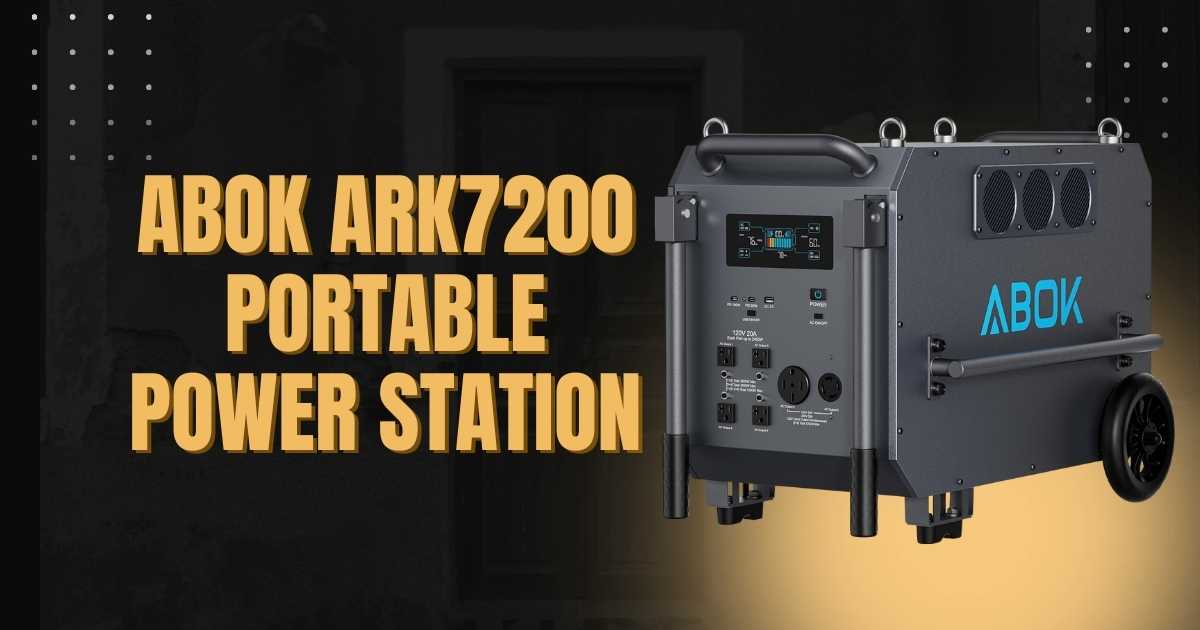
The ABOK Ark7200 is a genuinely capable, industrial-grade power station that delivers on its headline specs. Its 7200W output, 240V support, and 2-hour recharge make it the strongest option in this price tier for construction, whole-home backup, and off-grid living. The tradeoff: it’s heavy, large, and priced above most casual users’ needs.
ABOK Ark7200 Full Specifications
Before diving into how the Ark7200 performs in practice, here’s a comprehensive look at the technical specifications. These numbers tell a story: this is a unit designed around capacity and versatility, not compactness.
How Long Will the ABOK Ark7200 Power Your Devices?
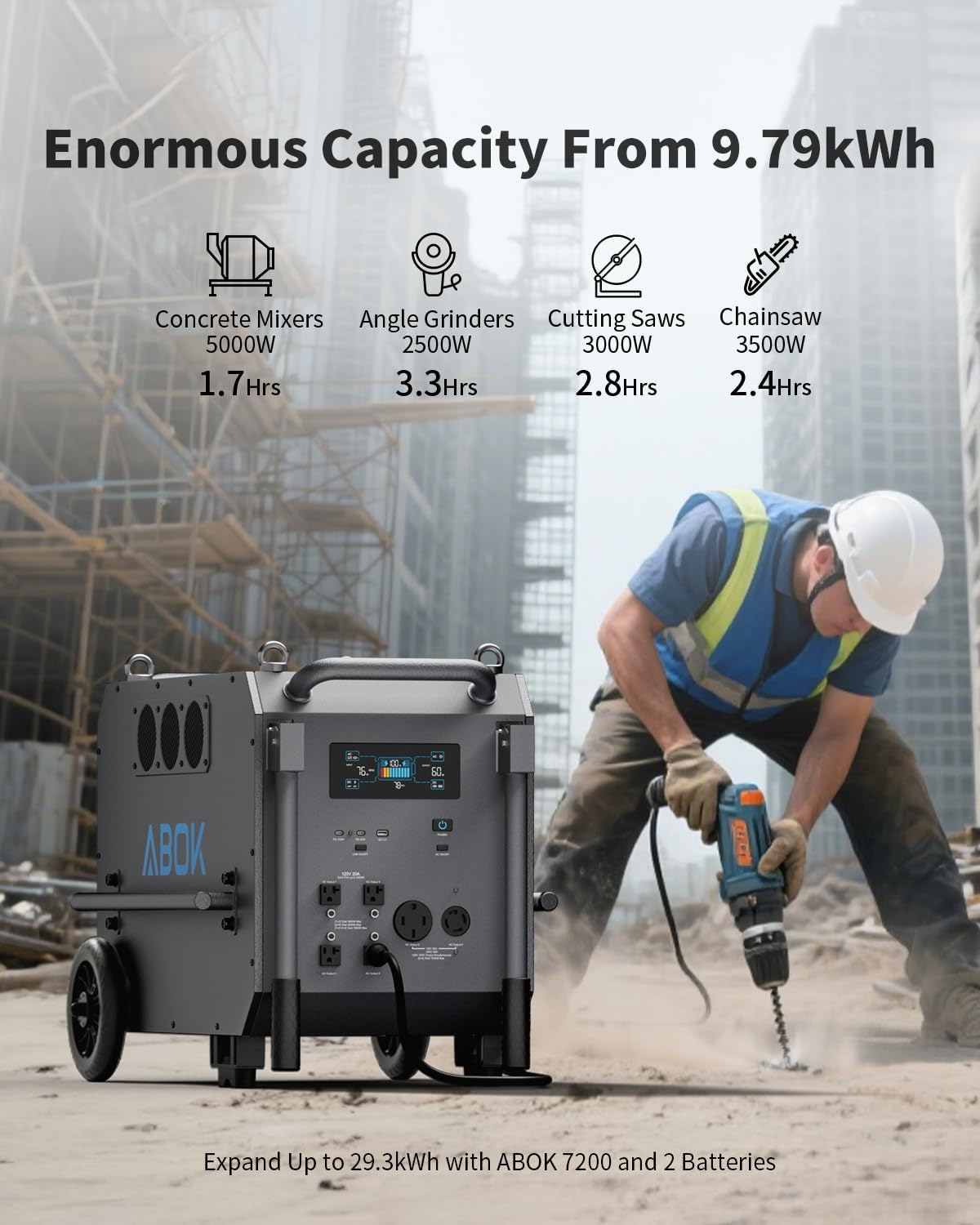
The Ark7200 provides 9792Wh of usable energy — enough to run most households’ essential loads for 4–8 hours depending on draw. At a conservative whole-home draw of 2,000W (lights, fridge, furnace fan, charging), you get roughly 4.9 hours of runtime. Drop to standby essentials at 800W and you’re looking at over 12 hours. That’s real emergency coverage, not just a bridge for a couple of hours.
One verified buyer — brandon smith, reviewing in January 2026 — confirmed he was able to power his refrigerator, washer/dryer, furnace, and lights simultaneously through the 240V connection. This lines up with what the specs promise: a 7200W continuous draw handles modern appliance combinations that simpler power stations can’t touch.
LiFePO4 charge cycles before reaching 80% capacity — equivalent to 16+ years of daily charging, compared to 500–1,000 cycles typical of lithium-ion NMC competitors. LiFePO4 chemistry is also significantly more thermally stable, reducing fire and thermal runaway risk.
The Ark7200 uses EV-grade LiFePO4 cells, the same battery chemistry found in leading electric vehicles, delivering exceptional cycle life and thermal safety.
How Fast Does the ABOK Ark7200 Charge, and What Are the Options?
The Ark7200 fully recharges in approximately 2 hours using its maximum hybrid input (AC + solar combined at 6200W) — which is genuinely competitive in this class. For a 9.7kWh battery, that’s a remarkable turnaround time that makes the unit practical for daily cycling or rapid recovery after a power event.
Here’s how the five charging methods compare:
| Charging Method | Max Input | Approx. Recharge Time | Best For |
|---|---|---|---|
| AC 240V (Two-Phase) | 5000W | ~2 hrs | Home / workshop |
| AC + Solar Hybrid | 6200W | ~1.6 hrs | Maximum speed |
| AC 120V (Single-Phase) | 1800W | ~5.4 hrs | Standard wall outlet |
| Solar HV (120–450V) | 2500W | ~3.9 hrs | Off-grid / large arrays |
| Solar LV (12–55V) | 1200W | ~8.2 hrs | Portable panel setups |
| Car Charger | 300W | ~32 hrs | Emergency supplemental |

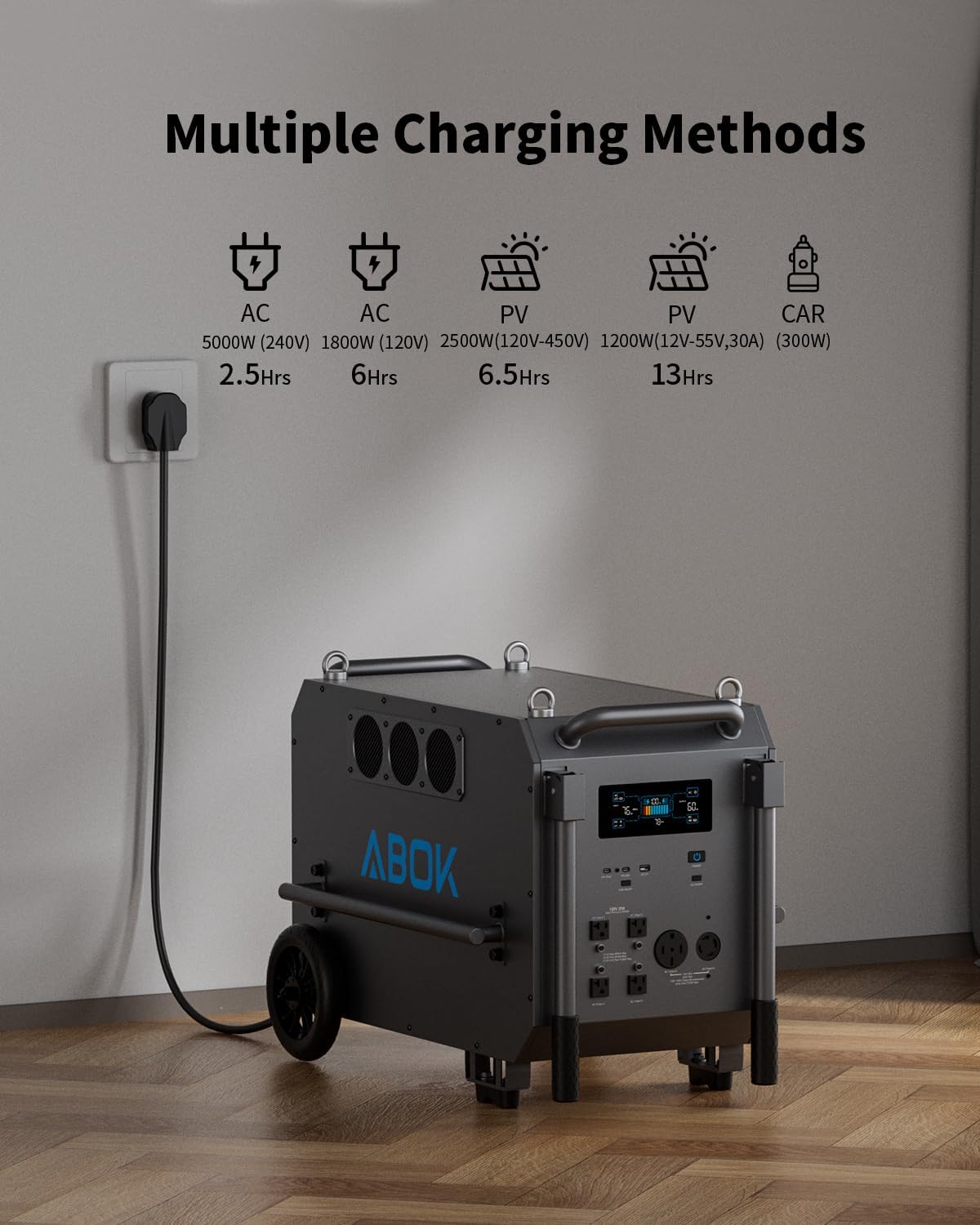
Left: The Ark7200’s fast-charge interface shows real-time input wattage. Right: Multiple input ports allow simultaneous charging via solar and AC for maximum speed.
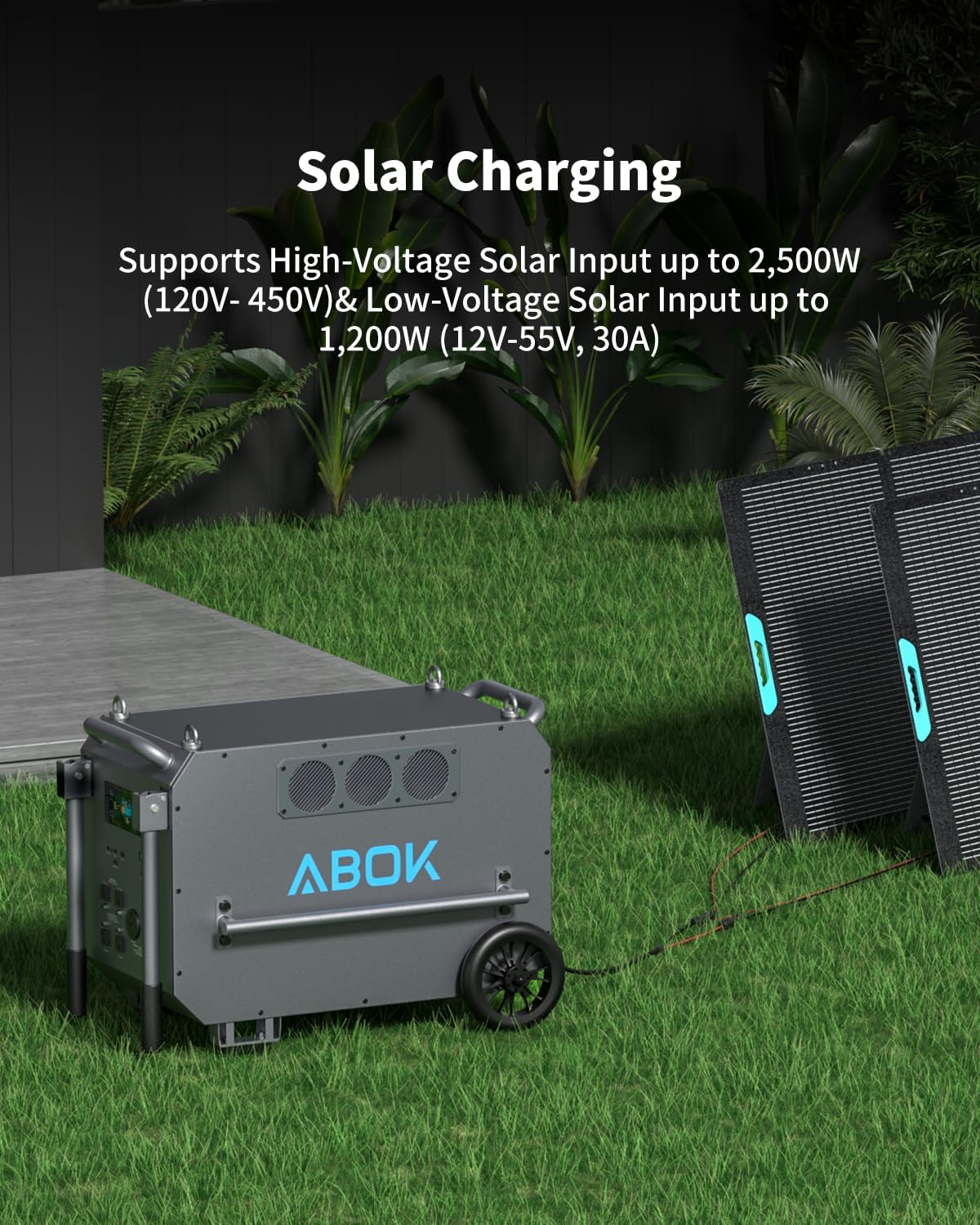
The Ark7200’s wide HV solar input range (120–450V) makes it compatible with most residential solar panel configurations without requiring additional conversion hardware.
Is the ABOK Ark7200 a Good Solar Generator for Off-Grid Living?
For off-grid use, the Ark7200 is a serious contender. The dual solar inputs — high-voltage at 2500W and low-voltage at 1200W — can theoretically accept up to 3700W from solar panels simultaneously when both are in use. A modest 8-panel array (400W panels) would fully charge the unit in a good solar day (7 peak sun hours).
According to the U.S. Energy Information Administration, the average American household consumed 10,500 kWh in 2023 — roughly 29 kWh per day. A fully charged Ark7200 at 9.79 kWh covers about one-third of an average day’s consumption, making it most effective when paired with solar or used to cover nighttime loads only.
Brandon Smith, one of the early buyers, specifically noted he was planning to add solar panels to his setup after using the AC charging as his primary method initially. ABOK’s support was reportedly responsive when he reached out with solar integration questions — something worth noting for a newer brand entering a crowded market.
Does the ABOK Ark7200 Work as a True UPS for Home Offices and Workshops?
Yes — the Ark7200 includes a genuine UPS (Uninterruptible Power Supply) mode that switches to battery power within 10 milliseconds of detecting a grid failure. For context, most sensitive electronics (computers, medical equipment, NAS devices) tolerate up to 20ms of power interruption before disruption. At 10ms, the Ark7200 qualifies as a true online-interactive UPS for these applications.
UPS switchover time — faster than the ~20ms threshold that causes computer shutdowns and NAS data corruption. Industry standard for online UPS systems is typically 0–4ms; interactive UPS units run 2–20ms. The Ark7200 qualifies for the latter category.

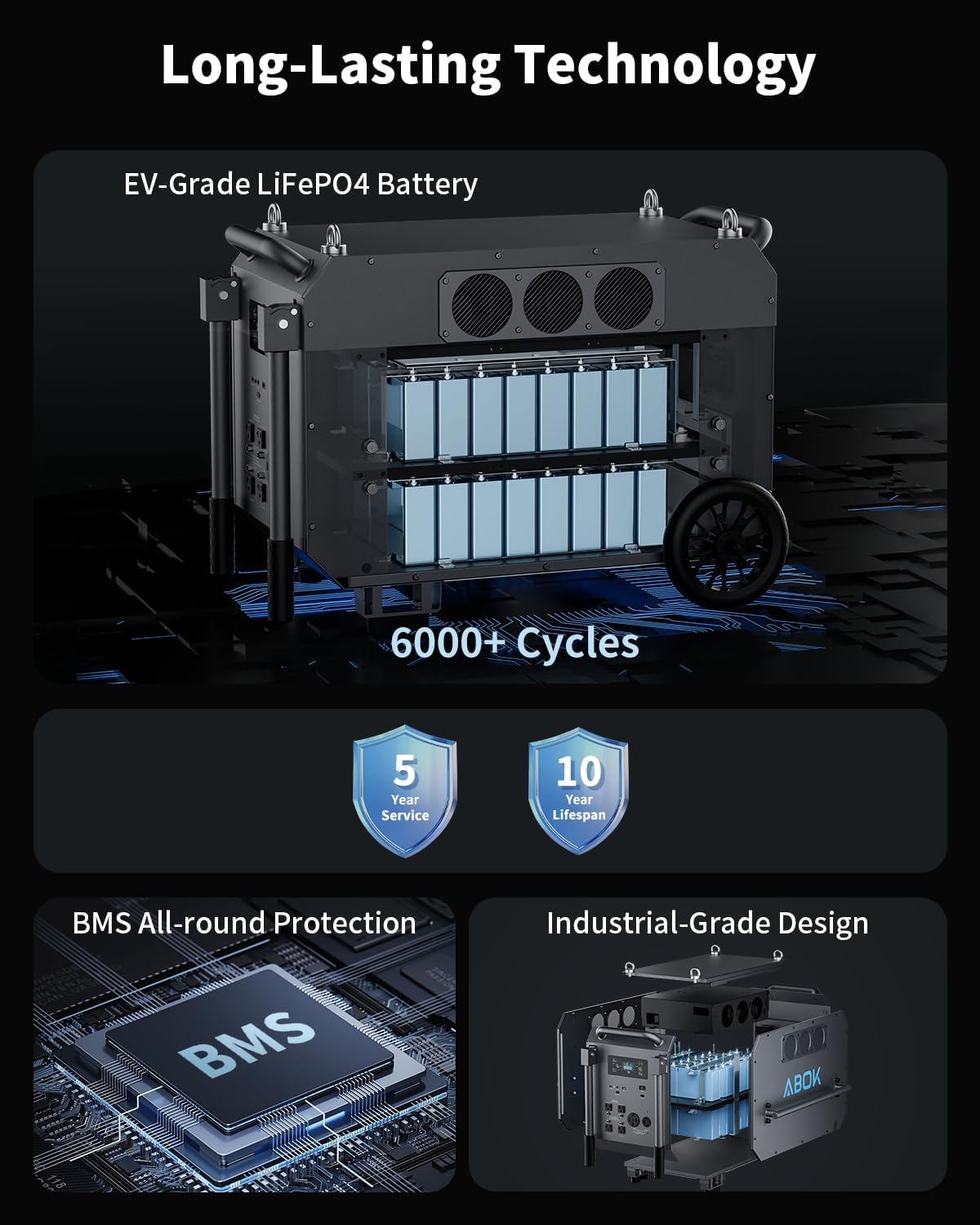
Left: The companion app enables real-time energy monitoring and remote mode switching. Right: LiFePO4 technology provides 6,000+ charge cycles before significant capacity degradation.
How Good Is the ABOK App for Monitoring and Control?
The app allows you to track real-time power input and output, switch operating modes, monitor battery state, and optimize usage patterns remotely. Early reviews mention an “intuitive user interface” that works well alongside the onboard display. For solar integration or home energy management, remote monitoring is genuinely useful — it lets you spot if your panels have a shading issue or if a load is drawing more than expected.
That said, ABOK is a newer brand and their app ecosystem is still maturing. If you require enterprise-grade monitoring integration (HomeKit, Modbus, home automation dashboards), you may find the native app limiting compared to established brands like EcoFlow.
How Well-Built Is the ABOK Ark7200? Real Buyer Experiences
The Ark7200 ships in a wooden crate — something the first verified reviewer specifically called out as impressive packaging. The unit itself features a steel and aluminum frame with plastic and rubber insulation panels. Multiple buyers describe it as “tank-like,” and Sam Lucarelli’s January 2026 review went so far as to say “I bet you could drop this off of a cliff into a boulder field and then into a tornado and it would still work.”
“The build quality is outstanding, with a rugged metal casing that ensures durability. The packaging was also impressive — it arrived in a secure wooden crate.”
“I connected to my house using the 240v receptacle and had no problem powering my fridge, washer/dryer, furnace, lights, etc. all at once.”
The Fashonti review is particularly useful for construction buyers: the reviewer confirmed running sanders, air compressors, and plasma cutters from the unit without issues. Plasma cutters typically draw 4,000–6,000W at startup — right at the Ark7200’s continuous rating and well within its 14,400W surge capacity.
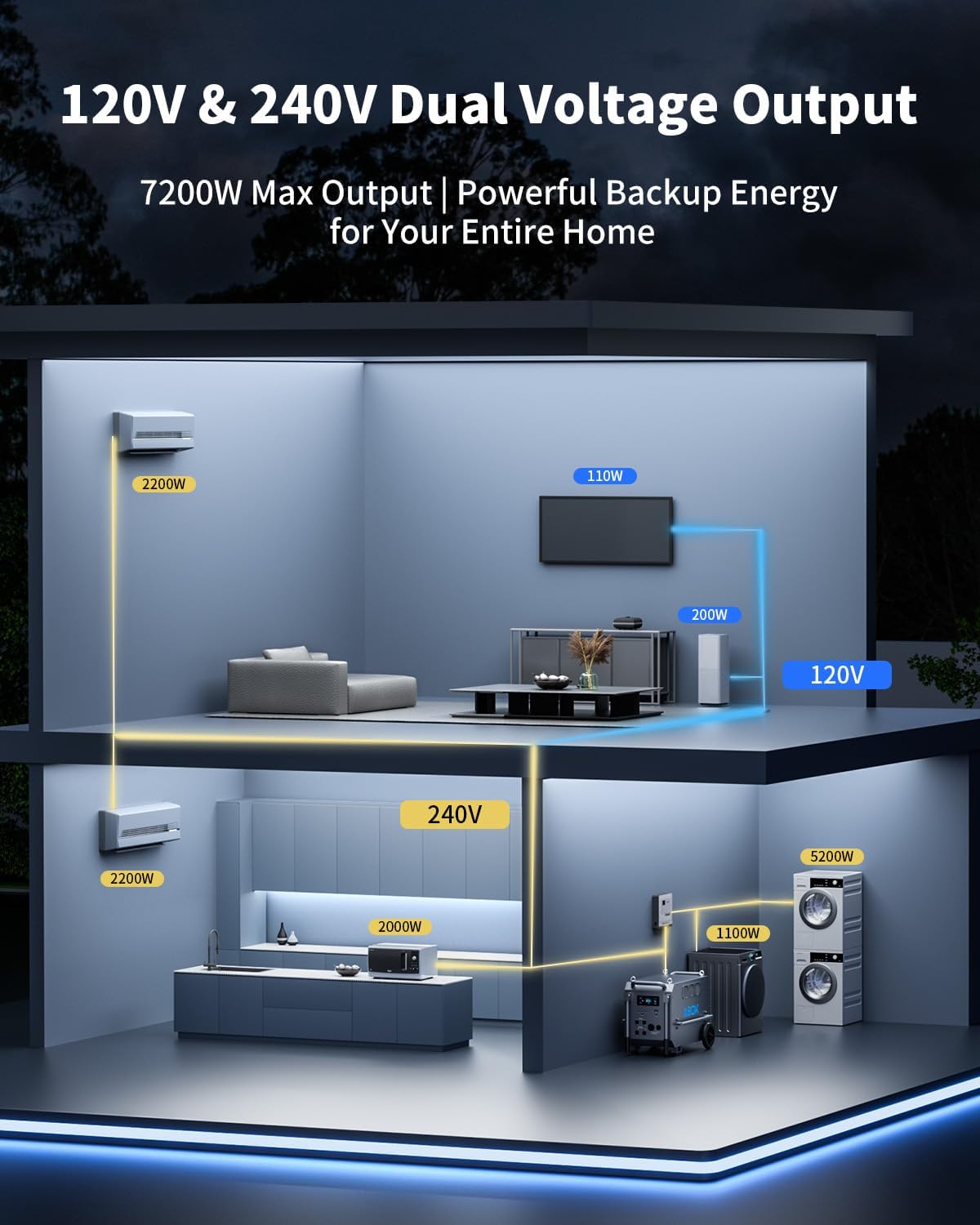
The dual-voltage output panel supports both standard 120V household loads and 240V high-draw equipment like EV chargers, HVAC units, and heavy power tools.
ABOK Ark7200 Pros and Cons: The Honest Assessment
- Largest capacity in class at 9792Wh — covers most whole-home backup scenarios
- True 240V output enables HVAC, EV charging, and professional tools most competitors can’t support
- 2-hour recharge via hybrid AC+solar is competitive at this capacity tier
- LiFePO4 chemistry provides 6,000+ cycles and superior thermal safety vs. NMC alternatives
- 10ms UPS switchover protects sensitive electronics during grid transitions
- 5-year total warranty (2+3) with multiple U.S. service centers is strong for a newer brand
- Very limited review history as a newer product (3 reviews at time of writing)
- Large physical footprint (32″ × 20″ × 23″) limits portability compared to consumer units
- $3,999 price point may be excessive for users who don’t need 240V or 7200W output
- App ecosystem is newer and less mature than EcoFlow or Jackery software platforms
- No built-in wheels or handles mentioned — moving a unit this size requires planning
How Does the ABOK Ark7200 Compare to EcoFlow and Jackery at This Capacity?
The Ark7200 occupies a relatively uncrowded price-performance tier. Most consumer power stations top out around 3–5kWh and 3,600W. To find units with comparable output, you’re looking at the EcoFlow DELTA Pro 2 and Jackery Explorer 3000 Pro — both of which undercut the Ark7200 on capacity and 240V capability while costing less.
| Feature | ABOK Ark7200 This Review | EcoFlow DELTA Pro 2 | Jackery 3000 Pro | Bluetti AC300 |
|---|---|---|---|---|
| Price (approx.) | $3,999 | $2,999 | $2,399 | $1,999 |
| Battery Capacity | 9792Wh | 4096Wh | 3024Wh | 3072Wh |
| Continuous Output | 7200W | 3600W | 3000W | 3000W |
| 240V Output | Yes | No (120V only) | No | Yes (via dual unit) |
| Solar Input Max | 3700W | 1600W | 1400W | 2400W |
| Fast Recharge | ~2 hrs | ~2.8 hrs | ~2.4 hrs | ~3 hrs |
| Cycle Life | 6,000+ | 3,500+ | 2,000+ | 3,500+ |
| UPS Function | Yes (≤10ms) | Yes | No | Yes |
| Warranty | 2+3 years | 5 years | 5 years | 5 years |
The Ark7200’s 9792Wh is more than double the EcoFlow DELTA Pro 2 and triple the Jackery 3000 Pro. It’s the only unit in this comparison offering native 240V single-unit output without requiring two units or an additional hub. For anyone who genuinely needs that capability — running a heat pump, EV charger, or industrial tool — there’s no direct competition at this price. For users who don’t need 240V or this much capacity, the EcoFlow DELTA Pro 2 offers strong performance at $1,000 less.
You can read our EF EcoFlow Delta 3 Max review for a detailed look at a strong alternative in the mid-tier range.
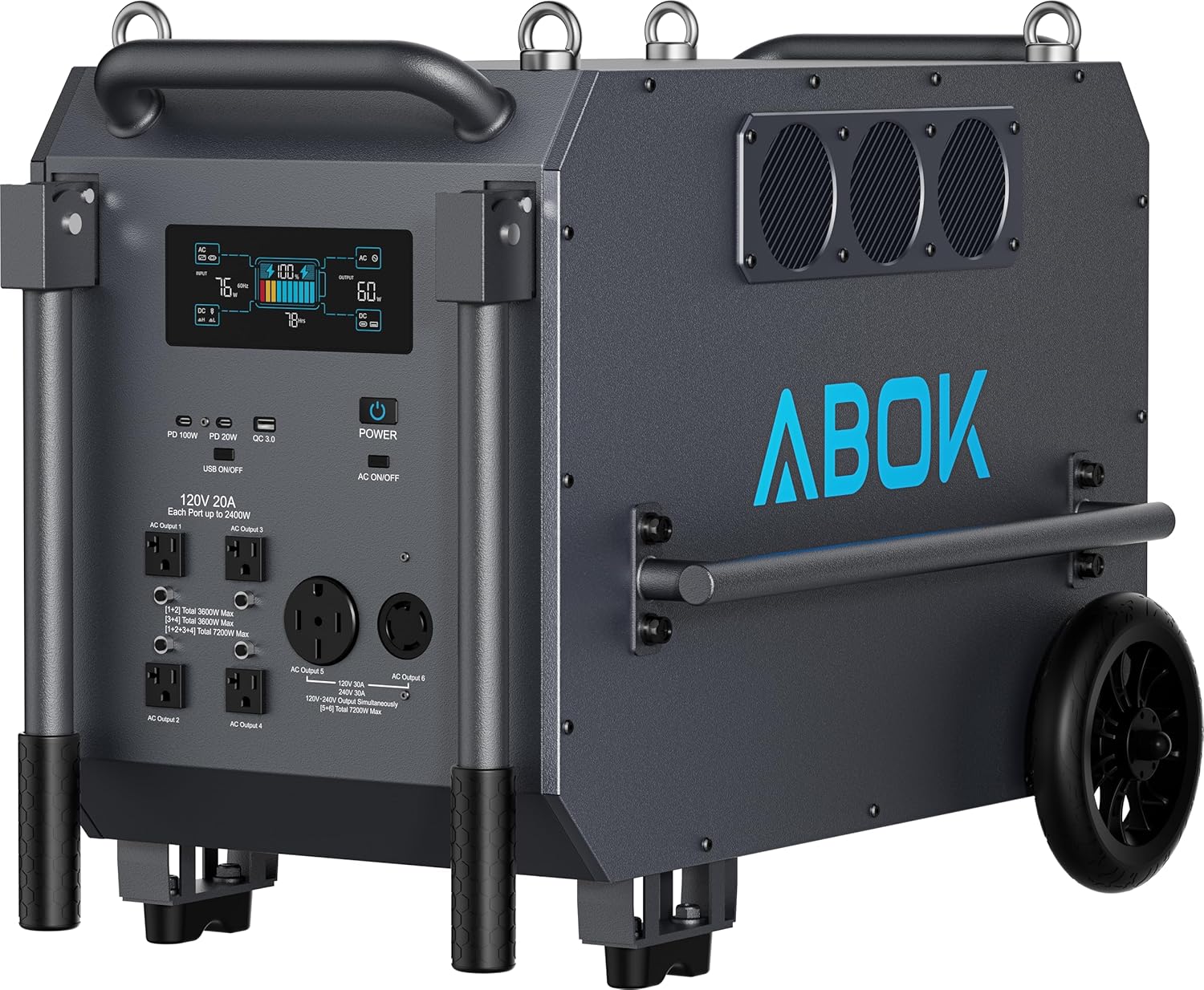
The Ark7200’s rugged build and high-wattage output make it practical for construction sites, forestry operations, and remote job sites where grid power isn’t available.
What Is the ABOK Ark7200 Best Suited For? Use Case Breakdown
Construction Sites and Heavy Tool Locations
This is where the Ark7200 earns its price premium. A 7200W continuous output handles air compressors (typically 1,500–4,000W), circular saws (1,200–2,000W), angle grinders (700–1,800W), and plasma cutters (up to 6,000W) without needing a generator — which means no fuel, no fumes, and no noise restrictions. The verified buyer Fashonti ran exactly this combination and reported zero issues.
Whole-Home Emergency Backup
Brandon Smith’s January 2026 review is the clearest data point here: fridge, washer/dryer, furnace, and lights running simultaneously through the 240V output. Most homes don’t pull more than 5,000–6,000W at any given moment on essential circuits, leaving headroom in the Ark7200’s output. At a moderate 3,000W draw, you get approximately 3.3 hours from a full charge — useful for overnight emergency coverage.
Off-Grid Living and Remote Cabins
Paired with a properly sized solar array (8–12 panels in the 400W class), the Ark7200 can serve as the primary power store for a small off-grid home. The high-voltage solar input (up to 450V) accommodates string-wired panel arrays common in residential solar installations. See our guide to off-grid power solutions for setup considerations.
Forestry and Remote Operations
The unit’s rugged construction (wooden crate shipping, steel/aluminum housing) is appropriate for field deployment. Forestry and agricultural operations often need 240V to run irrigation pumps, chainsaws, wood chippers, and small processing equipment — all within the Ark7200’s capability range.
Power Station Buyer’s Guide: 5 Key Factors Before You Spend $4,000
Choosing a high-capacity power station is a significant investment. Here’s what separates a good decision from a regrettable one at this price tier.
Calculate Your Actual Load Requirements
Add up the wattage of every device you need to run simultaneously — not just the largest one. A 7200W station doesn’t help if you need to run one 8000W device. Check running watts (continuous) and startup watts (surge) separately. Most construction tools have 2–3× startup surge requirements; the Ark7200’s 14,400W surge rating covers most scenarios.
Do You Actually Need 240V?
This is the Ark7200’s biggest differentiator and justifies much of the price premium. If your most demanding use case is a refrigerator, a few LED lights, and device charging — a 3,600W/120V unit at $2,000 less will serve you just as well. If you have a dryer, heat pump, HVAC, electric water heater, or professional tools that require 240V service, native dual-voltage output matters.
Battery Chemistry Matters More Than Capacity Headlines
LiFePO4 (lithium iron phosphate) offers 6,000+ cycles vs. 500–2,000 for NMC/NCA cells, significantly lower fire risk, and stable performance across temperature ranges. The premium you pay for LiFePO4 chemistry pays back in longevity. Avoid units that don’t specify battery chemistry in their marketing materials.
Recharge Speed vs. Capacity Ratio
A 2-hour recharge on 9792Wh is genuinely impressive, but only matters if you’re cycling the unit daily or need rapid recovery after an outage. For occasional emergency use where you might need it once every few months, a slower recharge rate is perfectly acceptable — and you might find better value in a unit optimized for output over charging speed.
Brand Track Record vs. Warranty Coverage
ABOK is a newer brand with a strong 2+3-year warranty and U.S. service centers, but lacks the multi-year track record of EcoFlow or Jackery. For a $4,000 purchase, evaluate whether the warranty terms are actionable — what’s the claims process, where are the service centers, how responsive is support? Early buyer reports suggest ABOK’s email support is strong.
Common Mistake: Sizing for Peak Load Instead of Average Load
Many buyers oversize (or undersize) based on total possible load rather than realistic concurrent draw. A house with a 200A service panel can theoretically pull 24,000W — but most households never pull more than 8,000–10,000W simultaneously. Map your realistic worst-case scenario, add 20% headroom, and size accordingly rather than buying maximum capacity “just in case.”
For more on choosing the right backup power setup, see our guides on the best power banks and current deals on power and charging.
Who Should Buy the ABOK Ark7200 — and Who Shouldn’t?
You need whole-home backup with 240V capability. You run heavy tools on job sites or in workshops. You want off-grid solar storage with expansion room. You need a LiFePO4 unit that will last a decade of daily use. You need genuine UPS protection for critical equipment.
Your max concurrent load is under 3,000W. You only need 120V for standard household devices. You want a compact, portable unit for camping and van life. You’re risk-averse about buying from a newer brand. Budget is under $3,000.
ABOK Ark7200 Frequently Asked Questions
Can the ABOK Ark7200 power a whole house during an outage?
Yes — the Ark7200’s 7200W continuous output and 9792Wh capacity can handle most essential home circuits simultaneously, including refrigerator, furnace, washer/dryer, and lighting. Real users have confirmed powering a full home on the 240V output. For a typical household drawing 2,000–3,000W, the battery provides 3–5 hours of full-load runtime.
How long does it take to fully charge the ABOK Ark7200?
Using the hybrid AC + solar charging mode at the maximum 6200W combined input, the Ark7200 reaches full charge in approximately 2 hours. AC-only charging via 240V two-phase input (5000W) takes about 2 hours as well. Standard 120V single-phase AC charging at 1800W takes roughly 5.4 hours.
What is the battery lifespan of the ABOK Ark7200?
The Ark7200 uses EV-grade LiFePO4 cells rated for over 6,000 charge cycles before dropping to 80% capacity. At one full cycle per day, that equals more than 16 years of daily use. ABOK backs this with a 2+3-year warranty (2 years standard plus 3 years extended service).
Does the ABOK Ark7200 support solar panel input?
Yes — the Ark7200 supports two solar input types: a high-voltage PV input accepting 120–450V at up to 2500W, and a low-voltage PV input accepting 12–55V at 30A (up to 1200W). Both inputs can run simultaneously and can be combined with AC charging for the maximum 6200W hybrid recharge rate.
Is the ABOK Ark7200 safe to use indoors?
Yes — unlike gas generators, the Ark7200 is 100% electric with zero emissions, making it safe for indoor use in garages, workshops, and home environments. The LiFePO4 battery chemistry is among the most thermally stable of all lithium battery types, significantly reducing fire risk compared to NMC batteries used in many competitors.
What heavy-duty tools can the ABOK Ark7200 run?
The Ark7200’s 7200W continuous output (14,400W surge/peak) can handle air compressors, plasma cutters, sanders, angle grinders, and other high-draw construction tools. Its 240V output also powers equipment that standard 120V power stations cannot handle, including certain HVAC units and professional-grade shop equipment. Verified buyers have confirmed successful use with all of these tool types.
How does the ABOK Ark7200 compare to EcoFlow units at this capacity?
The Ark7200 offers the largest capacity in its class at 9792Wh, compared to approximately 4kWh for the EcoFlow DELTA Pro 2 ($2,999). While the ABOK carries a higher price, its native 240V output capability, 6200W hybrid charging, and industrial-grade construction target a more demanding use case than the EcoFlow’s consumer-focused design. For users who need 240V and maximum capacity, the Ark7200 has no direct equivalent at this price.
Final Verdict: ABOK Ark7200 Power Station
The Ark7200 delivers on its headline claims. The 240V output, 9792Wh capacity, and 2-hour recharge are genuine differentiators in this price range. The main caveat is ABOK’s limited track record — but early signs from verified buyers and the generous warranty suggest they’re committed to the market. For buyers who genuinely need this level of output, it’s the most capable single-unit option available at $4,000.
Ready to Order the ABOK Ark7200?
Currently 22% off the list price on Amazon with fast shipping from U.S. warehouses. Check availability for the most current pricing and stock status.
View Current Deal on Amazon Visit Official ABOK StoreDisclosure: This article contains affiliate links. If you purchase through our links, we may earn a commission at no extra cost to you. All opinions and analysis are our own. Pricing accurate as of February 2026 — check current pricing on Amazon before purchasing.
Related posts: