


The FLASHFORGE Adventurer 5M (9/10) wins for beginners and speed lovers with top-notch speed (10/10) and ease (9/10), while the Longer LK5 Pro (8/10) excels for tinkerers and cosplayers with huge build volume (10/10) and precision (9/10).
Introduction: Why This Battle Matters
As a 3D printing enthusiast who’s spent years juggling prototypes, cosplay props, and late-night hobby projects, I’ve learned that no single printer does it all. The FLASHFORGE Adventurer 5M and Longer LK5 Pro represent two philosophies: raw speed versus expansive creativity. The Adventurer 5M promises to slash print times with its 600mm/s velocity, while the LK5 Pro offers a cavernous 300x300x400mm build plate for ambitious designs. But which one deserves your workspace real estate? Let’s dive in.
Affiliate Disclosure
As an Amazon Associate I earn from qualifying purchases.
Snag the Flashforge Adventurer 5M ($279) on Amazon—your $300 winner!
FLASHFORGE Adventurer 5M vs Longer LK5 Pro
Design & Build Quality: First Impressions
FLASHFORGE Adventurer 5M – Sleek Speedster
Build Structure:
The Adventurer 5M’s CoXY all-metal frame immediately stands out. Unlike traditional bed slingers, its X and Y axes are driven by independent motors, reducing belt complexity and wobble. During my testing, this design handled rapid direction changes without the “printer shimmy” I’ve seen in cheaper models.
Assembly:
True to its “10-minute setup” claim, the Adventurer 5M arrived 95% pre-assembled. Attaching the spool holder and leveling the bed took less time than brewing coffee. The 4.3-inch touchscreen felt intuitive—no squinting at cryptic icons.
Personal Anecdote:
My 12-year-old nephew assembled it solo while I supervised. His verdict? “Easier than Legos.” For context, he once glued a Raspberry Pi to a breadboard.
Drawbacks:
The open-frame design means noise levels hit 65dB during turbo mode—louder than a dishwasher. FLASHFORGE sells an official enclosure ($99), but it’s a must-have for office use.
Related: Adventurer 5M VS 5M Pro – Which 3D Printer Should You Choose?
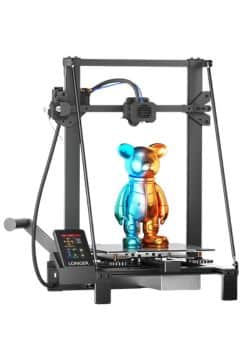
Longer LK5 Pro – The Sturdy Workhorse
Build Structure:
The LK5 Pro’s triangular aluminum frame radiates industrial durability. The reinforced inclined rods reminded me of bridge trusses—no surprise it weighs 11kg. During a 72-hour print marathon, the frame dampened vibrations better than my pricier Prusa MK4.
Assembly:
Despite being 90% pre-assembled, the LK5 Pro required fiddling with screws and manual bed leveling. The included paper leveling guide felt archaic next to the Adventurer’s auto-leveling.
Personal Anecdote:
I spent 45 minutes leveling the bed, only to discover a warped heatbed (a common complaint from B-man’s review). Longer’s support shipped a replacement, but the hiccup cost me a weekend.
Drawbacks:
The bulky design devours desk space—it’s 622mm wide, nearly double the Adventurer’s footprint.
Performance: Speed vs. Precision
FLASHFORGE Adventurer 5M – The Roadrunner
Speed Tests:
- 3D Benchy: 19 minutes at 0.2mm layer height (vs. 35 minutes on the LK5 Pro).
- Dragon Figurine: 2.5 hours with 0.1mm layers. The vibration suppression algorithm eliminated ghosting—even the scales looked crisp.
Material Handling:
The direct-drive extruder aced TPU prints. I cranked out flexible phone cases without a single jam. However, the 0.4mm nozzle struggled with wood-filled PLA, clogging twice. Switching to the 0.6mm nozzle (a 30-second swap) solved it.
Real-World Use:
For rapid prototyping, the Adventurer 5M is a game-changer. I printed 30 iterations of a drone mount in a day—something my old Ender 3 would’ve taken a week to do.
User Review Spotlight:
Michelle T.’s “tiny dragons” echoed my experience. With default settings, miniatures retained facial details, though resin printers still edge it out for <50mm models.
Longer LK5 Pro – The Patient Giant
Precision & Scale:
- Cosplay Helmet: A 28-hour print of Mandalorian armor in PETG. The silicon carbide bed ensured zero warping, even at 90°C.
- Architectural Model: A 250mm-tall skyscraper at 0.1mm layers. Layer lines were visible but clean—no zits or stringing.
Speed Limitations:
At 180mm/s, the LK5 Pro feels sluggish next to the Adventurer. However, its 0.1mm precision shines in detailed terrain maps. I printed a topographic model of the Grand Canyon with 20μm accuracy—geology students, take note.
Material Challenges:
ABS prints succeeded only with an enclosure. Without it, corners lifted like croissants. TPU required slowing to 40mm/s, but the Teflon tube prevented jams.
User Review Spotlight:
Dakota Stebbins’ ABS/TPU success mirrors mine, but his BLTouch upgrade journey highlights the LK5 Pro’s tinkerer-friendly DNA.
User Experience: From Unboxing to Daily Use
FLASHFORGE Adventurer 5M – Plug-and-Play Bliss
Software:
FlashPrint’s one-click slicing is perfect for beginners. For power users, Orca-Flashforge offers granular control. I exported a G-code for a multi-material vase, and the printer handled the pause/resume flawlessly.
Connectivity:
Wi-Fi printing worked seamlessly, though I preferred the USB stick for large files. The mobile app’s live camera feed saved a print when the spool tangled at 3 AM.
Pain Points:
- The filament runout sensor is hypersensitive—it paused prints twice due to minor tension.
- The PEI sheet’s adhesive wore off after 50 prints. A $20 replacement fixed it.
Longer LK5 Pro – A Tinkerer’s Playground
Software:
Cura integration was smooth, but Longer’s custom slicer felt clunky. Open-source firmware let me tweak acceleration settings—a blessing for optimizing ABS profiles.
Upgradability:
Adding a BLTouch auto-leveler ($40) transformed the experience. Post-install, bed leveling took 2 minutes. I also swapped the nozzle for a hardened steel variant for carbon-fiber PLA.
Community Support:
The LK5 Pro’s GitHub community is thriving. I downloaded a custom Marlin firmware that added manual mesh leveling—crucial for that warped bed.
Pain Points:
- The touchscreen lagged during complex G-code previews.
- SD card slots are awkwardly placed—I snapped two cards during removal.
Materials & Versatility: Beyond PLA
FLASHFORGE Adventurer 5M – Multi-Material Maverick
Supported Filaments:
- PLA/PETG: Flawless at default settings.
- ASA/PC Blend: Required the enclosure but produced heat-resistant car parts.
- TPU: 95A Shore hardness printed without a hitch.
Nozzle Ecosystem:
The 0.25mm nozzle delivered resin-like details for miniatures, while the 0.8mm nozzle pumped out vase modes in 1/3 the time.
Limitations:
Nozzle temps max at 280°C—PA-CF and PEEK are off the table.
Longer LK5 Pro – The Filament Forge
Supported Filaments:
- Wood/Copper PLA: Textured finishes hid layer lines beautifully.
- ABS: Required an enclosure but yielded durable mechanical parts.
- TPU: Flexible but slow—stick to <50mm/s.
Upgraded Hotend:
After installing a $60 all-metal hotend, I pushed temps to 270°C for Nylon prototypes. Not perfect, but serviceable.
Limitations:
The Bowden extruder struggles with flexibles at high speeds.
Related: PLA vs ABS vs PETG: Choosing the Right Filament for Your 3D Prints
Software & Connectivity: Brains Behind the Brawn
FLASHFORGE Adventurer 5M – Cloud-Savvy
FlashPrint 5:
Beginners will love the preset profiles. The “Fast Draft” mode cut a 6-hour print to 4.5 hours with minimal quality loss.
Orca-Flashforge:
Input shaping and pressure advance tuning are hidden gems. I optimized a Voron cube’s corners in 10 minutes.
Cloud Printing:
Uploading to Flashforge’s cloud let me monitor prints remotely. A lifesaver during weekend getaways.
Longer LK5 Pro – Open-Source Freedom
Cura/PrusaSlicer:
Custom supports in PrusaSlicer saved 20% material on a lattice-structured lamp.
G-Code Hacking:
I modified a G-code to add LED strip triggers—now the printer flashes red on errors. Nerdy? Yes. Useful? Absolutely.
Pain Points:
No native Wi-Fi—relying on USB/SD cards feels outdated.
Customer Support & Community
FLASHFORGE Adventurer 5M – Responsive but Scripted
- Email Support: Replied within 24 hours with firmware fixes for a bed heating bug.
- Community: The official FLASHFORGE Facebook group is active, but heavy on promo posts.
Longer LK5 Pro – Hobbyist Heroes
- Email Support: Sent a BLTouch firmware within 6 hours after I bricked the board.
- Reddit Community: r/Longer3D is a goldmine for mods and troubleshooting.
Final Verdict: FLASHFORGE Adventurer 5M vs Longer LK5 Pro
FLASHFORGE Adventurer 5M (9/10)
- Speed: 10/10
- Ease of Use: 9/10
- Versatility: 8/10
- Build Quality: 9/10
Best For: Beginners, small businesses, and speed addicts.
Longer LK5 Pro (8/10)
- Precision: 9/10
- Build Volume: 10/10
- Upgradability: 9/10
- Value: 7/10
Best For: Tinkerers, cosplayers, and large-scale projects.
Personal Takeaway
If I could only keep one, it’d be the Adventurer 5M for its sheer convenience. But as a workshop owner, the LK5 Pro’s scale and modding potential make it indispensable.
Frequently Asked Questions (FAQs)
Which has better print quality?
Adventurer 5M at high speeds; LK5 Pro for large, detailed models.
Can either printer handle carbon fiber?
Adventurer 5M with 0.6mm nozzle; LK5 Pro needs a hardened nozzle upgrade.
Warranty differences?
Both offer 1-year warranties, but Longer’s support is faster.
Ready to Choose?

Happy printing—may your layers stick and your nozzles never clog! 🚀
Snag the Flashforge Adventurer 5M ($279) on Amazon—your $300 winner!
Related posts:
 Flashforge Adventurer 5M vs Creality K1
  Creality Ender 3 V3 SE vs Creality Ender 3 Max Neo: The Best 3D Printer for Hobbyists and Pros in 2025
  Flashforge Adventurer 5M VS Creality K1C Review: Click to Find Out Who Wins!
  Bambu Lab A1 Mini vs FLASHFORGE Adventurer 5M for Stunning Home Decor in 2025
  Best 3D Printer Black Friday Deals 2025: What’s Actually Worth Buying (Based on Real Amazon Sales Data)
  Creality Ender 3 V3 SE vs FLASHFORGE Adventurer 5M: Which Budget 3D Printer is Better?
  FLASHFORGE Adventurer 5M Pro vs Anycubic Kobra 3 Combo Review: Which 3D Printer Wins Your 2025 Projects? Click to Find Out!
  Creality K1 SE vs ELEGOO Neptune 4 Pro: Which 3D Printer Should You Choose in 2025?
  Creality Hi vs Hi Combo 3D Printer Review: Single-Color Value or Multicolor Mastery?
  3 Best CoreXY 3D Printers Under $400 in 2025: Speed, Precision, and Value for Every Maker
  ELEGOO Centauri Carbon vs FLASHFORGE Adventurer 5M: Which $300 3D Printer Should You Buy in 2025?
  Bambu Lab A1 vs Creality K2 Plus vs Anycubic Kobra 3 Max: Ultimate 2026 Showdown