

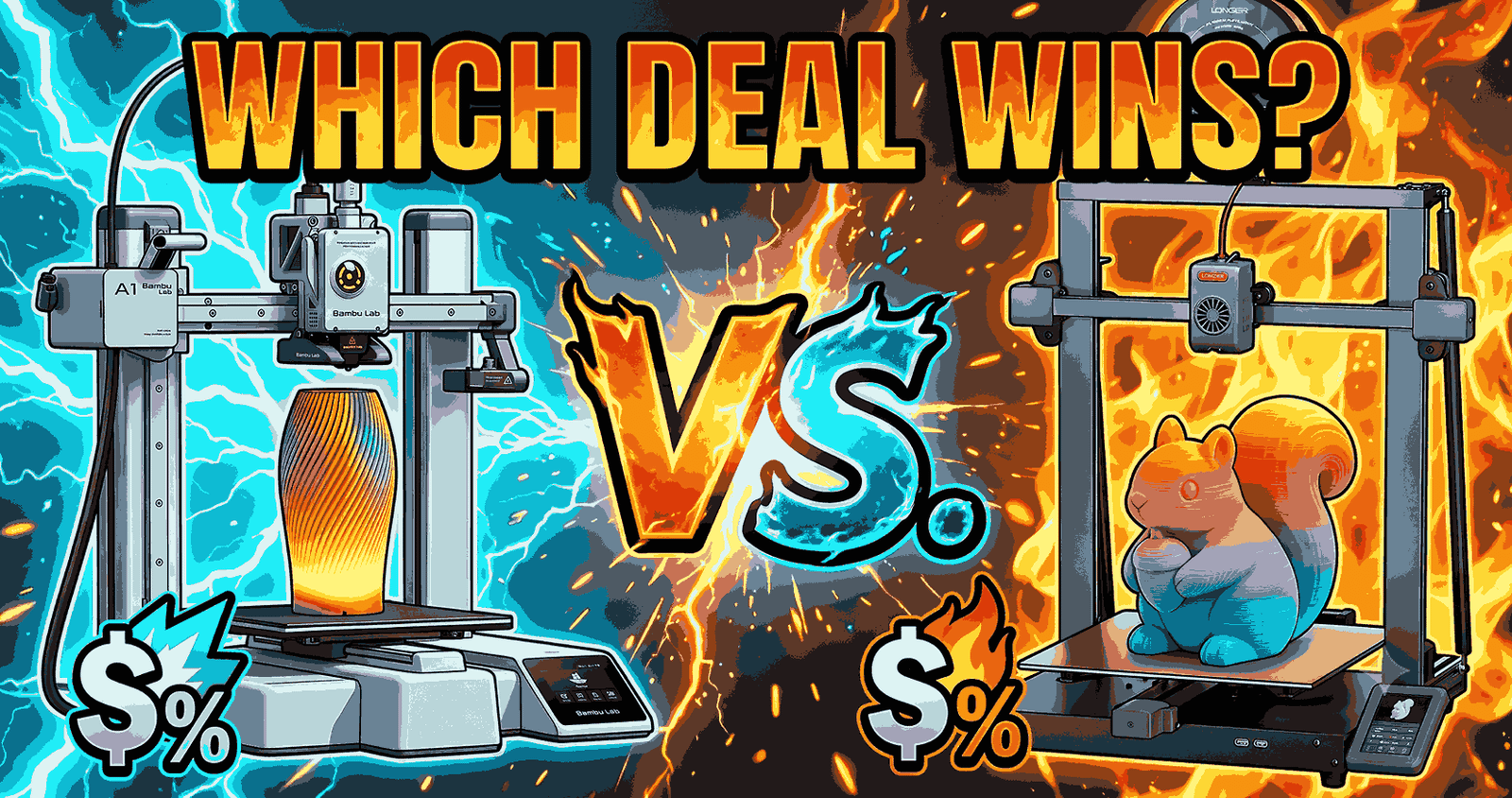
For most buyers, the Bambu Lab A1 mini is the better deal at $249.00. It is cheaper, compact, and comes with a mature software ecosystem and a multi-color option. The LONGER LK10 Plus at $377.99 wins only if you need to print big.
The deciding number is build volume. The LK10 Plus prints in 40.96 liters, versus 5.83 liters on the A1 mini. If your projects fit inside a 180mm cube, you do not need to pay $128.99 more for space you will not use.
The Bottom Line: Buy the A1 mini if you want an easy, compact first printer. Buy the LK10 Plus if you print large parts and accept some risk. Skip the LK10 Plus if you want a proven track record.
The Killer Feature: A1 mini: a polished ecosystem at $249.00. LK10 Plus: a 320×320×400mm build volume under $400.
The 2026 Value Score: A1 mini 9/10 · LK10 Plus 8/10 (our scores, based on specs and current market competition, not hands-on testing)
Which Printer Should You Buy? The 30-Second Answer
Pick the A1 mini if your prints are smaller than a 180mm cube, you want an easy start, or you may add multi-color later. Pick the LK10 Plus if you print large decor, props or batches. Space and risk tolerance decide it, not speed.
Both list the same 500mm/s top speed and 10,000mm/s² acceleration. So speed is a tie on paper. What differs is size, software, track record and price.
Bambu Lab A1 mini vs LONGER LK10 Plus: 3 Key Differences
The three differences that matter are size, ecosystem and risk. The LK10 Plus gives you about seven times the build volume. The A1 mini gives you a mature slicer, app and multi-color path, plus a lower price and an established user base.
| Feature | Bambu Lab A1 mini | LONGER LK10 Plus | Winner | Why It Won |
|---|---|---|---|---|
| Build volume | 180×180×180mm | 320×320×400mm | LK10 Plus | About 7× the printable volume, so large parts print in one piece. |
| Volume in liters | 5.83 L | 40.96 L | LK10 Plus | Fits tall pieces the A1 mini cannot print upright. |
| Max speed | Up to 500mm/s | 500mm/s | Tie | Both list the same peak figure. |
| Max acceleration | 10,000mm/s² | 10,000mm/s² | Tie | Both list the same figure. |
| Firmware and software | Bambu proprietary (Bambu slicer and app) | Klipper | Depends | Bambu is easier out of the box; Klipper suits tinkerers. |
| Multi-color | Supported via AMS lite (sold separately) | Not listed | A1 mini | The A1 mini has a clear multi-color path; the LK10 Plus listing mentions none. |
| Filament range | Built around PLA, PETG and TPU | PLA, PETG, ABS, ASA, TPU, Nylon | LK10 Plus | The listing covers engineering filaments the A1 mini is not designed around. |
| Track record | Established, large user base | New (July 2026), no reviews | A1 mini | More community support and documented fixes. |
| Sticker price | $249.00 | $377.99 | A1 mini | $128.99 cheaper up front. |
| Price per liter of build volume | about $42.70 | about $9.23 | LK10 Plus | Roughly 78% less per liter of printable space. |
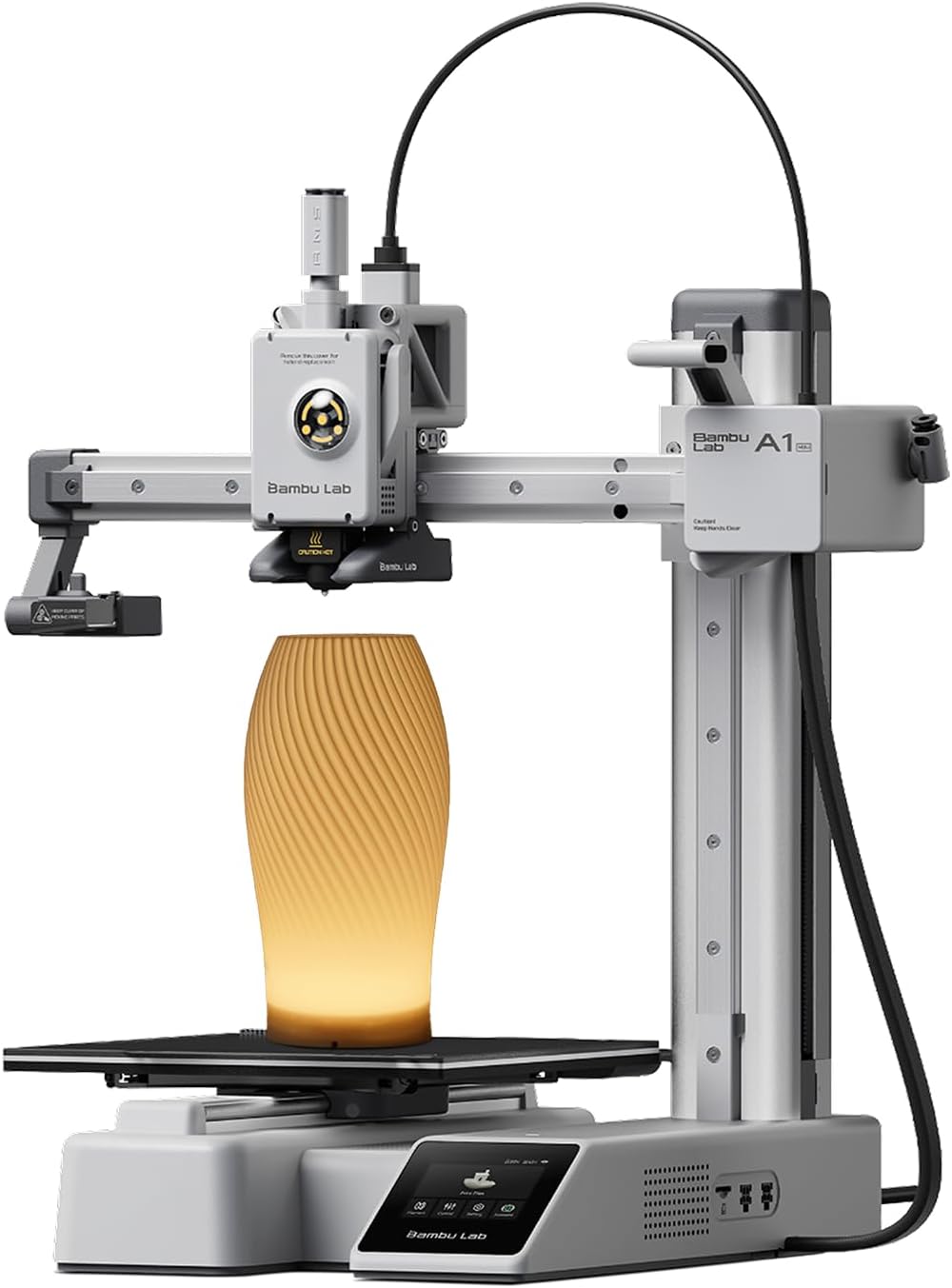
Is the Bambu Lab A1 mini Good for Beginners?
Yes. It is the easier of the two for a first printer. Auto bed leveling, a polished slicer and app, and a large user base mean fewer setup surprises.
The 180mm cube is the limit. It covers desk organizers, small planters, phone stands and miniatures. It cannot do a full-size lamp shade or a helmet in one piece.
Verified buyers of the A1 mini + LED Kit listing back this up. Non-experts report getting printing in 20 to 30 minutes, and praise the automatic calibration, quiet running and intuitive touchscreen. Several also say it works from a phone and from both Mac and Windows computers.
If you may want multi-color later, the A1 mini has a defined upgrade path through AMS lite. That accessory is sold separately, so budget for it before you count on it.
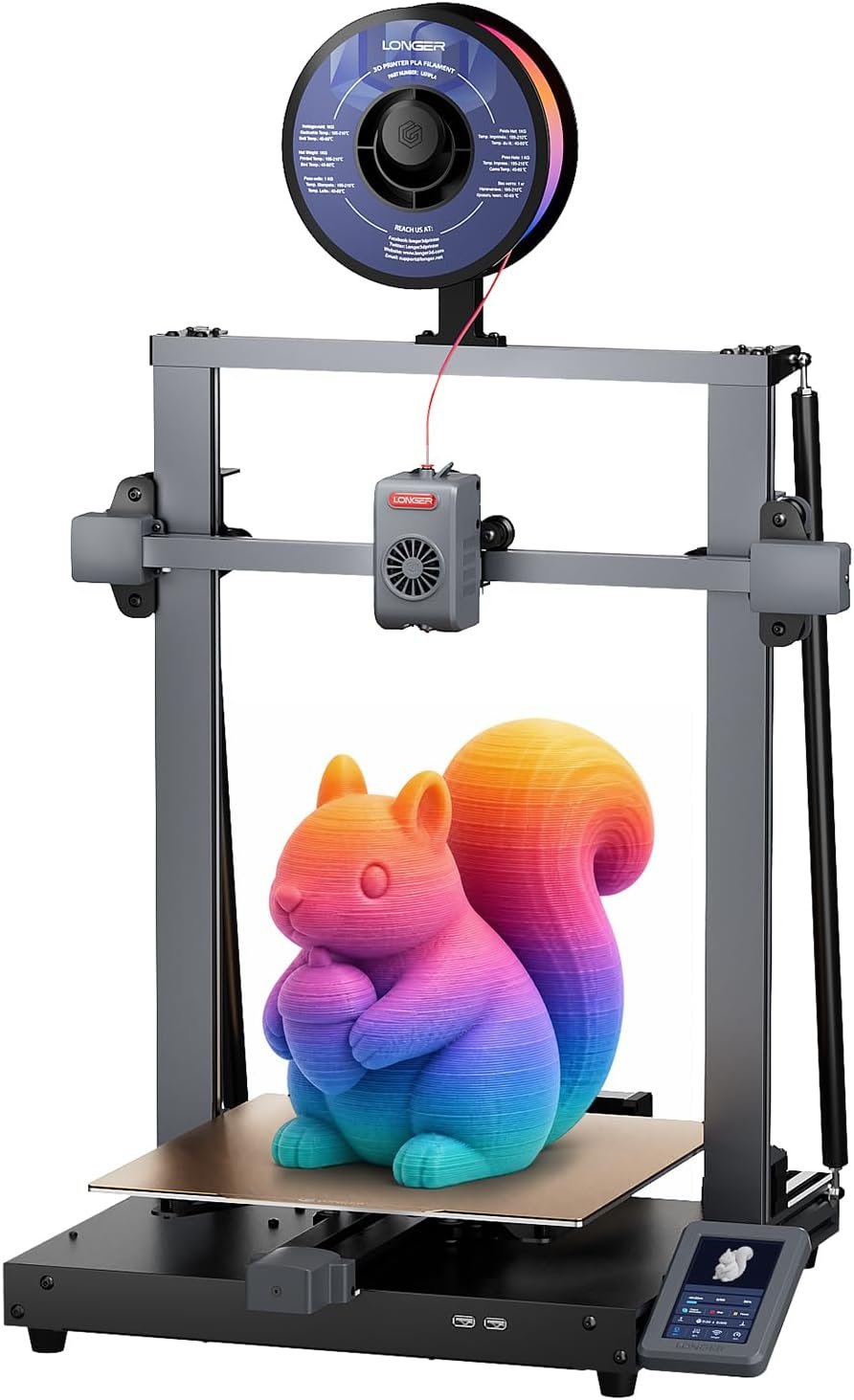
Is the LONGER LK10 Plus Worth $128.99 More?
Only if you will actually use the extra space. Per liter of build volume it is far cheaper, but a bigger bed does not help if your prints stay small. The LK10 Plus pays off on large decor, props and batch printing.
It also brings auto bed leveling with an eddy current sensor, a direct drive extruder, filament runout detection, power-loss recovery and dual-band WiFi. Klipper adds speed-tuning headroom. The trade-off is that it launched July 22, 2026, with no verified buyer reviews yet.
The Reality of Long-Term Ownership
We have no long-term data on either printer, so this section is design-based, not a report from months of use. The LK10 Plus has no buyer history at all. Treat it as an early-adopter purchase.
Maintenance & Wear
Both are direct drive, open-style printers that need regular nozzle changes and a clean build surface. The LK10 Plus has more frame and a second Z axis to keep clean and level. The A1 mini has fewer moving parts to maintain and a larger community to ask for help.
Hidden Costs
A1 mini: AMS lite if you want multi-color, plus spare nozzles and filament. LK10 Plus: a filament dryer if you plan to print Nylon or TPU, and enough spools for big parts, which can use most of a kilogram on tall prints. The LK10 Plus listing does not mention an enclosure, so ABS, ASA and Nylon at that size are advanced jobs.
What Are the Pros and Cons of Each Printer?
The A1 mini wins on price, ease and ecosystem. The LK10 Plus wins on size and price per liter. Each one’s main weakness is the other’s strength.
A1 mini Pros
- $249.00, the lower entry price
- Polished slicer, app and large user base
- Clear multi-color upgrade path
- Compact enough for a small desk
A1 mini Cons
- Only 180×180×180mm of build space
- Multi-color needs a separate purchase
- Built around PLA, PETG and TPU, not engineering filaments
LK10 Plus Pros
- 40.96-liter build volume under $400
- Roughly 78% cheaper per liter of space
- Supports ABS, ASA and Nylon alongside PLA, PETG and TPU
- Power-loss recovery and filament runout detection
LK10 Plus Cons
- New product with no buyer reviews yet
- Large footprint needs real desk space
- No multi-color system listed
- Klipper has a steeper learning curve
Which Deal Wins for Your Situation?
Match the printer to the biggest part you plan to make. Under 180mm, the A1 mini is the better deal. Over that, the LK10 Plus is the only one of the two that can do the job.
Choose the A1 mini for a first printer, a small desk, or a future multi-color setup. Choose the LK10 Plus for large decor, props and batch runs, and if you are comfortable being an early adopter.
Bambu Lab A1 mini vs LONGER LK10 Plus FAQ
Which is better for beginners, the A1 mini or the LK10 Plus?
The A1 mini is the easier start. It has a mature slicer, app and large user base, while the LK10 Plus is new, uses Klipper and has no buyer reviews yet.
Is the LK10 Plus really faster than the A1 mini?
No. Both list a 500mm/s top speed and 10,000mm/s² acceleration. Real print times depend on the model, settings and quality targets.
Can the A1 mini print multi-color?
Yes, through the AMS lite accessory, which is sold separately. The LK10 Plus listing does not mention a multi-color system.
Can the LK10 Plus print ABS and Nylon?
The listing supports ABS, ASA and Nylon along with PLA, PETG and TPU. The listing does not mention an enclosure, so these materials at large sizes are best left to experienced users.
Is the LK10 Plus worth $128.99 more than the A1 mini?
Only if you need the larger build volume. It has about seven times the printable volume and costs roughly 78% less per liter, but the A1 mini is the better value for small prints.
Related posts:
 Best 3D Printer Black Friday Deals 2025: What’s Actually Worth Buying (Based on Real Amazon Sales Data)
  Creality Ender 3 V3 Series Complete Guide: SE vs KE vs Plus
  Bambu Lab 3D Printer Review 2026: Real User Experience After 1000+ Hours
  Bambu A1 Mini: Is the AMS Lite Worth $150? (Real Answer)
  Bambu Lab A1 Mini Hands-On Review: Best All-Around 3D Printer in Its Class?
  Best 3D Printers Under $300 for Christmas 2025
  Bambu Lab A1 vs A1 Mini: Complete 2025 Comparison
  Why 87% of Small Businesses Waste Money on Wrong 3D Printers (2025 Buying Guide)
  LONGER LK10 Plus Review 2026: Is It Worth $377.99?
  The Ultimate 3D Printer Tier List 2025: Best Machines for Beginners, Pros & Every Budget
  Top 5 Reasons to Buy the Elegoo Neptune 4 Plus in 2025 (And 2 Reasons Not To)
  Anycubic Kobra X Review 2026: The $299 Multicolor 3D Printer That Outclasses Its Price Tag